Silvius gigantulus
Golden Deer Fly
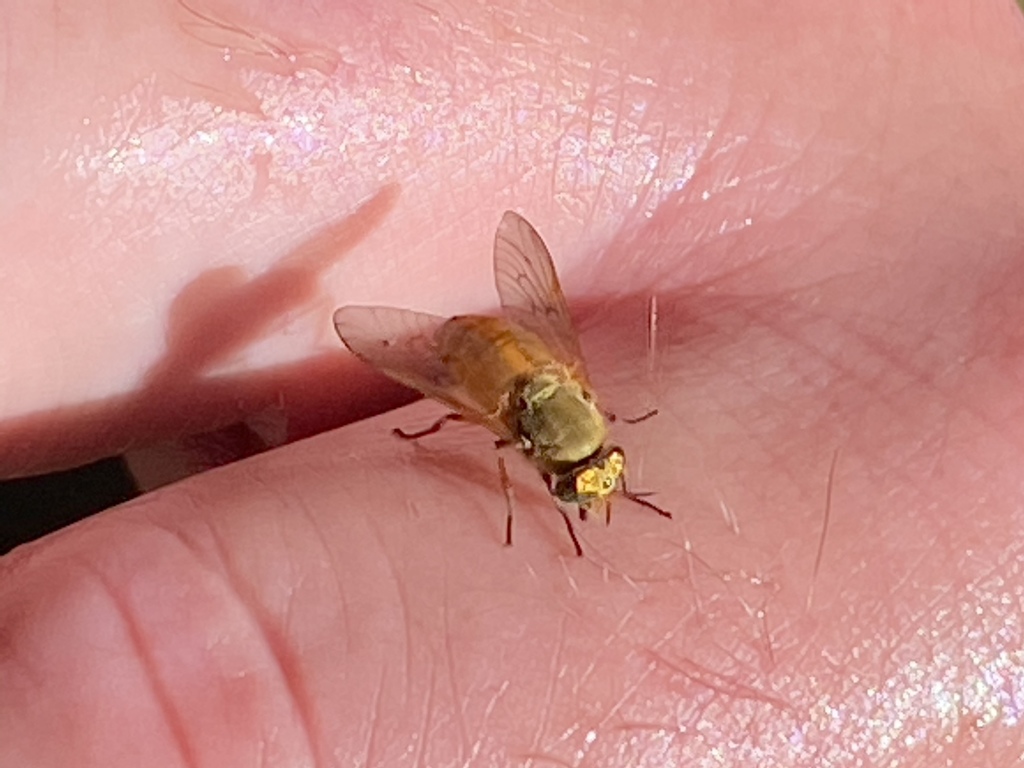
(c) Rebecca Johnson, some rights reserved (CC BY) · licence
Family: Tabanidae · Class: Insecta · Order: Diptera
Silvius gigantulus (Golden Deer Fly) is a California animal in the Tabanidae family.
The golden deer fly (Silvius gigantulus) is a large tabanid fly belonging to the family Tabanidae, commonly known as deer flies, horse flies, and yellow flies. This species represents one of the larger members of the genus Silvius, which comprises blood-feeding dipterans distributed across North America. Adult golden deer flies are robust insects with prominent compound eyes and strong flight capabilities characteristic of their family. Males typically measure 12-15 mm in body length, while females are generally larger at 15-18 mm. The species exhibits the typical tabanid body plan with a broad thorax, well-developed wings, and powerful legs adapted for landing on hosts. The golden coloration that gives this species its common name appears as yellowish-brown to golden-brown hues on the thorax and abdomen. The compound eyes are large and often display iridescent patterns, with males typically having larger eyes that meet at the top of the head, while female eyes are separated by a broader frons. Silvius gigantulus occurs across western North America, with documented populations extending from British Columbia south through California and into parts of Mexico. In California, the species has been recorded in various counties, though specific distribution data remains limited. The species appears to have a preference for mountainous and foothill regions rather than coastal areas. The golden deer fly inhabits diverse environments including mixed coniferous forests, oak woodlands, chaparral, and riparian zones. Adults are typically found in areas near water sources, as larvae require aquatic or semi-aquatic environments for development. Elevation ranges from sea level to approximately 2,500 meters, though the species shows greater abundance at middle elevations between 500-1,500 meters. Adults are most commonly observed in sunny clearings and forest edges where they can effectively locate potential hosts. Like other tabanids, golden deer flies exhibit sexual dimorphism in feeding behavior. Females are hematophagous, requiring blood meals for egg development, and will attack various mammals including deer, cattle, horses, and occasionally humans. Males feed primarily on nectar and other plant fluids. Mating typically occurs in swarms near breeding sites during late spring and early summer. Females deposit eggs in moist soil or vegetation near water sources. Larvae are predaceous, developing in mud, sand, or organic matter where they feed on other invertebrates. The life cycle typically requires one year for completion, with adults emerging during warm months. Currently, Silvius gigantulus has no formal conservation status listings at federal or state levels. According to NatureServe, the species is ranked as G4 (apparently secure globally), suggesting stable populations across its range (NatureServe Explorer, accessed December 2025). However, like many dipteran species, comprehensive population data and trend analysis are lacking. Potential threats may include habitat modification, wetland degradation affecting larval development sites, and climate change impacts on seasonal emergence patterns.
Classification
Class: Insecta · Order: Diptera · Family: Tabanidae
Frequently asked questions
How is Silvius gigantulus classified?
Silvius gigantulus belongs to class Insecta, order Diptera, family Tabanidae.
What family does Silvius gigantulus belong to?
Silvius gigantulus is in the Tabanidae family.
What is Silvius gigantulus?
The golden deer fly (Silvius gigantulus) is a large tabanid fly belonging to the family Tabanidae, commonly known as deer flies, horse flies, and yellow flies.
Is Silvius gigantulus found in California?
Yes. Silvius gigantulus is recorded in California in The California Species Project's catalogue.
Related species
Other California species in the same genus, family, or bioregion.
Data from The California Species Project — 14,000+ California species with verified data from CNPS, CDFW, USFWS, and more.