Sitona lineatus
Pea Weevil
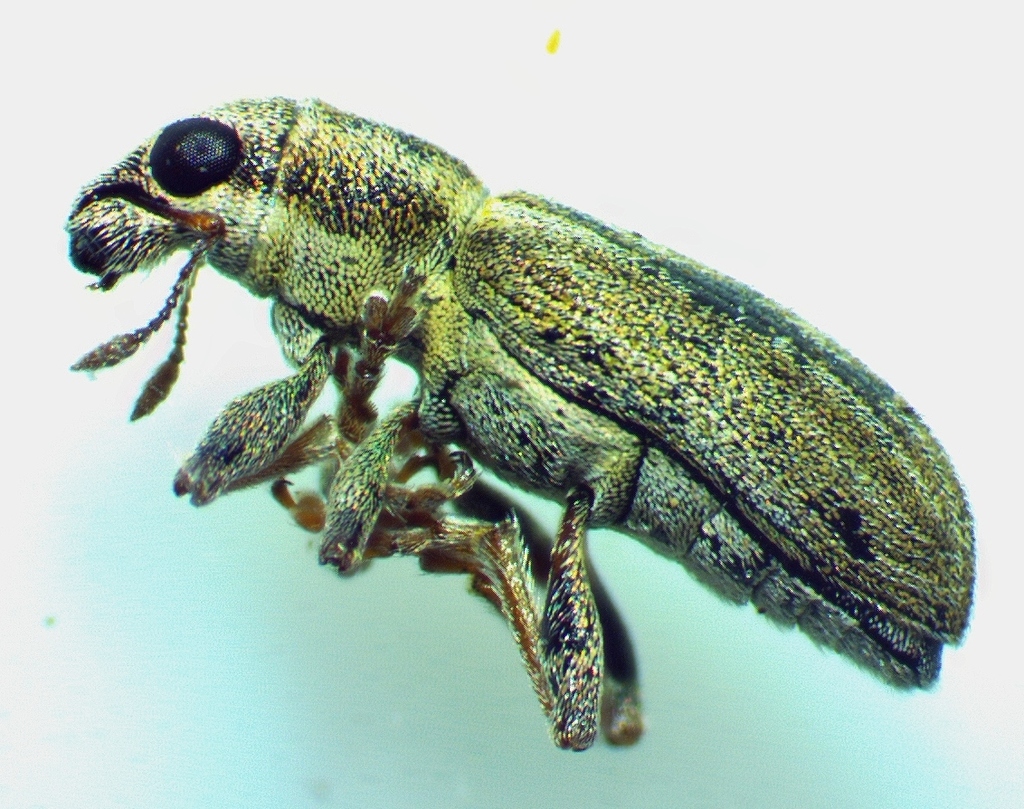
no rights reserved · CC0
Family: Curculionidae · Class: Insecta · Order: Coleoptera
Sitona lineatus (Pea Weevil) is a California animal in the Curculionidae family.
The pea weevil (Sitona lineatus) is a small beetle in the family Curculionidae, measuring approximately 3.5 to 5.0 mm (0.14 to 0.20 inches) in length. Adults are brownish-gray with a distinctly elongated snout characteristic of weevils. The elytra display pale longitudinal stripes alternating with darker bands, giving the species its specific epithet 'lineatus' meaning lined. The body is covered with fine scales that create a somewhat mottled appearance, and the antennae are elbowed with a distinct club at the tip. Sitona lineatus is native to Europe and has become widely established across temperate regions of North America, including California. The species occurs throughout much of the continental United States and southern Canada, having been introduced through agricultural trade. In California, populations are documented from agricultural areas in the Central Valley, coastal regions, and foothill zones where leguminous crops are cultivated. This weevil inhabits agricultural landscapes, particularly areas where legumes are grown commercially or occur naturally. Adults are commonly found in alfalfa fields, clover pastures, and other forage legume crops. The species shows a strong preference for areas with Medicago (alfalfa), Trifolium (clover), and Vicia (vetch) species. Elevation range extends from sea level to approximately 1,500 meters (4,900 feet) in mountainous agricultural regions. Adult pea weevils feed by chewing notches along the margins of legume leaves, creating characteristic semicircular feeding damage. Larvae develop in the soil, feeding on nitrogen-fixing root nodules of host plants, which can reduce the plants' ability to fix atmospheric nitrogen. This root nodule feeding distinguishes Sitona species from many other agricultural weevils. Adults overwinter in soil, leaf litter, or other protected sites, emerging in spring when temperatures consistently exceed 10°C (50°F). Females deposit eggs in soil near host plant roots. The species typically completes one generation per year in temperate climates, though partial second generations may occur in warmer regions. Sitona lineatus is not listed under federal or state conservation programs, as it is considered an introduced agricultural pest species rather than a conservation concern. Population trends indicate the species remains well-established across its introduced range in North America. In agricultural systems, this weevil is managed through integrated pest management approaches including crop rotation, beneficial insect conservation, and targeted pesticide applications when economic thresholds are exceeded. The species serves as prey for various native predators and parasitoids, contributing to agricultural food webs. While not native to California, S. lineatus has become a permanent component of the state's agricultural landscape, with populations fluctuating based on host plant availability, weather conditions, and management practices.
Classification
Class: Insecta · Order: Coleoptera · Family: Curculionidae
Frequently asked questions
How is Sitona lineatus classified?
Sitona lineatus belongs to class Insecta, order Coleoptera, family Curculionidae.
What family does Sitona lineatus belong to?
Sitona lineatus is in the Curculionidae family.
What is Sitona lineatus?
The pea weevil (Sitona lineatus) is a small beetle in the family Curculionidae, measuring approximately 3.5 to 5.0 mm (0.14 to 0.20 inches) in length.
Is Sitona lineatus found in California?
Yes. Sitona lineatus is recorded in California in The California Species Project's catalogue.
Related species
Other California species in the same genus, family, or bioregion.
Data from The California Species Project — 14,000+ California species with verified data from CNPS, CDFW, USFWS, and more.