Sitta canadensis
Red-breasted Nuthatch
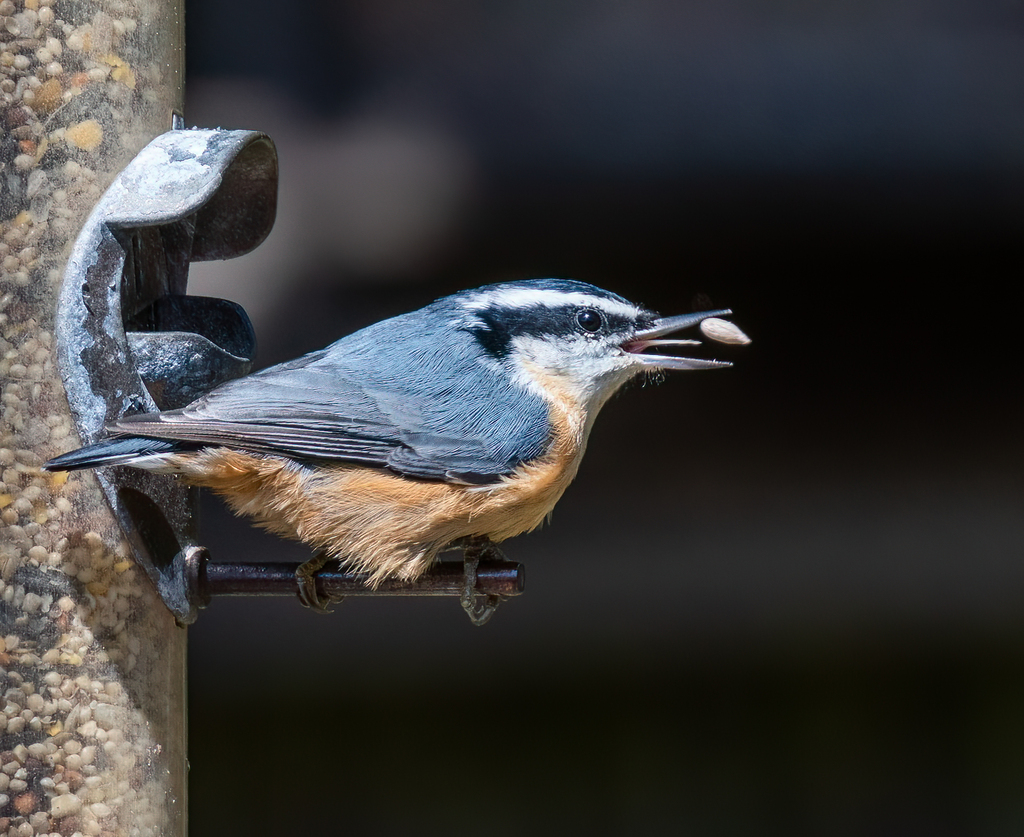
no rights reserved · CC0
Family: Sittidae · Class: Aves · Order: Passeriformes
Sitta canadensis (Red-breasted Nuthatch) is a California animal in the Sittidae family.
The Red-breasted Nuthatch is a small, compact songbird measuring 11 to 12 centimeters (4.3 to 4.7 inches) in length with a wingspan of 20 to 27 centimeters (7.9 to 10.6 inches). Adults weigh 8 to 13 grams (0.3 to 0.5 ounces). Males display blue-gray upperparts, rusty-orange underparts, and a distinctive black cap extending through the eye with a prominent white eyebrow stripe. Females and juveniles show similar patterns but with duller coloration, grayer caps, and paler underparts. Both sexes possess the characteristic nuthatch bill: straight, pointed, and slightly upturned, adapted for extracting insects and seeds from bark crevices. The species breeds across boreal and montane coniferous forests from Alaska to Newfoundland, extending south through the western mountains to California, Arizona, and New Mexico, and in the east to the Great Lakes region and northern New England. In California, Red-breasted Nuthatches occur primarily in the Sierra Nevada, Cascade Range, Coast Ranges, and higher elevations of the Transverse and Peninsular Ranges. Populations also inhabit montane forests of the Warner Mountains and Modoc Plateau. The species exhibits irregular migration patterns, with northern populations moving south during years when conifer seed crops fail. Red-breasted Nuthatches inhabit mature coniferous and mixed forests, showing strong preferences for spruce, fir, pine, and hemlock stands. In California, they occupy forests dominated by Douglas fir, white fir, red fir, lodgepole pine, and ponderosa pine, typically at elevations from 600 to 3,200 meters (2,000 to 10,500 feet). The species requires forests with substantial dead wood for nesting and foraging, along with adequate cone and seed production from mature conifers. This species exhibits the classic nuthatch foraging behavior of moving headfirst down tree trunks and branches while searching for insects, spiders, and conifer seeds. Red-breasted Nuthatches excavate nest cavities in dead or decaying wood, typically 1.5 to 40 meters (5 to 130 feet) above ground. A distinctive behavior involves smearing conifer resin around the nest entrance, possibly to deter predators and competitors. Breeding occurs from May through July, with females laying 4 to 7 white eggs marked with reddish-brown spots. Incubation lasts 12 to 13 days, with young fledging after 14 to 21 days. The species caches seeds and insects in bark crevices for winter consumption, demonstrating spatial memory capabilities to relocate stored food. Red-breasted Nuthatches are not federally or state-listed and maintain stable populations across most of their range. According to the North American Breeding Bird Survey, populations have remained relatively stable from 1966 to 2019, with some regional variations. Climate change poses potential long-term threats through upslope shifts of suitable habitat and altered precipitation patterns affecting coniferous forest composition. Forest management practices that maintain mature forest structure with snags and diverse age classes support population sustainability.
Classification
Class: Aves · Order: Passeriformes · Family: Sittidae
Frequently asked questions
How is Sitta canadensis classified?
Sitta canadensis belongs to class Aves, order Passeriformes, family Sittidae.
What family does Sitta canadensis belong to?
Sitta canadensis is in the Sittidae family.
What is Sitta canadensis?
The Red-breasted Nuthatch is a small, compact songbird measuring 11 to 12 centimeters (4.3 to 4.7 inches) in length with a wingspan of 20 to 27 centimeters (7.9 to 10.6 inches).
Is Sitta canadensis found in California?
Yes. Sitta canadensis is recorded in California in The California Species Project's catalogue.
Related species
Other California species in the same genus, family, or bioregion.
Data from The California Species Project — 14,000+ California species with verified data from CNPS, CDFW, USFWS, and more.