Sitta carolinensis
White-breasted Nuthatch
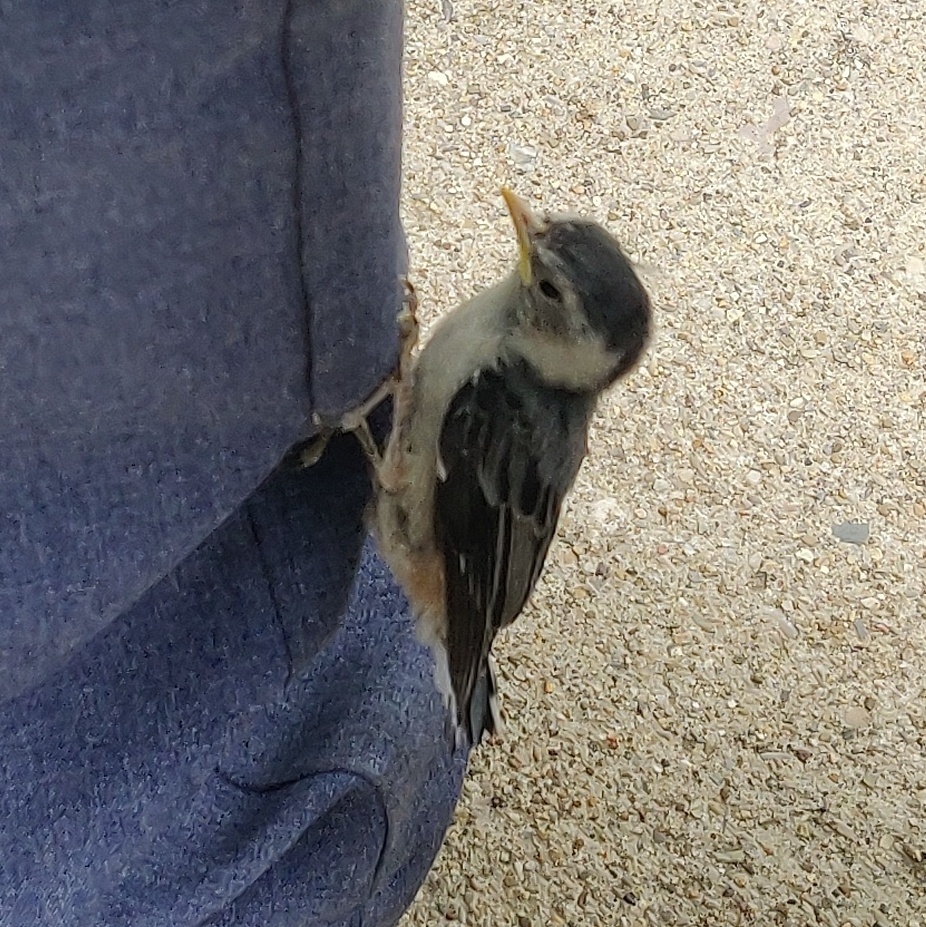
(c) Rusty, some rights reserved (CC BY) · licence
Family: Sittidae · Class: Aves · Order: Passeriformes
Sitta carolinensis (White-breasted Nuthatch) is a California animal in the Sittidae family.
The White-breasted Nuthatch is a compact, acrobatic songbird measuring 13 to 14 cm (5.1 to 5.5 inches) in length with a wingspan of 20 to 27 cm (7.9 to 10.6 inches). Adults weigh 18 to 30 grams (0.6 to 1.1 ounces). The species exhibits distinct sexual dimorphism: males display a crisp black cap extending from the forehead to the nape, while females show a gray cap. Both sexes have white faces, underparts, and undertail coverts, contrasting with blue-gray upperparts and wings. The bill is long, straight, and pointed, adapted for probing bark crevices. The tail is short and square-tipped, and the legs are relatively long with strong, curved claws for gripping vertical surfaces. The White-breasted Nuthatch has a broad distribution across North America, ranging from southern Canada to central Mexico. In California, the species occurs throughout much of the state except for the Central Valley, southeastern deserts, and coastal regions south of San Luis Obispo County. Populations are found in the Sierra Nevada, Cascade Range, Coast Ranges, and Transverse and Peninsular Ranges. The species is present year-round as a permanent resident, with some altitudinal movement during winter months. This nuthatch inhabits mature deciduous and mixed coniferous-deciduous forests, typically at elevations from sea level to 2,500 meters (8,200 feet) in California. The species shows strong preference for oak woodlands, particularly coast live oak, valley oak, and blue oak communities. It also occurs in mixed oak-pine forests, riparian woodlands with large trees, and mature pine forests. Large, mature trees with rough bark and substantial dead wood are essential habitat components, providing both nesting sites and foraging substrate. White-breasted Nuthatches are primarily insectivorous, foraging by moving headfirst down tree trunks and large branches, a unique behavior among North American birds. Their diet consists of beetles, caterpillars, ants, and other arthropods extracted from bark crevices using their specialized bill. During autumn and winter, they cache seeds and nuts, particularly acorns, pine seeds, and sunflower seeds, storing them in bark crevices for later retrieval. The species is typically monogamous, with pairs maintaining territories year-round. Breeding occurs from March through June, with females constructing nests in natural tree cavities or old woodpecker holes. Clutch size ranges from 5 to 9 eggs, which are incubated for 12 to 14 days. Young fledge after 18 to 26 days. The White-breasted Nuthatch is not federally or state-listed and maintains stable populations across most of its California range. The species is classified as Least Concern by the International Union for Conservation of Nature. However, local populations may face pressure from habitat loss due to urban development, intensive forest management, and removal of mature oak woodlands. Fire suppression has altered natural forest structure in some areas, potentially reducing habitat quality. Climate change may affect the species through shifts in tree species composition and altered precipitation patterns affecting oak regeneration.
Classification
Class: Aves · Order: Passeriformes · Family: Sittidae
Frequently asked questions
How is Sitta carolinensis classified?
Sitta carolinensis belongs to class Aves, order Passeriformes, family Sittidae.
What family does Sitta carolinensis belong to?
Sitta carolinensis is in the Sittidae family.
What is Sitta carolinensis?
The White-breasted Nuthatch is a compact, acrobatic songbird measuring 13 to 14 cm (5.1 to 5.5 inches) in length with a wingspan of 20 to 27 cm (7.9 to 10.6 inches).
Is Sitta carolinensis found in California?
Yes. Sitta carolinensis is recorded in California in The California Species Project's catalogue.
Related species
Other California species in the same genus, family, or bioregion.
Data from The California Species Project — 14,000+ California species with verified data from CNPS, CDFW, USFWS, and more.