Smerinthus cerisyi
One-eyed sphinx
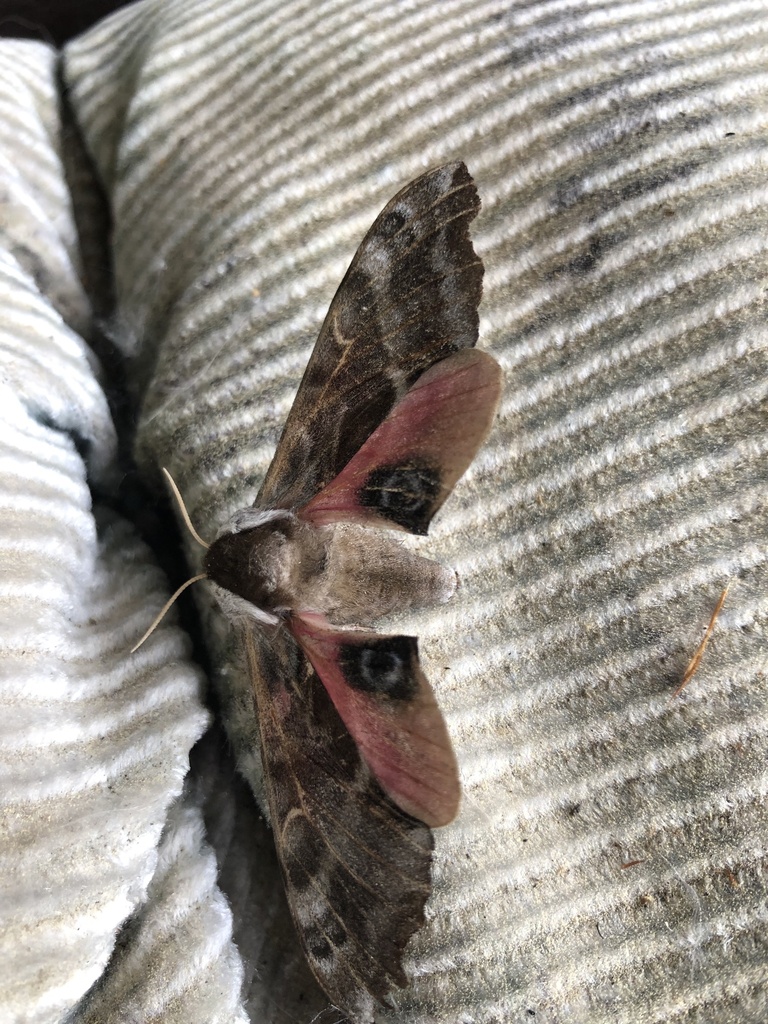
no rights reserved · CC0
Family: Sphingidae · Class: Insecta · Order: Lepidoptera
Smerinthus cerisyi (One-eyed sphinx) is a California animal in the Sphingidae family.
The one-eyed sphinx (Smerinthus cerisyi) is a large moth in the family Sphingidae, commonly known as hawkmoths or sphinx moths. Adults have a wingspan ranging from 60 to 90 mm (2.4 to 3.5 inches). The forewings are gray-brown with darker zigzag markings and pale patches, while the hindwings display a distinctive blue and black eyespot with a white center, giving the species its common name. The body is robust and covered in dense, grayish-brown scales. At rest, the moth holds its wings horizontally, resembling a broken twig or piece of bark. The one-eyed sphinx has a broad distribution across North America, extending from Newfoundland and Maine west across Michigan, the northern states, and southern Canada to British Columbia and Washington. The range extends south to southern California, Baja California Norte, and west Texas, with additional populations documented in Tennessee and Missouri. This extensive range reflects the species' adaptability to diverse climatic conditions across temperate North America. The species inhabits deciduous and mixed forests, riparian woodlands, urban parks, and suburban areas where host plants occur. In California, one-eyed sphinx moths are found from sea level to approximately 2,400 meters (7,900 feet) elevation in the Sierra Nevada and other mountain ranges. Adults are most commonly encountered near streams, rivers, and other water sources where willows and poplars grow naturally. One-eyed sphinx larvae feed exclusively on willow (Salix) and poplar (Populus) species. The large, green caterpillars reach 75 to 100 mm (3.0 to 3.9 inches) in length and possess a distinctive horn at the posterior end, characteristic of sphinx moth larvae. Pupation occurs in the soil, where larvae construct earthen chambers. The species is bivoltine in warmer regions, producing two generations per year, while northern populations typically complete one generation annually. Adults are active from May through September, depending on latitude and elevation. Flight activity peaks during evening and nighttime hours, when adults visit flowers for nectar, particularly favoring lilac, honeysuckle, and other tubular flowers. The one-eyed sphinx is not federally or state-listed as threatened or endangered, and populations appear stable across most of its range. However, habitat loss due to riparian development, removal of native willows and poplars, and urban expansion may impact local populations. Climate change could potentially alter the distribution of suitable habitat, particularly at the species' southern range limits. The moth's dependence on specific host plants makes it vulnerable to changes in riparian ecosystem management and water availability, which directly affect willow and poplar growth. Conservation of riparian corridors and maintenance of native deciduous tree species supports continued population stability for this species and associated riparian fauna.
Classification
Class: Insecta · Order: Lepidoptera · Family: Sphingidae
Frequently asked questions
How is Smerinthus cerisyi classified?
Smerinthus cerisyi belongs to class Insecta, order Lepidoptera, family Sphingidae.
What family does Smerinthus cerisyi belong to?
Smerinthus cerisyi is in the Sphingidae family.
What is Smerinthus cerisyi?
The one-eyed sphinx (Smerinthus cerisyi) is a large moth in the family Sphingidae, commonly known as hawkmoths or sphinx moths.
Is Smerinthus cerisyi found in California?
Yes. Smerinthus cerisyi is recorded in California in The California Species Project's catalogue.
Related species
Other California species in the same genus, family, or bioregion.
Data from The California Species Project — 14,000+ California species with verified data from CNPS, CDFW, USFWS, and more.