Smerinthus ophthalmica
Western Eyed Sphinx
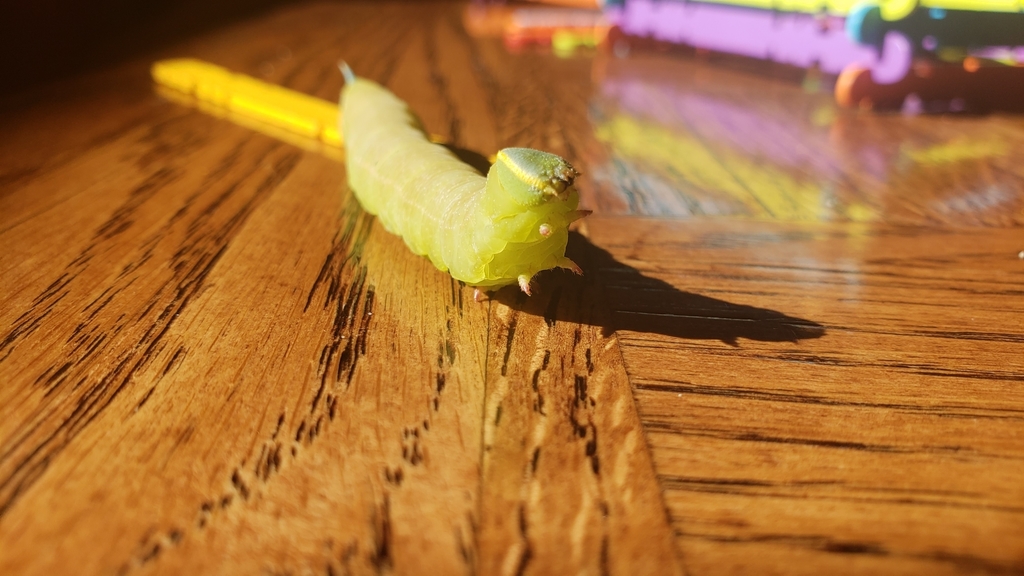
(c) Shannon seesholtz, some rights reserved (CC BY) · licence
Family: Sphingidae · Class: Insecta · Order: Lepidoptera
Smerinthus ophthalmica (Western Eyed Sphinx) is a California animal in the Sphingidae family.
The Western Eyed Sphinx is a large moth in the family Sphingidae, characterized by distinctive eyespots on the hindwings that give the species its common name. Adults have a wingspan typically ranging from 65 to 90 mm (2.6 to 3.5 inches). The forewings are mottled brown and gray with irregular darker markings, providing effective camouflage against tree bark. The hindwings feature prominent blue and black eyespots with white centers, which are displayed when the moth is disturbed as a defensive mechanism against predators. Smerinthus ophthalmica occurs across western North America, ranging from southern British Columbia and southern Alberta south to near the border with Mexico. The species is replaced by S. cerisyi to the east and north, and by S. saleceti in the southern-most Rocky Mountains and southern Arizona. Within this range, the species has been documented from sea level to montane elevations, with records from various western states including Idaho, Oregon, and Arizona. The Western Eyed Sphinx inhabits a variety of wooded habitats including riparian areas, mountain canyons, and mixed coniferous-deciduous forests. Adults are typically found in valleys and along streamsides where host plants are abundant. The species shows a preference for areas with willows and poplars, which serve as larval host plants. Elevation records suggest the species occurs from lower valleys up to approximately 8,000 feet in mountainous regions. Adults are nocturnal and are attracted to artificial lights. Flight period varies by latitude and elevation but generally extends from May through August, with peak activity in June and July based on collection records from Idaho and other western states. Larvae feed primarily on willows (Salix species) and poplars (Populus species), including cottonwoods. The caterpillars are large, green hornworms with diagonal white stripes and a prominent horn at the posterior end, typical of sphinx moth larvae. Pupation occurs in underground chambers, with the species overwintering in the pupal stage. Like other sphinx moths, adults are strong fliers capable of rapid, sustained flight. They do not typically feed as adults, though some may visit tree sap or rotting fruit. Mating occurs during nighttime hours, with females laying eggs singly on host plant foliage. The species completes one generation per year in most of its range. The Western Eyed Sphinx is not federally or state listed and appears to maintain stable populations throughout most of its range. The species' association with riparian habitats makes it potentially vulnerable to habitat loss from development, water diversion, and climate change impacts on western water resources. However, no specific conservation concerns have been documented for this species, and it continues to be regularly encountered by collectors and researchers throughout its distribution.
Classification
Class: Insecta · Order: Lepidoptera · Family: Sphingidae
Frequently asked questions
How is Smerinthus ophthalmica classified?
Smerinthus ophthalmica belongs to class Insecta, order Lepidoptera, family Sphingidae.
What family does Smerinthus ophthalmica belong to?
Smerinthus ophthalmica is in the Sphingidae family.
What is Smerinthus ophthalmica?
The Western Eyed Sphinx is a large moth in the family Sphingidae, characterized by distinctive eyespots on the hindwings that give the species its common name.
Is Smerinthus ophthalmica found in California?
Yes. Smerinthus ophthalmica is recorded in California in The California Species Project's catalogue.
Related species
Other California species in the same genus, family, or bioregion.
Data from The California Species Project — 14,000+ California species with verified data from CNPS, CDFW, USFWS, and more.