Smerinthus saliceti
Salicet sphinx
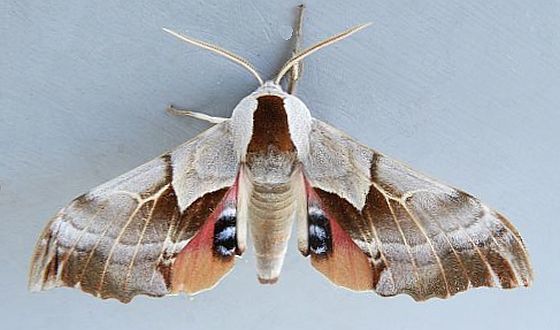
(c) jimeckert49, some rights reserved (CC BY) · licence
Family: Sphingidae · Class: Insecta · Order: Lepidoptera
Smerinthus saliceti (Salicet sphinx) is a California animal in the Sphingidae family.
The Salicet sphinx (Smerinthus saliceti) is a medium-sized hawk moth in the family Sphingidae. Adults typically measure 65 to 85 mm (2.6 to 3.3 inches) in wingspan. The forewings are grayish-brown with darker brown crosslines and a distinctive pale patch near the apex. The hindwings display characteristic blue and black eyespots with orange borders, a feature common to many Smerinthus species. The body is robust and covered in dense scales matching the wing coloration. Males can be distinguished from females by their more feathered antennae and slightly smaller size. The species ranges from Mexico City north to west Texas, southern Arizona, and extreme southern California. A Colorado occurrence requires confirmation. Within California, the Salicet sphinx is found only in the extreme southern portions of the state, likely in riparian areas along the Colorado River and its tributaries. This represents the northwestern edge of the species' distribution, which extends southward through much of Mexico. Salicet sphinx moths inhabit riparian woodlands and areas adjacent to waterways where their host plants occur. The species is associated with willow (Salix) and poplar (Populus) communities, typically at lower elevations in desert and semi-arid regions. Adults are most commonly found near permanent or seasonal water sources that support gallery forests and riparian vegetation. The species tolerates both natural riparian corridors and modified landscapes such as agricultural areas with irrigation ditches lined by willows or cottonwoods. Adults are nocturnal and most active during late spring and summer months, typically from April through August. Like other sphinx moths, they are strong fliers capable of hovering while feeding on nectar from flowers. Females deposit eggs singly on host plant foliage, probably willow or poplar species. Larvae, known as hornworms, feed on leaves and develop through five instars before pupating in the soil. The caterpillars are typically green with diagonal white stripes and a prominent horn at the posterior end. Pupation occurs in underground chambers, with adults emerging the following year. The conservation status of the Salicet sphinx in California is not well documented, as the species appears to be uncommon and localized within the state. The moth is not federally or state listed, suggesting populations are considered stable across its range. However, the species' dependence on riparian habitats makes it potentially vulnerable to water diversions, habitat modification, and drought conditions that affect willow and poplar communities. In California's arid southern regions, maintenance of adequate water flows and protection of remaining riparian corridors are likely important for sustaining local populations. Climate change may alter the distribution of suitable habitat, particularly at the northern margins of the species' range where California populations occur.
Classification
Class: Insecta · Order: Lepidoptera · Family: Sphingidae
Frequently asked questions
How is Smerinthus saliceti classified?
Smerinthus saliceti belongs to class Insecta, order Lepidoptera, family Sphingidae.
What family does Smerinthus saliceti belong to?
Smerinthus saliceti is in the Sphingidae family.
What is Smerinthus saliceti?
The Salicet sphinx (Smerinthus saliceti) is a medium-sized hawk moth in the family Sphingidae.
Is Smerinthus saliceti found in California?
Yes. Smerinthus saliceti is recorded in California in The California Species Project's catalogue.
Related species
Other California species in the same genus, family, or bioregion.
Data from The California Species Project — 14,000+ California species with verified data from CNPS, CDFW, USFWS, and more.