Solenopsis xyloni
Southern Fire Ant
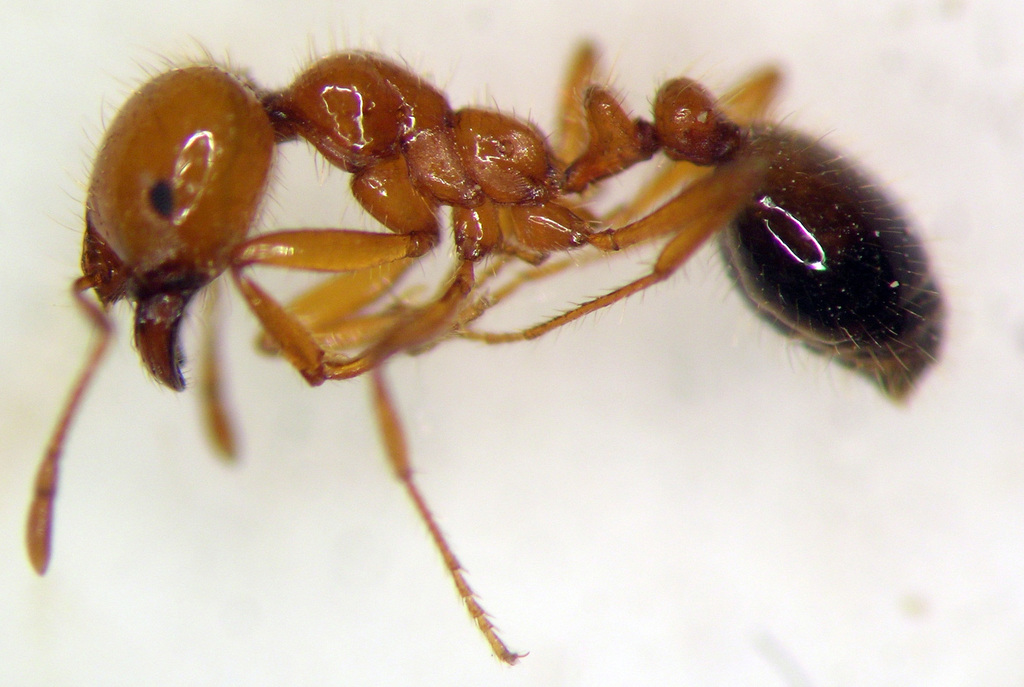
(c) Jason Eckberg, some rights reserved (CC BY) · licence
Family: Formicidae · Class: Insecta · Order: Hymenoptera
Solenopsis xyloni (Southern Fire Ant) is a California animal in the Formicidae family.
The southern fire ant is a medium-sized ant species native to the southwestern United States and northwestern Mexico. Workers exhibit polymorphism, with individuals ranging from 2.5 to 6.5 mm in length. The species displays reddish-brown to dark brown coloration, distinguishing it from the more aggressive red imported fire ant (Solenopsis invicta) which has a characteristically red head and thorax contrasting with a darker abdomen. Southern fire ants possess two petiolar nodes connecting the abdomen to the thorax, a diagnostic feature of the genus Solenopsis. Solenopsis xyloni occurs naturally throughout much of California, extending from sea level to approximately 2,400 meters elevation. The species ranges eastward through Arizona, New Mexico, Nevada, and into parts of Texas, with populations documented in Baja California, Mexico. In California, the species is found in multiple biogeographic regions including the Central Valley, Coast Ranges, Transverse Ranges, and Peninsular Ranges. Historical records indicate the species was likely more widespread before habitat modification and competition from introduced fire ant species. The southern fire ant inhabits diverse habitat types including grasslands, oak woodlands, chaparral, desert scrub, and riparian zones. The species demonstrates considerable ecological flexibility, constructing colonies in sandy soils, beneath rocks, fallen logs, and around the base of shrubs and trees. Unlike some fire ant species that prefer disturbed areas, S. xyloni commonly occurs in relatively undisturbed native habitats. Colonies typically consist of shallow, irregular chambers connected by tunnels, often lacking the prominent mounded nests characteristic of imported fire ants. Southern fire ants are omnivorous foragers, feeding on seeds, nectar, small arthropods, and carrion. Workers exhibit a division of labor, with smaller individuals tending larvae and maintaining the nest while larger workers engage in foraging and colony defense. Reproductive flights typically occur during warm months following rainfall. Colonies are generally polygynous, containing multiple reproductive queens. The species plays important ecological roles as both predator and prey, controlling populations of various insects while serving as food for lizards, birds, and other arthropods. Notably, southern fire ants have been documented preying on desert tortoise eggs, representing a conservation concern for this threatened species. Solenopsis xyloni faces significant conservation challenges primarily from competition with invasive fire ant species, particularly the red imported fire ant. Habitat loss due to urbanization and agricultural development has reduced available nesting sites throughout the species' California range. Climate change may alter precipitation patterns that influence reproductive success and colony establishment. The species lacks formal conservation status but represents an important component of native ant fauna. Unlike invasive fire ants, southern fire ants are less aggressive toward humans and rarely cause significant stings, making them ecologically beneficial for natural pest control in agricultural and natural systems.
Classification
Class: Insecta · Order: Hymenoptera · Family: Formicidae
Frequently asked questions
How is Solenopsis xyloni classified?
Solenopsis xyloni belongs to class Insecta, order Hymenoptera, family Formicidae.
What family does Solenopsis xyloni belong to?
Solenopsis xyloni is in the Formicidae family.
What is Solenopsis xyloni?
The southern fire ant is a medium-sized ant species native to the southwestern United States and northwestern Mexico.
Is Solenopsis xyloni found in California?
Yes. Solenopsis xyloni is recorded in California in The California Species Project's catalogue.
Related species
Other California species in the same genus, family, or bioregion.
Data from The California Species Project — 14,000+ California species with verified data from CNPS, CDFW, USFWS, and more.