Somateria mollissima
Common Eider
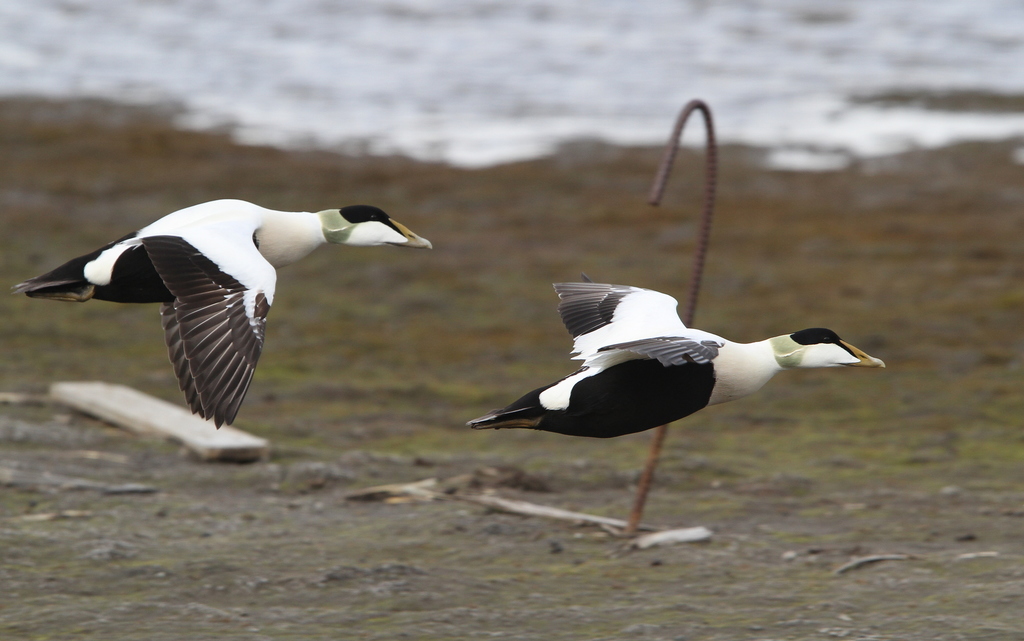
(c) Christoph Moning, some rights reserved (CC BY) · licence
Family: Anatidae · Class: Aves · Order: Anseriformes
Somateria mollissima (Common Eider) is a California animal in the Anatidae family.
The Common Eider is a large sea duck measuring 50 to 71 cm (20 to 28 inches) in length with a wingspan of 80 to 108 cm (31 to 43 inches). Males weigh 1.2 to 2.2 kg (2.6 to 4.9 pounds), while females are lighter at 1.0 to 1.8 kg (2.2 to 4.0 pounds). Breeding males display distinctive black and white plumage with a black cap, white back and breast, and black belly and flanks. The bill is olive-yellow with a pronounced frontal lobe. Females and non-breeding males are mottled brown with darker barring throughout. Both sexes have a characteristic triangular head profile and orange-yellow legs. Common Eiders breed across Arctic and subarctic regions of North America, Europe, and Asia. In North America, the species ranges from Alaska and northern Canada south to Maine and the Maritime Provinces. The subspecies Somateria mollissima v-nigrum occurs along the Pacific coast from Alaska to British Columbia. In California, Common Eiders are rare visitors, primarily documented as vagrant individuals along the northern coast during winter months. Most California records come from Humboldt, Del Norte, and Mendocino counties. This species inhabits marine coastal environments, favoring rocky shorelines, shallow bays, and nearshore waters with extensive mussel and clam beds. Common Eiders typically remain in waters less than 10 meters deep where they can dive to forage on benthic invertebrates. During breeding season, they nest on islands and coastal areas with low vegetation, often selecting sites protected from terrestrial predators. Wintering birds concentrate in areas with persistent open water and abundant shellfish populations. Common Eiders are specialized molluscivores, feeding primarily on blue mussels, clams, sea urchins, and crabs. They dive to depths of 3 to 10 meters, using their powerful bills to dislodge prey from rocky substrates. Breeding occurs from May through August, with females constructing nests lined with down feathers plucked from their breast. Clutch size ranges from 3 to 6 eggs, with an incubation period of 25 to 28 days. Females provide all parental care, leading ducklings to water within hours of hatching. Young eiders form communal creches attended by multiple females. The Common Eider is not federally listed under the Endangered Species Act and maintains stable populations across most of its range. The global population is estimated at 3 to 4 million individuals. However, some regional populations face pressures from climate change, which affects Arctic breeding habitats and prey availability. Oil spills pose significant threats to wintering concentrations, as the species' dense plumage loses insulation when contaminated with petroleum products. In California, the species remains a rare but regular winter visitor, with no evidence of breeding populations.
Classification
Class: Aves · Order: Anseriformes · Family: Anatidae
Frequently asked questions
How is Somateria mollissima classified?
Somateria mollissima belongs to class Aves, order Anseriformes, family Anatidae.
What family does Somateria mollissima belong to?
Somateria mollissima is in the Anatidae family.
What is Somateria mollissima?
The Common Eider is a large sea duck measuring 50 to 71 cm (20 to 28 inches) in length with a wingspan of 80 to 108 cm (31 to 43 inches).
Is Somateria mollissima found in California?
Yes. Somateria mollissima is recorded in California in The California Species Project's catalogue.
Related species
Other California species in the same genus, family, or bioregion.
Data from The California Species Project — 14,000+ California species with verified data from CNPS, CDFW, USFWS, and more.