Somateria spectabilis
King Eider
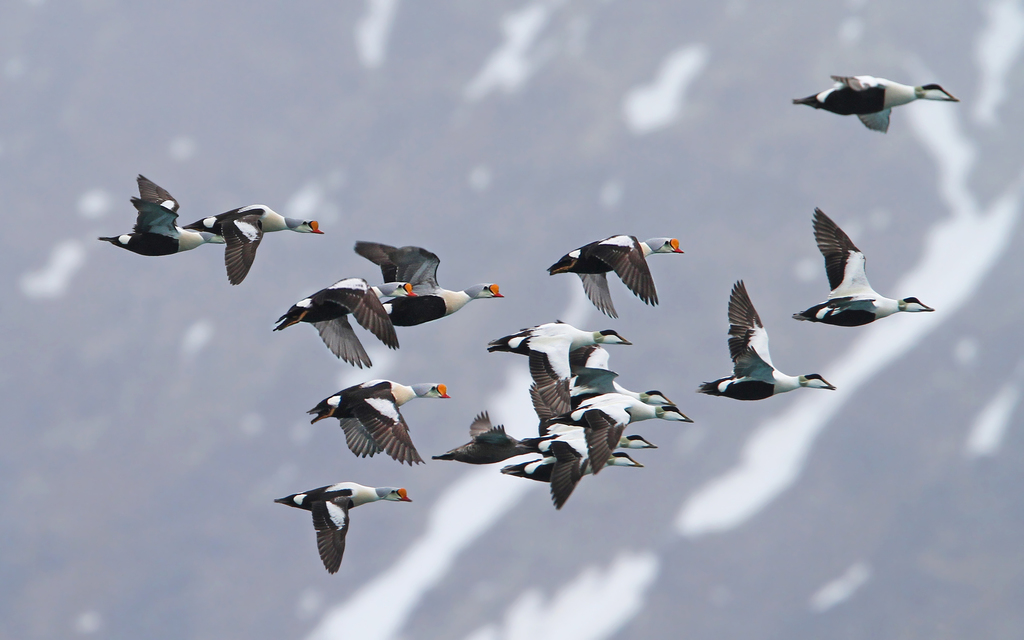
(c) Christoph Moning, some rights reserved (CC BY) · licence
Family: Anatidae · Class: Aves · Order: Anseriformes
Somateria spectabilis (King Eider) is a California animal in the Anatidae family.
The King Eider is a large sea duck with distinctive sexual dimorphism. Adult males measure 55 to 63 cm (21.7 to 24.8 inches) in length with a wingspan of 86 to 102 cm (33.9 to 40.2 inches), weighing 1.4 to 2.1 kg (3.1 to 4.6 pounds). Breeding males display a striking multicolored plumage with a white breast and back, black body and wings, and an orange-yellow frontal shield above a bright red bill. The head features a distinctive blue-gray crown and nape with pale green cheeks. Females and non-breeding males are brown overall with darker barring and scaling, measuring slightly smaller at 50 to 57 cm in length. Both sexes have relatively small bills compared to other eiders and distinctive white wing patches visible in flight. King Eiders breed in Arctic tundra regions across northern Alaska, northern Canada, Greenland, and northern Eurasia. In North America, they nest primarily along the Arctic Ocean coastline from northern Alaska to the Canadian Arctic archipelago. During winter, populations migrate south to ice-free coastal waters. Small numbers regularly winter along the Pacific Coast from Alaska to northern California, with occasional sightings reported as far south as Monterey Bay. In California, King Eiders are considered rare visitors, typically observed from December through March in nearshore marine waters. The species inhabits Arctic coastal plains and tundra during the breeding season, preferring areas with numerous freshwater ponds and lakes within 10 km of the coast. Nests are typically placed on small islands or peninsulas in shallow tundra ponds, often near sedge meadows or moss-dominated areas. During migration and winter, King Eiders occupy marine environments, favoring rocky coastlines, kelp beds, and areas with depths of 2 to 40 meters where they can access preferred prey species. King Eiders are diving ducks that feed primarily on benthic invertebrates. Their diet consists mainly of blue mussels, other bivalves, gastropods, crustaceans, and polychaete worms. During the breeding season, they also consume aquatic insects, small fish, and plant material. Breeding occurs from May to August, with females laying 3 to 7 olive-brown eggs in ground nests lined with down and vegetation. Incubation lasts 22 to 24 days, performed exclusively by females. Ducklings fledge after 50 to 60 days and become independent shortly thereafter. King Eiders are not federally listed in the United States, though populations face several conservation challenges. Climate change poses the primary threat through Arctic warming, which affects breeding habitat availability and prey species distribution. Oil and gas development in Arctic regions creates additional habitat disturbance and pollution risks. Marine pollution, particularly oil spills, threatens wintering populations along migration routes and coastal areas. According to the North American Bird Conservation Initiative, King Eider populations have shown moderate declines over recent decades, though the species maintains a large global population estimated at 3 to 4 million individuals.
Classification
Class: Aves · Order: Anseriformes · Family: Anatidae
Frequently asked questions
How is Somateria spectabilis classified?
Somateria spectabilis belongs to class Aves, order Anseriformes, family Anatidae.
What family does Somateria spectabilis belong to?
Somateria spectabilis is in the Anatidae family.
What is Somateria spectabilis?
The King Eider is a large sea duck with distinctive sexual dimorphism.
Is Somateria spectabilis found in California?
Yes. Somateria spectabilis is recorded in California in The California Species Project's catalogue.
Related species
Other California species in the same genus, family, or bioregion.
Data from The California Species Project — 14,000+ California species with verified data from CNPS, CDFW, USFWS, and more.