Sorex bendirii
Marsh Shrew
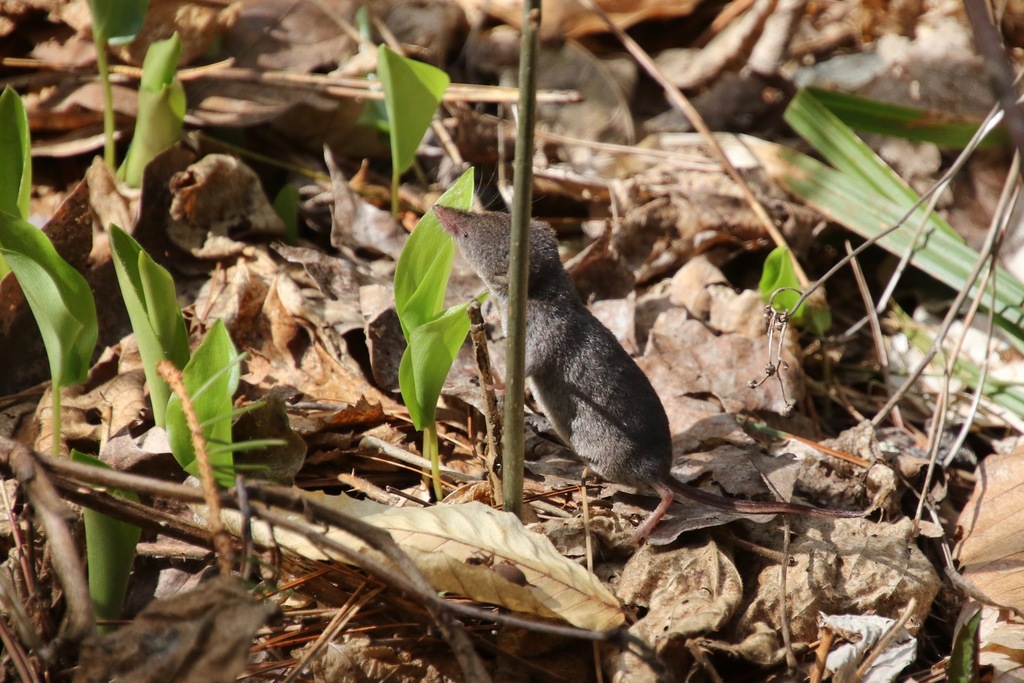
(c) er-birds, some rights reserved (CC BY) · licence
Family: Soricidae · Class: Mammalia · Order: Eulipotyphla
Sorex bendirii (Marsh Shrew) is a California animal in the Soricidae family.
The marsh shrew (Sorex bendirii) is a semi-aquatic mammal and the largest shrew species in North America. Adults measure 140 to 170 mm (5.5 to 6.7 inches) in total length, with a tail comprising approximately 60% of total body length at 85 to 100 mm (3.3 to 3.9 inches). Body weight ranges from 8 to 21 grams (0.3 to 0.7 ounces). The dense, velvety fur is dark brown to blackish on the dorsal surface, transitioning to lighter grayish-brown on the ventral surface. The long tail is distinctly bicolored, dark above and pale below, with a fringe of stiff hairs that aids in swimming. The hind feet are enlarged and partially webbed, measuring 18 to 20 mm in length, and feature a fringe of stiff hairs along the outer edges that function as swimming aids. Marsh shrews occur along the Pacific Coast from southwestern British Columbia through western Washington and Oregon to northwestern California. In California, the species is documented from Del Norte, Humboldt, and Mendocino counties, with populations extending south to Sonoma County. The species' range is closely tied to coastal and near-coastal watersheds, rarely extending more than 50 kilometers inland from the Pacific Ocean. This species inhabits riparian areas, freshwater marshes, wet meadows, and the margins of slow-moving streams and ponds. Marsh shrews prefer areas with dense emergent vegetation, including sedges, rushes, and cattails, along with adjacent upland areas containing fallen logs and dense understory vegetation. They construct nests in elevated locations such as tussocks of grass or sedge, hollow logs, or abandoned bird nests, typically 0.3 to 1.5 meters above water level. The species occurs from sea level to elevations of approximately 1,200 meters (3,900 feet) in the Sierra Nevada foothills. Marsh shrews are semi-aquatic predators, diving and swimming to capture aquatic invertebrates including caddisfly larvae, mayfly nymphs, amphipods, and small fish. They are active throughout the day and night in short cycles of 2 to 3 hours of activity followed by similar periods of rest. Breeding occurs from February through September, with females producing 2 to 3 litters annually. Gestation lasts 20 to 21 days, and litter size ranges from 3 to 8 young, typically 5 to 6. Young reach sexual maturity at 6 to 7 months of age. The marsh shrew is not federally listed but faces population pressure from habitat loss and degradation. Wetland destruction, stream channelization, and water diversions have reduced available habitat throughout the species' range. Urban development and agricultural conversion of riparian areas continue to fragment populations. Climate change poses additional threats through altered precipitation patterns and increased frequency of drought conditions. The species' specialized habitat requirements and limited dispersal ability make it particularly vulnerable to habitat fragmentation. Population monitoring is limited, but the species appears stable in protected areas with intact wetland habitat.
Classification
Class: Mammalia · Order: Eulipotyphla · Family: Soricidae
Frequently asked questions
How is Sorex bendirii classified?
Sorex bendirii belongs to class Mammalia, order Eulipotyphla, family Soricidae.
What family does Sorex bendirii belong to?
Sorex bendirii is in the Soricidae family.
What is Sorex bendirii?
The marsh shrew (Sorex bendirii) is a semi-aquatic mammal and the largest shrew species in North America.
Is Sorex bendirii found in California?
Yes. Sorex bendirii is recorded in California in The California Species Project's catalogue.
Related species
Other California species in the same genus, family, or bioregion.
Data from The California Species Project — 14,000+ California species with verified data from CNPS, CDFW, USFWS, and more.