Sorex merriami
Merriam's Shrew
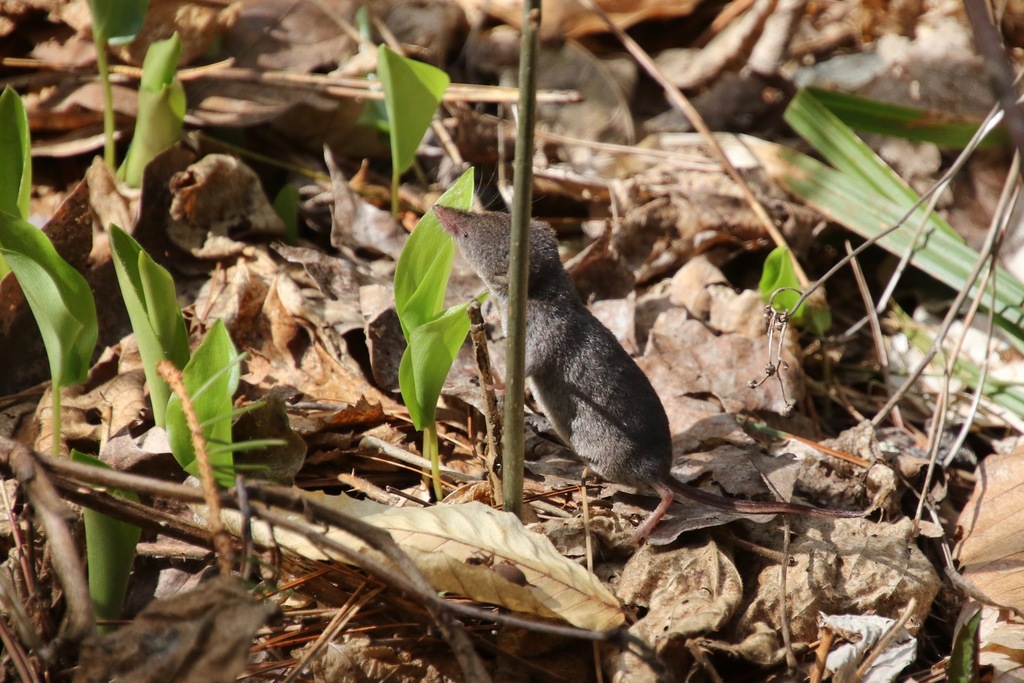
(c) er-birds, some rights reserved (CC BY) · licence
Family: Soricidae · Class: Mammalia · Order: Eulipotyphla
Sorex merriami (Merriam's Shrew) is a California animal in the Soricidae family.
Merriam's shrew (Sorex merriami) is a small mammal in the family Soricidae, representing one of the least studied shrews in North America. Adults measure 85 to 105 mm (3.3 to 4.1 inches) in total length, with the tail comprising approximately 40 to 45 mm of this measurement. Body mass ranges from 3 to 6 grams (0.1 to 0.2 ounces). The dorsal pelage is grayish-brown to brownish-gray, while the ventral surface is slightly paler. The species exhibits the typical shrew characteristics of a pointed snout, small eyes, and dense, velvety fur. The tail is bicolored, darker above and lighter below, and sparsely haired compared to some other Sorex species. Merriam's shrew has a limited distribution in western North America, occurring primarily in arid and semi-arid regions. In California, the species is found in the eastern Sierra Nevada, the Mojave Desert, and portions of the Great Basin region. The range extends northward through Nevada, eastern Oregon, and into southern Idaho, with isolated populations documented in Utah and Colorado. This distribution represents one of the most restricted ranges among North American shrews, with populations often occurring as isolated metapopulations across the landscape. The species inhabits arid shrublands, sagebrush communities, and areas with scattered juniper trees. Merriam's shrew demonstrates a preference for rocky outcrops, talus slopes, and areas with well-developed cryptobiotic soil crusts that support diverse invertebrate communities. Elevation ranges from approximately 1,200 to 2,800 meters (4,000 to 9,200 feet). Microhabitat selection appears closely tied to moisture availability, with individuals often associated with seeps, intermittent streams, or areas where subsurface water creates localized mesic conditions within otherwise xeric environments. Like other shrews, Merriam's shrew maintains an extremely high metabolic rate and must consume food equivalent to 80 to 90 percent of its body weight daily. The diet consists primarily of small arthropods, including beetles, spiders, moth larvae, and other invertebrates found in arid soil and litter layers. Reproduction occurs from late spring through early fall, with females producing two to three litters annually. Litter sizes range from three to six young, with a gestation period of approximately 20 days. The species is primarily nocturnal and crepuscular, avoiding daytime activity to minimize water loss and heat stress. Merriam's shrew is not federally listed or protected under state regulations, though its conservation status remains poorly understood due to limited research. Population trends are unknown, and the species' secretive nature and specialized habitat requirements make detection and monitoring challenging. Climate change poses potential threats through altered precipitation patterns and increased temperatures in already marginal arid habitats. Habitat fragmentation from development and livestock grazing may impact local populations, particularly given the species' apparent dependence on specific microhabitat conditions.
Classification
Class: Mammalia · Order: Eulipotyphla · Family: Soricidae
Frequently asked questions
How is Sorex merriami classified?
Sorex merriami belongs to class Mammalia, order Eulipotyphla, family Soricidae.
What family does Sorex merriami belong to?
Sorex merriami is in the Soricidae family.
What is Sorex merriami?
Merriam's shrew (Sorex merriami) is a small mammal in the family Soricidae, representing one of the least studied shrews in North America.
Is Sorex merriami found in California?
Yes. Sorex merriami is recorded in California in The California Species Project's catalogue.
Related species
Other California species in the same genus, family, or bioregion.
Data from The California Species Project — 14,000+ California species with verified data from CNPS, CDFW, USFWS, and more.