Sorex monticolus
Montane Shrew
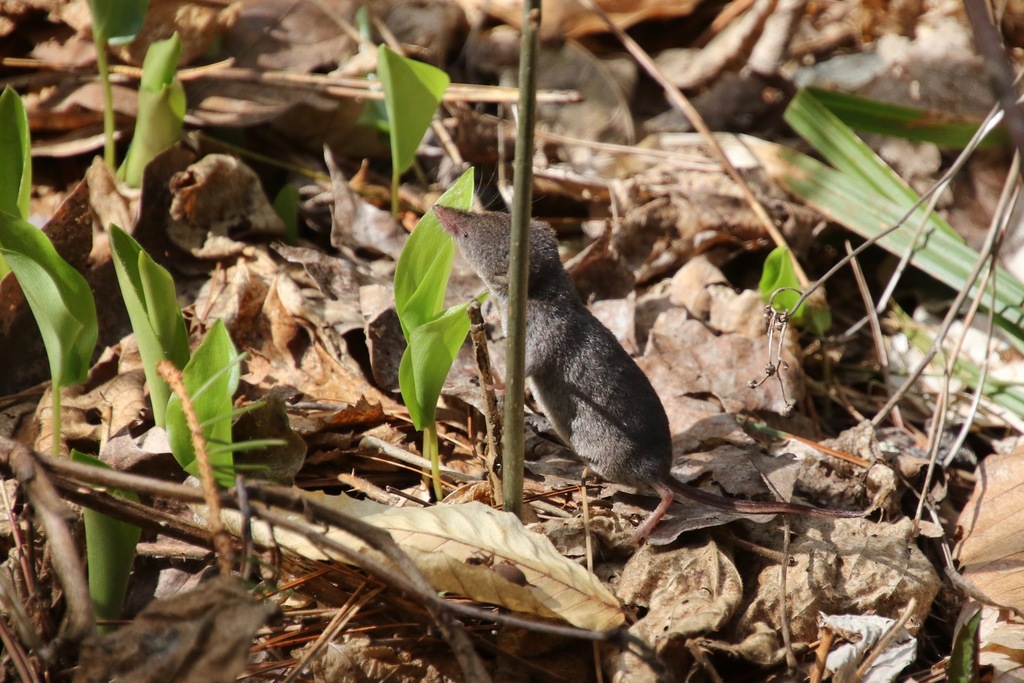
(c) er-birds, some rights reserved (CC BY) · licence
Family: Soricidae · Class: Mammalia · Order: Eulipotyphla
Sorex monticolus (Montane Shrew) is a California animal in the Soricidae family.
The Montane Shrew is a small insectivorous mammal belonging to the family Soricidae. Adults measure 95 to 115 mm (3.7 to 4.5 inches) in total length, with the tail comprising approximately 40% of total body length. Body mass ranges from 4 to 8 grams. The pelage is dense and velvety, typically grayish-brown to dark brown dorsally, transitioning to lighter gray or buff coloration on the ventral surface. The snout is elongated and pointed, characteristic of shrews, with small eyes and ears that are nearly hidden by fur. The tail is bicolored, dark above and pale below, and covered with short hairs. Montane Shrews occur across western North America, ranging from Alaska and western Canada south through the western United States to New Mexico and Arizona. In California, the species is found primarily in the Sierra Nevada, Cascade Range, and coastal mountains from sea level to approximately 3,500 meters (11,500 feet) elevation. Populations occur in counties including Alpine, Amador, Calaveras, El Dorado, Fresno, Inyo, Kern, Los Angeles, Madera, Mariposa, Mono, Nevada, Placer, Riverside, San Bernardino, Shasta, Tulare, and Tuolumne. This species inhabits diverse montane environments including coniferous forests, mixed woodlands, riparian zones, meadows, and talus slopes. Montane Shrews show strong association with areas having dense ground cover, fallen logs, rock crevices, and moist microhabitats. They are commonly found in Douglas fir, ponderosa pine, lodgepole pine, and mixed conifer forests, as well as aspen groves and willow thickets near streams. The species demonstrates considerable ecological flexibility, occupying habitats ranging from dry rocky slopes to wet meadows. Montane Shrews are active year-round and do not hibernate. They exhibit high metabolic rates typical of shrews, requiring frequent feeding to maintain body temperature. The diet consists primarily of invertebrates including beetles, fly larvae, caterpillars, spiders, centipedes, and earthworms. Hunting occurs both above and below ground, with individuals foraging through leaf litter, under logs, and in soil. Reproduction begins in spring, with females producing one to three litters annually. Gestation lasts approximately 20 days, and litter size ranges from 2 to 8 young, with an average of 5 to 6 offspring. Young are born altricial and reach sexual maturity at 2 to 3 months of age. The Montane Shrew currently lacks federal or state conservation listing status and appears to maintain stable populations across much of its range. The species benefits from protection within national parks and forests throughout the Sierra Nevada and other mountain ranges. However, localized populations may face pressure from habitat fragmentation, timber harvesting practices, and climate change effects on montane ecosystems. Fire suppression policies that alter natural forest structure and composition may impact habitat quality in some areas. The species' broad elevational range and habitat flexibility provide some resilience to environmental changes.
Classification
Class: Mammalia · Order: Eulipotyphla · Family: Soricidae
Frequently asked questions
How is Sorex monticolus classified?
Sorex monticolus belongs to class Mammalia, order Eulipotyphla, family Soricidae.
What family does Sorex monticolus belong to?
Sorex monticolus is in the Soricidae family.
What is Sorex monticolus?
The Montane Shrew is a small insectivorous mammal belonging to the family Soricidae.
Is Sorex monticolus found in California?
Yes. Sorex monticolus is recorded in California in The California Species Project's catalogue.
Related species
Other California species in the same genus, family, or bioregion.
Data from The California Species Project — 14,000+ California species with verified data from CNPS, CDFW, USFWS, and more.