Sorex ornatus
Ornate Shrew
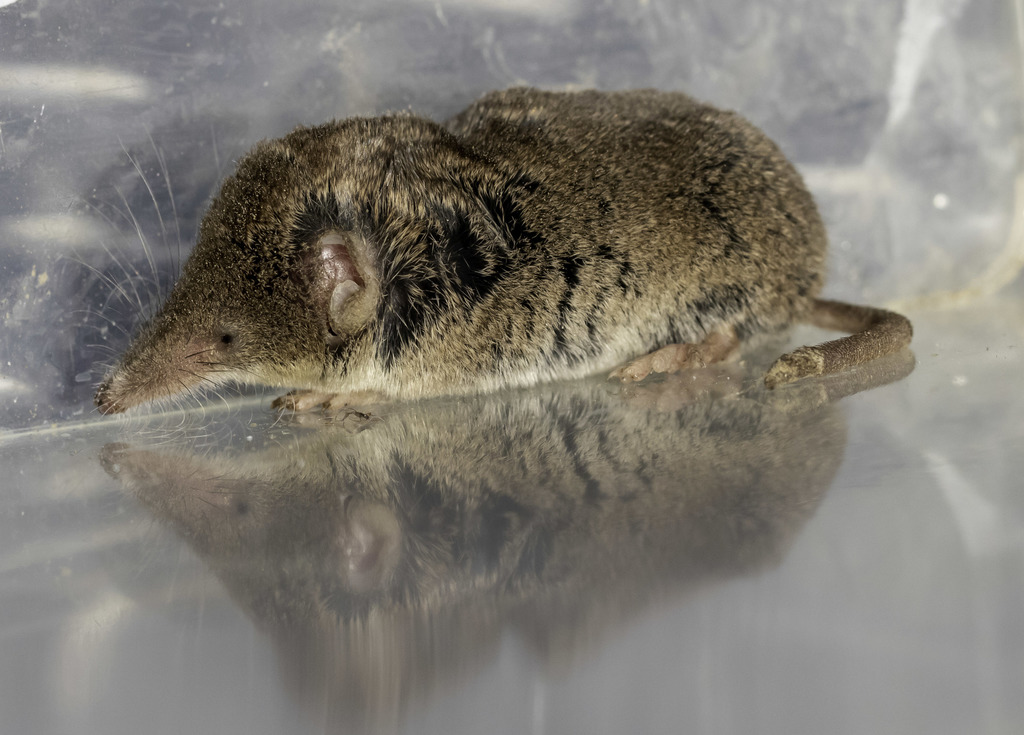
(c) Zack Abbey, some rights reserved (CC BY) · licence
Family: Soricidae · Class: Mammalia · Order: Eulipotyphla
Sorex ornatus (Ornate Shrew) is a California animal in the Soricidae family.
The ornate shrew (Sorex ornatus) is a small insectivorous mammal endemic to California and Baja California, Mexico. Adults measure 80 to 110 mm (3.1 to 4.3 inches) in total length, with the tail comprising approximately half of this measurement at 35 to 50 mm. Body weight ranges from 3 to 6 grams. The species exhibits typical shrew characteristics with a pointed snout, small eyes, and dense, velvety fur. The dorsal pelage is grayish-brown to brownish-gray, while the ventral surface is lighter gray to whitish. The tail is distinctly bicolored, dark above and pale below, and sparsely haired. The ornate shrew occurs along the Pacific coast of California from Sonoma County south through the Channel Islands and into Baja California. The species is found primarily in coastal and near-coastal areas, with populations documented in the San Francisco Bay Area, Central Coast, and Southern California regions including the Channel Islands of Santa Rosa, Santa Cruz, and San Miguel. Several subspecies are recognized across this range, with some endemic to specific islands. This species inhabits a variety of coastal and chaparral environments, typically in areas with dense ground cover and adequate moisture. Ornate shrews occur in coastal sage scrub, chaparral, oak woodlands, and riparian areas, generally below 1,500 meters elevation. They require habitats with loose soil or leaf litter that supports abundant invertebrate prey and provides cover from predators. The species shows a preference for areas near water sources or with higher humidity levels. Ornate shrews are solitary, highly active predators with extremely high metabolic rates requiring frequent feeding. They consume primarily small invertebrates including beetles, spiders, centipedes, fly larvae, and other arthropods. Due to their rapid metabolism, individuals must consume food equivalent to 80-90% of their body weight daily. The species is active year-round, foraging both day and night in short bursts separated by brief rest periods. Breeding occurs primarily from February through August, with females producing 2 to 8 young after a gestation period of approximately 20 days. Multiple litters per year are common when conditions are favorable. The ornate shrew is not federally listed, though several subspecies face conservation concerns due to habitat loss and fragmentation. The Suisun ornate shrew (S. o. sinuosus) from the San Francisco Bay Area is considered particularly vulnerable due to wetland habitat destruction. Primary threats include urban development, agricultural conversion, and habitat fragmentation along California's heavily developed coastal regions. Climate change may pose additional challenges through altered precipitation patterns affecting soil moisture and prey availability. Some island populations may face threats from introduced predators and habitat modification.
Classification
Class: Mammalia · Order: Eulipotyphla · Family: Soricidae
Frequently asked questions
How is Sorex ornatus classified?
Sorex ornatus belongs to class Mammalia, order Eulipotyphla, family Soricidae.
What family does Sorex ornatus belong to?
Sorex ornatus is in the Soricidae family.
What is Sorex ornatus?
The ornate shrew (Sorex ornatus) is a small insectivorous mammal endemic to California and Baja California, Mexico.
Is Sorex ornatus found in California?
Yes. Sorex ornatus is recorded in California in The California Species Project's catalogue.
Related species
Other California species in the same genus, family, or bioregion.
Data from The California Species Project — 14,000+ California species with verified data from CNPS, CDFW, USFWS, and more.