Sorex ornatus salarius
Monterey Shrew
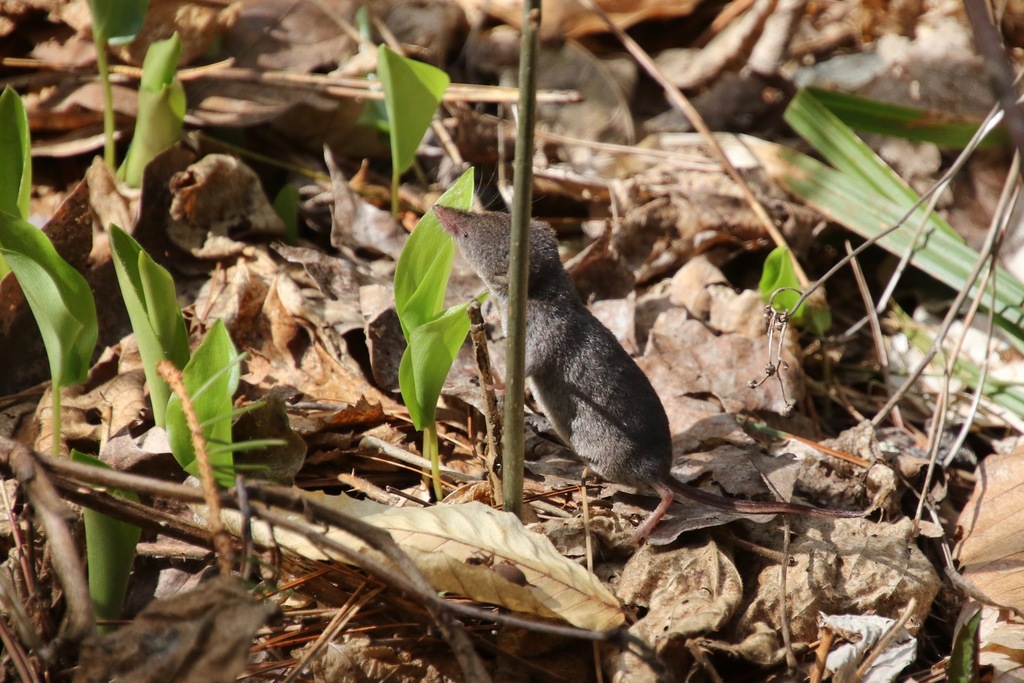
(c) er-birds, some rights reserved (CC BY) · licence
Family: Soricidae · Class: Mammalia · Order: Eulipotyphla
Conservation status: G5T1T2 S1S2
Sorex ornatus salarius (Monterey Shrew) is a California animal in the Soricidae family.
The Monterey ornate shrew (Sorex ornatus salarius) is a small mammalian insectivore endemic to coastal California. Adults typically measure 75-95 mm (3.0-3.7 inches) in total length, with a tail comprising approximately 40% of body length. The species displays the characteristic shrew morphology with an elongated, pointed snout, small eyes, and velvety fur that ranges from grayish-brown to dark brown dorsally with lighter underparts. Like other soricids, it possesses distinctive red-pigmented tips on its canine-like upper incisors, a diagnostic feature of the family Soricidae. Historically, the Monterey ornate shrew was distributed throughout coastal areas of central California, particularly in Monterey County. Current distribution is severely restricted compared to historical range, with populations confined to fragmented coastal habitats along the Monterey Peninsula and adjacent areas. The species represents one of several geographically isolated subspecies of Sorex ornatus, each adapted to specific regional conditions along the California coast. The species inhabits coastal scrub, dune systems, and adjacent grassland areas within the fog belt of the central California coast. It shows preference for areas with dense ground cover, including native shrubs and herbaceous vegetation that provide shelter and foraging opportunities. The species occurs from sea level to approximately 200 meters (650 feet) elevation, remaining within the maritime influence zone where cool, moist conditions persist throughout much of the year. Suitable habitat requires adequate leaf litter and organic debris that supports invertebrate prey populations. As an insectivore, the Monterey ornate shrew maintains a high metabolic rate requiring frequent feeding. The diet consists primarily of small invertebrates including beetles, spiders, centipedes, and other arthropods found within the leaf litter and soil surface. Shrews must consume food equivalent to their body weight daily to maintain their rapid metabolism. Breeding occurs from spring through early fall, with females producing multiple litters annually. Gestation lasts approximately 20 days, with litter sizes ranging from 2-6 young. The species is primarily nocturnal and crepuscular, remaining active throughout the year due to California's mild coastal climate. The Monterey ornate shrew currently holds no federal listing status but is designated with a Global/State Rank of G5T1T2 S1S2, indicating it is critically imperiled to imperiled both globally as a subspecies and within California. Primary threats include habitat loss from coastal development, recreational activities, and invasive plant species that alter native vegetation communities. Urban expansion along the Monterey Peninsula has eliminated much historical habitat, while remaining populations face fragmentation and edge effects. Climate change poses additional concerns through potential alterations to the coastal fog regime that maintains the cool, moist conditions essential for this subspecies. The restricted range and small population size make the Monterey ornate shrew particularly vulnerable to local extinctions from habitat disturbance or extreme weather events.
Classification
Class: Mammalia · Order: Eulipotyphla · Family: Soricidae
Conservation status
G5T1T2 S1S2
Frequently asked questions
How is Sorex ornatus salarius classified?
Sorex ornatus salarius belongs to class Mammalia, order Eulipotyphla, family Soricidae.
What family does Sorex ornatus salarius belong to?
Sorex ornatus salarius is in the Soricidae family.
Is Sorex ornatus salarius protected or of conservation concern?
Sorex ornatus salarius carries the following status: G5T1T2 S1S2.
What is Sorex ornatus salarius?
The Monterey ornate shrew (Sorex ornatus salarius) is a small mammalian insectivore endemic to coastal California.
Is Sorex ornatus salarius found in California?
Yes. Sorex ornatus salarius is recorded in California in The California Species Project's catalogue.
Related species
Other California species in the same genus, family, or bioregion.
Data from The California Species Project — 14,000+ California species with verified data from CNPS, CDFW, USFWS, and more.