Sorex palustris
American Water Shrew
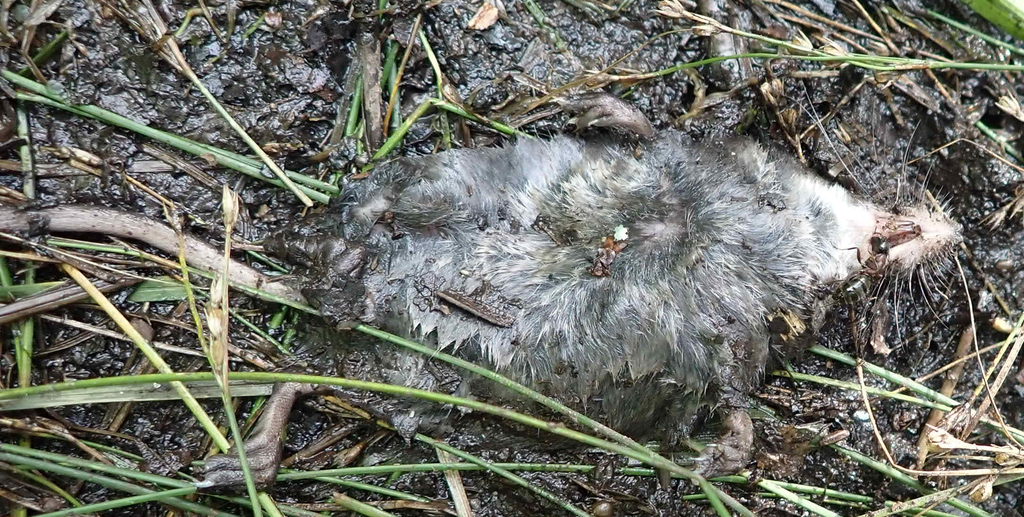
(c) Mary Krieger, some rights reserved (CC BY) · licence
Family: Soricidae · Class: Mammalia · Order: Eulipotyphla
Sorex palustris (American Water Shrew) is a California animal in the Soricidae family.
The American water shrew is a small, semi-aquatic mammal measuring 130-170 mm (5.1-6.7 inches) in total length, with adults weighing 8-18 grams (0.3-0.6 ounces). The tail comprises approximately half the total body length at 65-85 mm. The species exhibits dense, velvety fur that appears dark brown to blackish above and slightly paler below. The fur's unique structure traps air bubbles when submerged, creating a silvery appearance underwater and providing insulation. The hind feet are enlarged and fringed with stiff bristles that aid in swimming, while the snout is elongated and highly sensitive. Historically, American water shrews occurred across boreal and montane regions of North America, from Alaska and Canada south through the northern United States. In California, the species reaches its southernmost distribution limit in the Sierra Nevada mountains, with documented populations in montane areas of the northern and central Sierra Nevada. Populations have also been recorded in the Cascade Range of northern California. The California range represents a disjunct southern extension of the species' primary distribution. American water shrews inhabit areas near streams, springs, marshes, and other permanent water sources in montane coniferous forests. In California, they occur primarily at elevations between 1,200-3,000 meters (3,900-9,800 feet), typically in association with lodgepole pine, red fir, and mixed conifer forests. The species requires dense riparian vegetation along stream corridors, including sedges, rushes, and moss-covered rocks that provide cover and foraging habitat. They construct nests in burrows along stream banks or under logs and rocks near water. This species exhibits specialized aquatic adaptations, capable of running across water surfaces for short distances due to surface tension and specialized foot morphology. They dive frequently to hunt aquatic invertebrates, remaining submerged for up to 20 seconds. Their diet consists primarily of aquatic insect larvae, particularly caddisfly and midge larvae, as well as small fish, amphipods, and terrestrial invertebrates. Reproduction occurs from late winter through early summer, with females producing 2-3 litters annually. Litter size ranges from 4-8 young after a gestation period of approximately 21 days. The species maintains high metabolic rates, requiring consumption of 2-3 times their body weight daily. The American water shrew is not federally or state listed in California, though populations face potential threats from habitat modification, water diversions, and climate change effects on montane aquatic systems. Stream channelization, logging activities near riparian zones, and alterations to natural flow regimes can negatively impact habitat quality. The species' limited California distribution and specialized habitat requirements make populations potentially vulnerable to environmental changes. Climate change may shift suitable habitat to higher elevations, potentially reducing available range. Current population trends in California are not well documented, reflecting the need for targeted surveys to assess conservation status.
Classification
Class: Mammalia · Order: Eulipotyphla · Family: Soricidae
Frequently asked questions
How is Sorex palustris classified?
Sorex palustris belongs to class Mammalia, order Eulipotyphla, family Soricidae.
What family does Sorex palustris belong to?
Sorex palustris is in the Soricidae family.
What is Sorex palustris?
The American water shrew is a small, semi-aquatic mammal measuring 130-170 mm (5.1-6.7 inches) in total length, with adults weighing 8-18 grams (0.3-0.6 ounces).
Is Sorex palustris found in California?
Yes. Sorex palustris is recorded in California in The California Species Project's catalogue.
Related species
Other California species in the same genus, family, or bioregion.
Data from The California Species Project — 14,000+ California species with verified data from CNPS, CDFW, USFWS, and more.