Sorex trowbridgii
Trowbridge's Shrew
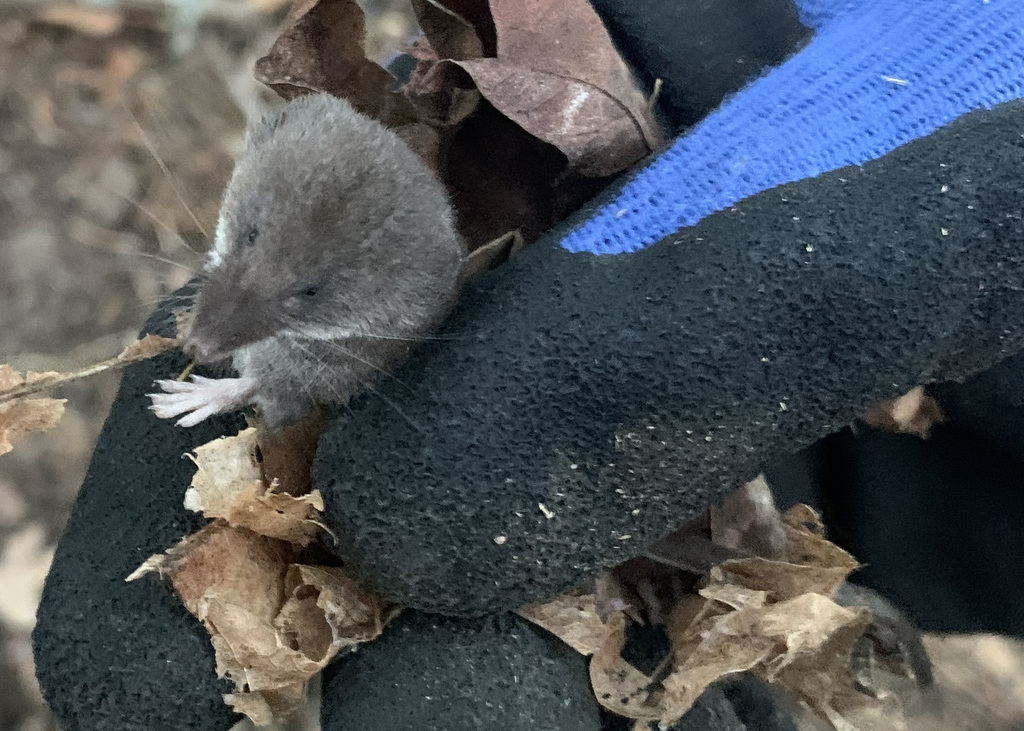
(c) John G. Phillips, some rights reserved (CC BY) · licence
Family: Soricidae · Class: Mammalia · Order: Eulipotyphla
Sorex trowbridgii (Trowbridge's Shrew) is a California animal in the Soricidae family.
Trowbridge's shrew is a small, dark-colored mammal endemic to the Pacific Coast region. Adults measure 95 to 128 mm (3.7 to 5.0 inches) in total length, with a tail length of 38 to 53 mm (1.5 to 2.1 inches). Body mass ranges from 3 to 6 grams (0.1 to 0.2 ounces). The species exhibits uniformly dark brown to nearly black fur on the dorsal surface, with slightly lighter brown coloration on the ventral side. The tail is distinctly bicolored, dark above and pale below, and comprises approximately 40% of the total body length. Trowbridge's shrew possesses the characteristic pointed snout and small eyes typical of the family Soricidae, with a dental formula of 3.1.3.3/1.1.1.3. The species occurs along the Pacific Coast from southwestern British Columbia south to central California. In California, Trowbridge's shrew is documented from Humboldt County south through the Coast Ranges to Santa Barbara County, and in the Sierra Nevada foothills from Shasta County to Tulare County. The species is absent from the Central Valley and southern California deserts. Elevational range extends from sea level to approximately 2,100 meters (6,900 feet), with most populations occurring below 1,500 meters (4,900 feet). Trowbridge's shrew inhabits dense coniferous and mixed forests, particularly those dominated by Douglas fir, redwood, and associated understory vegetation. The species shows strong association with areas containing substantial woody debris, including fallen logs, stumps, and root systems. Optimal habitat includes mature forest stands with closed canopy cover, thick leaf litter, and minimal ground disturbance. The species also occurs in riparian zones with dense shrub cover and occasionally in second-growth forests with adequate ground cover structure. This species is primarily insectivorous, consuming beetles, fly larvae, spiders, centipedes, and other small arthropods found in leaf litter and decaying wood. Trowbridge's shrew exhibits high metabolic demands typical of shrews, requiring consumption of food equivalent to 80-90% of body weight daily. The species is active year-round and shows both diurnal and nocturnal activity patterns. Breeding occurs from February through September, with females producing 2-3 litters annually. Litter size ranges from 2 to 6 young, with an average of 4 offspring per litter. Gestation period is approximately 20 days, and young reach sexual maturity at 3-4 months of age. Trowbridge's shrew is not federally or state listed and appears to maintain stable populations throughout most of its range. However, the species faces habitat pressure from timber harvesting, particularly clear-cutting practices that eliminate the complex ground cover structure essential for foraging and shelter. Urban development in coastal areas has resulted in localized population declines. Climate change may affect the species through altered precipitation patterns and increased fire frequency in forest ecosystems. Conservation efforts focus on maintaining mature forest habitats with adequate woody debris and understory complexity through sustainable forestry practices.
Classification
Class: Mammalia · Order: Eulipotyphla · Family: Soricidae
Frequently asked questions
How is Sorex trowbridgii classified?
Sorex trowbridgii belongs to class Mammalia, order Eulipotyphla, family Soricidae.
What family does Sorex trowbridgii belong to?
Sorex trowbridgii is in the Soricidae family.
What is Sorex trowbridgii?
Trowbridge's shrew is a small, dark-colored mammal endemic to the Pacific Coast region.
Is Sorex trowbridgii found in California?
Yes. Sorex trowbridgii is recorded in California in The California Species Project's catalogue.
Related species
Other California species in the same genus, family, or bioregion.
Data from The California Species Project — 14,000+ California species with verified data from CNPS, CDFW, USFWS, and more.