Sorex vagrans
Vagrant Shrew
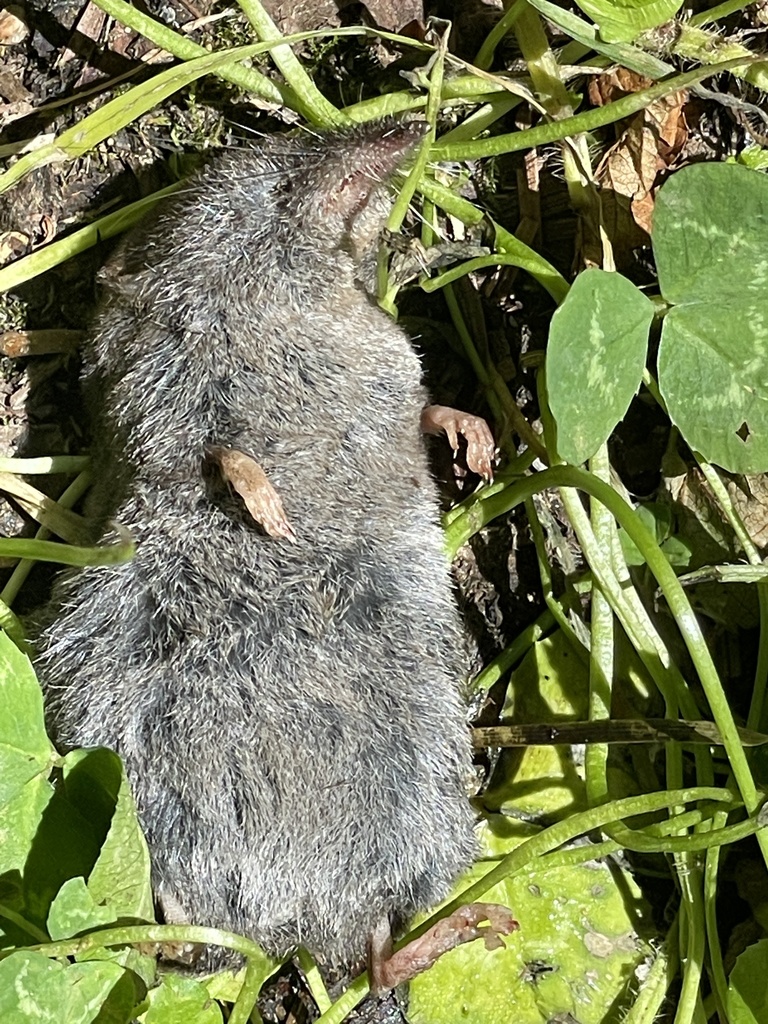
no rights reserved · CC0
Family: Soricidae · Class: Mammalia · Order: Eulipotyphla
Sorex vagrans (Vagrant Shrew) is a California animal in the Soricidae family.
The vagrant shrew is a small, dark-colored mammal belonging to the family Soricidae. Adults measure 95 to 110 mm (3.7 to 4.3 inches) in total length, with a tail length of 35 to 45 mm (1.4 to 1.8 inches) comprising approximately one-third of the total body length. Body mass ranges from 4 to 8 grams (0.14 to 0.28 ounces). The dorsal pelage is dark brown to blackish-brown, grading to slightly paler grayish-brown on the ventral surface. The fur is dense and velvety in texture. The elongated, pointed snout extends well beyond the lower jaw, and the small eyes are barely visible in the dense fur. The ears are small and largely concealed by fur. Vagrant shrews occur throughout much of western North America, with populations distributed from British Columbia south to California and east to Montana and Colorado. In California, the species is found primarily in the northern and central regions, including the Coast Ranges, Sierra Nevada, and Cascade Range. Populations occur from near sea level to elevations exceeding 3,000 meters (9,800 feet) in montane environments. This species inhabits diverse forest and woodland environments, showing particular association with areas containing abundant leaf litter, fallen logs, and dense understory vegetation. Vagrant shrews occupy coniferous forests dominated by Douglas-fir, ponderosa pine, and mixed conifer stands, as well as deciduous and mixed woodlands. They utilize riparian areas, meadow edges, and forest clearings with sufficient ground cover. The species requires habitats with high invertebrate prey density and adequate moisture retention. Vagrant shrews are highly active predators with extremely high metabolic rates, requiring consumption of food equal to 80 to 90 percent of their body weight daily. Their diet consists primarily of small invertebrates including beetles, moth larvae, spiders, centipedes, and earthworms. Foraging occurs both day and night in short, intensive periods separated by brief rest intervals. The species constructs tunnel systems in leaf litter and soil, utilizing natural spaces under logs and rocks. Breeding occurs from March through September, with females producing two to three litters per year. Gestation lasts approximately 20 days, and litter sizes range from 2 to 9 young, typically averaging 5 to 6. Newborns are altricial, weighing less than 0.5 grams at birth. Sexual maturity is reached at 4 to 6 months of age. Lifespan in the wild rarely exceeds 18 months. Vagrant shrews are not federally or state-listed as threatened or endangered. According to NatureServe, the species has a conservation rank of G5 (globally secure) and populations appear stable across most of their range. However, localized population declines may occur due to habitat fragmentation, timber harvest practices that remove critical ground cover, and climate change impacts on forest ecosystems. The species' dependence on moist microhabitats makes it vulnerable to drought conditions and altered precipitation patterns.
Classification
Class: Mammalia · Order: Eulipotyphla · Family: Soricidae
Frequently asked questions
How is Sorex vagrans classified?
Sorex vagrans belongs to class Mammalia, order Eulipotyphla, family Soricidae.
What family does Sorex vagrans belong to?
Sorex vagrans is in the Soricidae family.
What is Sorex vagrans?
The vagrant shrew is a small, dark-colored mammal belonging to the family Soricidae.
Is Sorex vagrans found in California?
Yes. Sorex vagrans is recorded in California in The California Species Project's catalogue.
Related species
Other California species in the same genus, family, or bioregion.
Data from The California Species Project — 14,000+ California species with verified data from CNPS, CDFW, USFWS, and more.