Sorex vagrans halicoetes
Salt-marsh Wandering Shrew
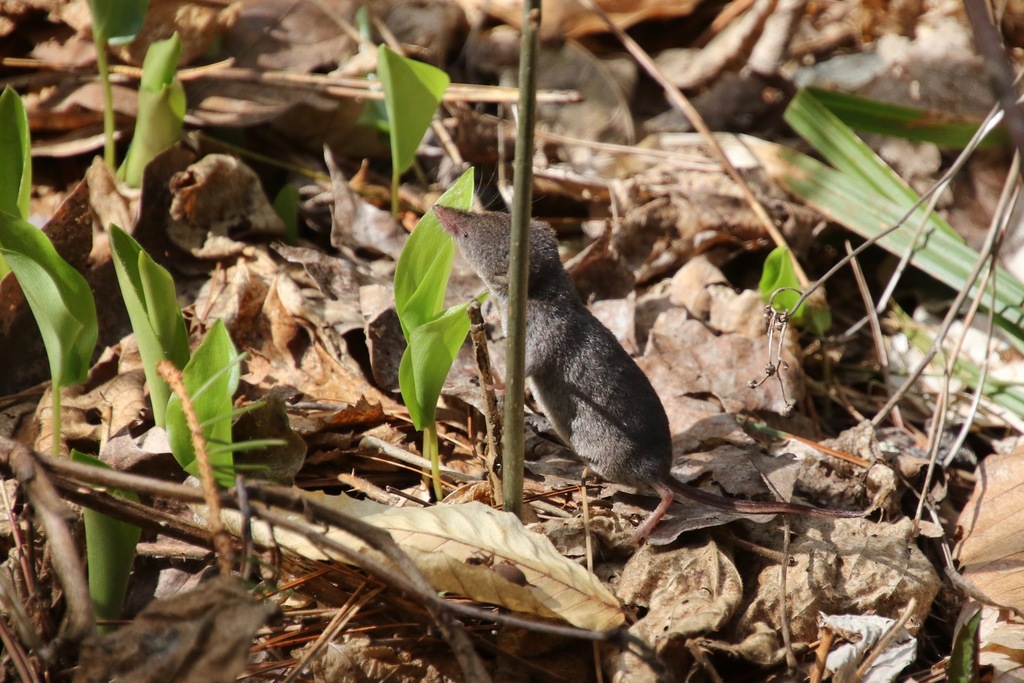
(c) er-birds, some rights reserved (CC BY) · licence
Family: Soricidae · Class: Mammalia · Order: Eulipotyphla
Conservation status: G5T1 S1
Sorex vagrans halicoetes (Salt-marsh Wandering Shrew) is a California animal in the Soricidae family.
The Salt-marsh Wandering Shrew is a small mammal endemic to the tidal marshes of the San Francisco Bay Estuary. This subspecies of the vagrant shrew (Sorex vagrans) was originally described by Grinnell in 1913 as a distinct species, Sorex halicoetes, based on a type specimen collected from salt marshes near Palo Alto in 1908 (USFWS 2013). Jackson later reclassified it as a subspecies of the widespread Sorex vagrans, noting its darker coat coloration compared to inland populations. Very little is known about the physical characteristics of this subspecies, though it presumably shares the general morphology of other vagrant shrews, with a small, elongated body typical of the Soricidae family. The Salt-marsh Wandering Shrew occurs exclusively in tidal marsh habitats of the San Francisco Bay Estuary. Its range is extremely restricted, encompassing only the salt marshes and brackish wetlands around San Francisco Bay. Historical records include collections from marshes near Palo Alto and other Bay Area locations. The species appears to be closely associated with the same tidal marsh ecosystems that support other endemic Bay Area species such as the salt marsh harvest mouse and California clapper rail. This subspecies inhabits the upper portions of tidal marshes, particularly areas dominated by pickleweed (Sarcocornia pacifica) and salt grass communities. It occupies the transition zones between the lower cordgrass (Spartina foliosa) marshes and the higher elevation upland areas. The species requires the complex microhabitat structure provided by dense marsh vegetation, which offers both foraging opportunities and protection from predators and tidal flooding. Like other shrews, the Salt-marsh Wandering Shrew is presumably insectivorous, feeding on small invertebrates found within the marsh substrate and vegetation. Shrews have extremely high metabolic rates and must consume food equivalent to their body weight daily to survive. The species likely forages actively throughout both day and night, searching for prey items such as small beetles, spiders, and other arthropods that inhabit the marsh environment. Specific details about reproduction, seasonal activity patterns, and social behavior have not been documented for this subspecies. The Salt-marsh Wandering Shrew is not federally listed but carries a Global/State conservation rank of G5T1 S1, indicating it is critically imperiled in California and globally as a subspecies. The species faces significant conservation challenges due to the extensive loss and degradation of San Francisco Bay tidal marshes over the past century. Habitat loss from urban development, diking, and filling of marshes has reduced suitable habitat by over 95 percent region-wide. The U.S. Fish and Wildlife Service includes this species as a Species of Concern in its Recovery Plan for Tidal Marsh Ecosystems of Northern and Central California (USFWS 2013). Current threats include continued habitat fragmentation, sea level rise, invasive species, and altered hydrology from development. The species' extremely restricted range and specialized habitat requirements make it particularly vulnerable to environmental changes and local extinctions.
Classification
Class: Mammalia · Order: Eulipotyphla · Family: Soricidae
Conservation status
G5T1 S1
Frequently asked questions
How is Sorex vagrans halicoetes classified?
Sorex vagrans halicoetes belongs to class Mammalia, order Eulipotyphla, family Soricidae.
What family does Sorex vagrans halicoetes belong to?
Sorex vagrans halicoetes is in the Soricidae family.
Is Sorex vagrans halicoetes protected or of conservation concern?
Sorex vagrans halicoetes carries the following status: G5T1 S1.
What is Sorex vagrans halicoetes?
The Salt-marsh Wandering Shrew is a small mammal endemic to the tidal marshes of the San Francisco Bay Estuary.
Is Sorex vagrans halicoetes found in California?
Yes. Sorex vagrans halicoetes is recorded in California in The California Species Project's catalogue.
Related species
Other California species in the same genus, family, or bioregion.
Data from The California Species Project — 14,000+ California species with verified data from CNPS, CDFW, USFWS, and more.