Sparganothis unifasciana
One-lined Sparganothis
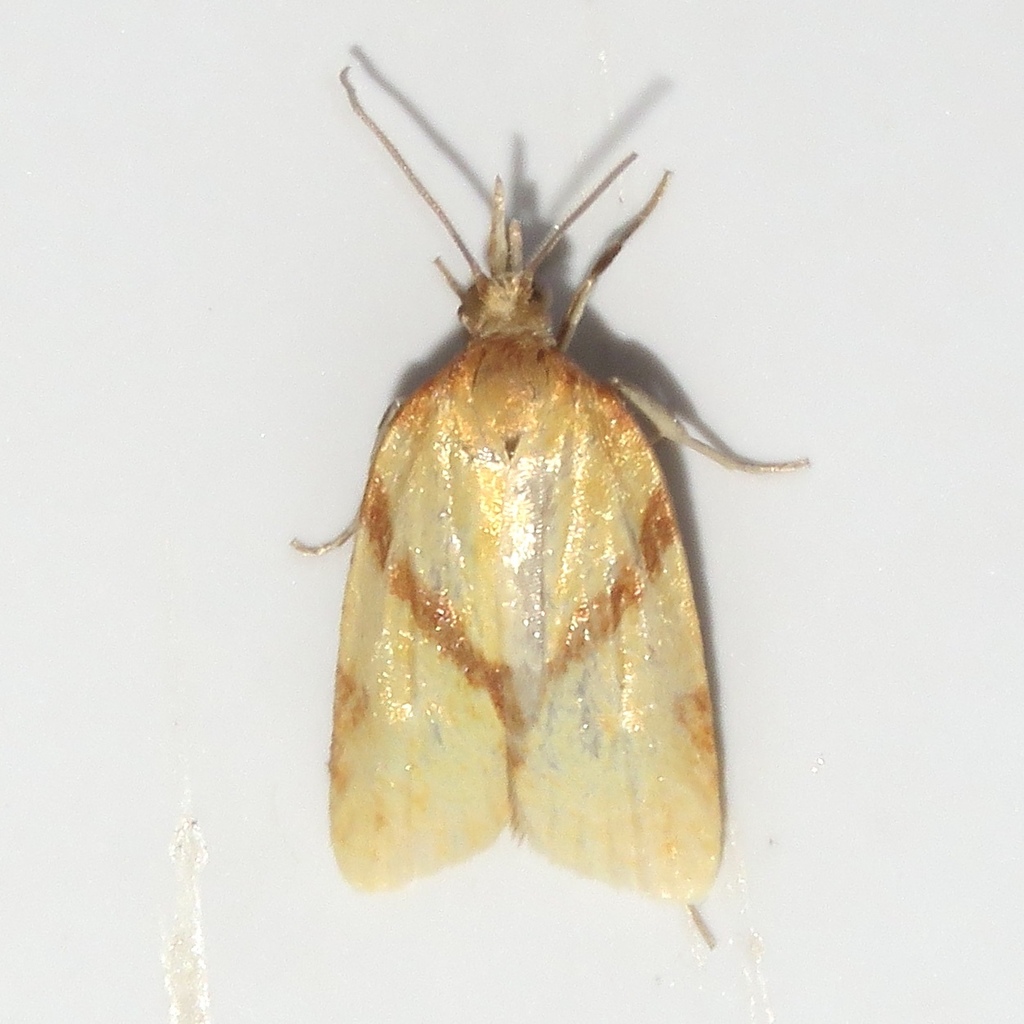
(c) Dan MacNeal, some rights reserved (CC BY) · licence
Family: Tortricidae · Class: Insecta · Order: Lepidoptera
Sparganothis unifasciana (One-lined Sparganothis) is a California animal in the Tortricidae family.
The One-lined Sparganothis is a moderately large tortricid moth with a wingspan ranging from 20 to 25 mm (0.8 to 1.0 inches). The forewings display a distinctive dark yellow ground color marked with a unique pattern of brown markings that distinguish it from other Sparganothis species (Pogue & Lavigne 1981). The specific arrangement of these brown marks on the yellow forewings provides the primary identification characteristic for this species. Sparganothis unifasciana occurs across a broad range of North America, extending from boreal forests in the north to more temperate regions in the south. In California, the species has been documented from various elevations and habitats, though specific county records within the state require further documentation. The species appears to have a transcontinental distribution, with records extending into Alberta, Canada, where it represents a notable northern range extension (Pohl et al. 2005). Like other members of the Sparganothini tribe, this species likely inhabits areas supporting diverse dicotyledenous vegetation. The larvae of most Sparganothini are polyphagous leaf-rollers that feed primarily on foliage, flowers, and fruit of various plant families, creating shelters from rolled or webbed leaves of their host plants. While some Sparganothini species specialize on conifers, most utilize broadleaf plants across multiple families. Specific host plant associations for S. unifasciana have not been well documented in the available literature. The larvae exhibit typical tortricid behavior, feeding within protective shelters constructed from host plant leaves. Adult flight periods and seasonal activity patterns for this species require further study, though related Sparganothis species typically show distinct seasonal emergence patterns. The reproductive biology follows the general Sparganothini pattern, with females likely depositing eggs in masses covered by a protective secretion that extends beyond the edge of the egg mass. The conservation status of Sparganothis unifasciana has not been formally assessed. The species lacks federal or state protection status, and specific population trends remain undocumented. Like many microlepidopteran species, S. unifasciana may face threats from habitat modification and loss, particularly given the polyphagous feeding habits typical of the genus that make them dependent on diverse plant communities. Climate change impacts on both the species and its host plants represent potential long-term concerns. Detailed ecological studies of this species are lacking. The information presented here synthesizes available taxonomic and distributional data from BugGuide, regional lepidopteran surveys, and scientific literature. The tribe Sparganothini includes several economically important agricultural pests, though S. unifasciana does not appear to have documented pest status. Further research is needed to document specific host plant relationships, detailed life history characteristics, and population status across the species' range.
Classification
Class: Insecta · Order: Lepidoptera · Family: Tortricidae
Frequently asked questions
How is Sparganothis unifasciana classified?
Sparganothis unifasciana belongs to class Insecta, order Lepidoptera, family Tortricidae.
What family does Sparganothis unifasciana belong to?
Sparganothis unifasciana is in the Tortricidae family.
What is Sparganothis unifasciana?
The One-lined Sparganothis is a moderately large tortricid moth with a wingspan ranging from 20 to 25 mm (0.8 to 1.0 inches).
Is Sparganothis unifasciana found in California?
Yes. Sparganothis unifasciana is recorded in California in The California Species Project's catalogue.
Related species
Other California species in the same genus, family, or bioregion.
Data from The California Species Project — 14,000+ California species with verified data from CNPS, CDFW, USFWS, and more.