Spatula clypeata
Northern Shoveler
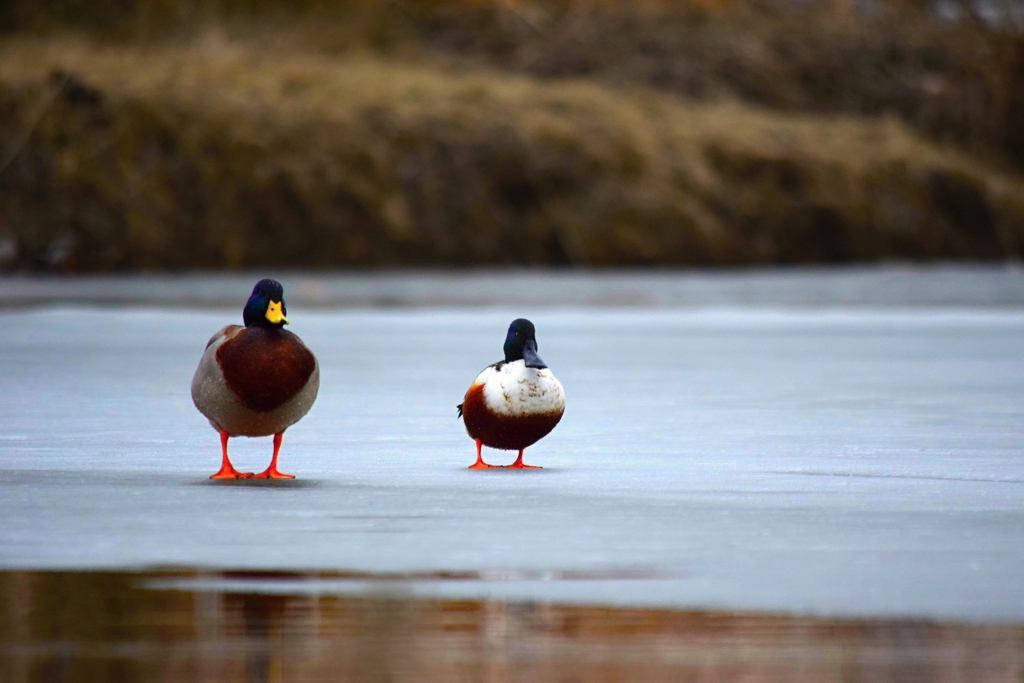
(c) Daniel Benák, some rights reserved (CC BY) · licence
Family: Anatidae · Class: Aves · Order: Anseriformes
Spatula clypeata (Northern Shoveler) is a California animal in the Anatidae family.
The Northern Shoveler is a medium-sized dabbling duck distinguished by its distinctive spatulate bill, which measures 65-70 mm (2.6-2.8 inches) in length and is nearly twice as wide at the tip as at the base. Adult males in breeding plumage display iridescent green heads, white breasts, and chestnut flanks, with pale blue wing coverts visible in flight. Females are mottled brown throughout with the same characteristic oversized bill. Both sexes measure 43-53 cm (17-21 inches) in length with a wingspan of 70-84 cm (28-33 inches), weighing 400-1,000 grams (0.9-2.2 pounds). Northern Shovelers breed across much of western and northern North America, with California supporting both breeding and wintering populations. The species breeds primarily in the Central Valley, northeastern California, and scattered locations in the Sierra Nevada foothills. During winter, large concentrations occur throughout the Central Valley, San Francisco Bay Area, and coastal regions south to the Mexican border. Major wintering areas include the Sacramento-San Joaquin Delta, Suisun Marsh, and Imperial Valley. The species inhabits shallow wetlands with muddy substrates and abundant invertebrate populations. Preferred habitats include freshwater and brackish marshes, seasonal wetlands, flooded agricultural fields, sewage treatment ponds, and managed waterfowl areas. Breeding pairs select sites with emergent vegetation for nesting cover, typically within 100 meters of water. Optimal water depths range from 10-60 cm (4-24 inches), allowing effective foraging with their specialized bills. Northern Shovelers employ a unique feeding strategy, using their lamellae-lined bills to filter small invertebrates, seeds, and algae from water and mud. They often feed in groups, swimming in tight circles to create feeding vortexes that concentrate prey. The breeding season extends from March through July, with peak nesting in April and May. Females construct ground nests in dense vegetation, laying 8-12 cream-colored eggs. Incubation lasts 23-25 days, with ducklings fledging at 52-65 days of age. Northern Shovelers are highly gregarious outside the breeding season, forming flocks of hundreds to thousands of individuals. The Northern Shoveler is not federally or state listed and maintains stable populations across most of its range. The North American Waterfowl Management Plan estimates the continental breeding population at approximately 4.5 million birds, with long-term trends showing relative stability. In California, the species benefits from waterfowl habitat conservation programs, including the Central Valley Joint Venture and North American Waterfowl Management Plan initiatives. Primary conservation concerns include wetland habitat loss, drought impacts on breeding success, and climate change effects on precipitation patterns. The California Waterfowl Association and Ducks Unlimited have protected and restored thousands of acres of shoveler habitat through conservation easements and habitat enhancement projects.
Classification
Class: Aves · Order: Anseriformes · Family: Anatidae
Frequently asked questions
How is Spatula clypeata classified?
Spatula clypeata belongs to class Aves, order Anseriformes, family Anatidae.
What family does Spatula clypeata belong to?
Spatula clypeata is in the Anatidae family.
What is Spatula clypeata?
The Northern Shoveler is a medium-sized dabbling duck distinguished by its distinctive spatulate bill, which measures 65-70 mm (2.6-2.8 inches) in length and is nearly twice as wide at the tip as at the base.
Is Spatula clypeata found in California?
Yes. Spatula clypeata is recorded in California in The California Species Project's catalogue.
Related species
Other California species in the same genus, family, or bioregion.
Data from The California Species Project — 14,000+ California species with verified data from CNPS, CDFW, USFWS, and more.