Spatula cyanoptera
Cinnamon Teal
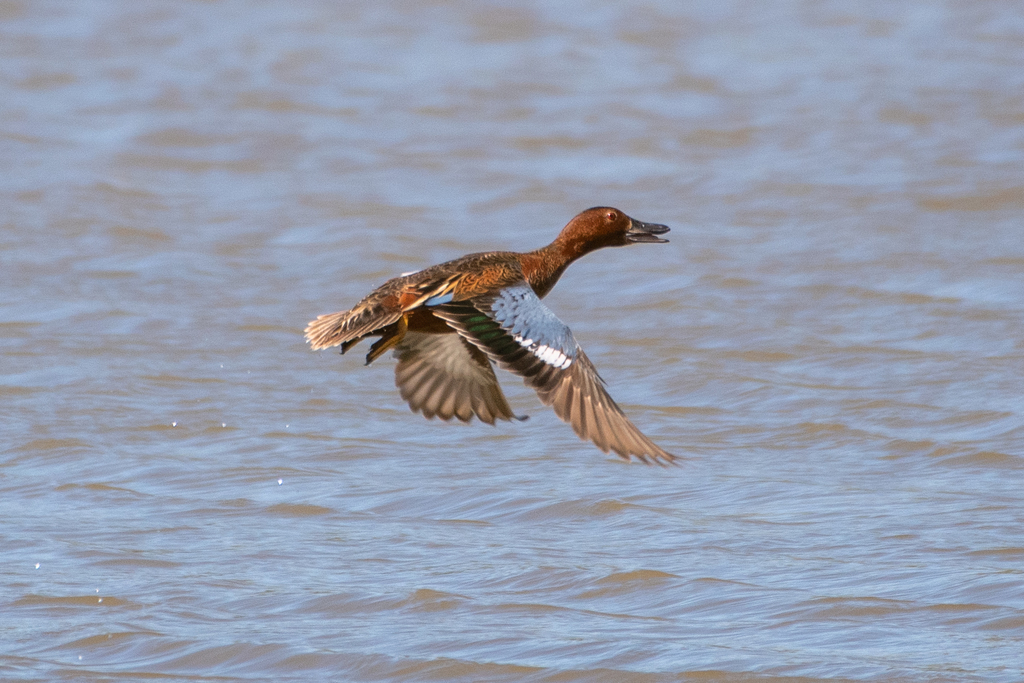
(c) Jonathan Eisen, some rights reserved (CC BY) · licence
Family: Anatidae · Class: Aves · Order: Anseriformes
Spatula cyanoptera (Cinnamon Teal) is a California animal in the Anatidae family.
The Cinnamon Teal is a medium-sized dabbling duck native to western North America. Adult males in breeding plumage display distinctive cinnamon-red plumage on the head, neck, and body, with darker backs and bright blue wing patches (specula) bordered by white. Males measure 38 to 43 cm (15 to 17 inches) in length with a wingspan of 61 to 71 cm (24 to 28 inches). Females are mottled brown overall with similar blue wing patches, resembling female Blue-winged Teal but typically showing warmer brown tones. Both sexes have spatulate bills adapted for filter feeding, with males displaying bright orange-yellow eyes during breeding season. Cinnamon Teal breed across much of western North America, from British Columbia south to Argentina. In California, the species breeds primarily in the Central Valley, northeastern regions including the Modoc Plateau, and scattered locations in the Sierra Nevada foothills and coastal areas. During winter, California populations are supplemented by migrants from northern breeding areas, with concentrations in the Central Valley, San Francisco Bay area, and southern California coastal wetlands. The species occurs from sea level to approximately 2,400 meters (7,900 feet) elevation. This species inhabits shallow freshwater wetlands including marshes, ponds, irrigation canals, flooded agricultural fields, and seasonal wetlands. Breeding habitat requires emergent vegetation for nesting cover and open water areas for foraging. Optimal sites feature water depths of 15 to 61 cm (6 to 24 inches) with abundant submerged and floating aquatic vegetation. During migration and winter, Cinnamon Teal utilize managed wetlands, rice fields, and brackish marshes. Cinnamon Teal are omnivorous, feeding primarily on seeds of aquatic plants, small invertebrates, and algae obtained through dabbling and surface gleaning. During breeding season, protein requirements increase, with females consuming more invertebrates including chironomid larvae, amphipods, and gastropods. Breeding occurs from April through July, with peak nesting in May and June. Females construct nests in dense vegetation, typically within 100 meters of water. Clutch size ranges from 7 to 12 eggs, with an incubation period of 21 to 25 days. Ducklings are precocial and capable of flight at 7 weeks of age. Cinnamon Teal populations appear stable across most of their range, with the species not currently listed under federal or California endangered species acts. The North American Breeding Bird Survey indicates relatively stable population trends from 1966 to 2019, though regional variations exist. Primary conservation concerns include wetland loss and degradation, particularly in California's Central Valley where over 95% of historical wetlands have been eliminated. Climate change may affect breeding success through altered precipitation patterns and increased drought frequency. Water management practices, agricultural conversion, and urban development continue to impact available habitat. Conservation efforts focus on wetland restoration and protection through programs like the North American Waterfowl Management Plan and California's Wildlife Conservation Board initiatives.
Classification
Class: Aves · Order: Anseriformes · Family: Anatidae
Frequently asked questions
How is Spatula cyanoptera classified?
Spatula cyanoptera belongs to class Aves, order Anseriformes, family Anatidae.
What family does Spatula cyanoptera belong to?
Spatula cyanoptera is in the Anatidae family.
What is Spatula cyanoptera?
The Cinnamon Teal is a medium-sized dabbling duck native to western North America.
Is Spatula cyanoptera found in California?
Yes. Spatula cyanoptera is recorded in California in The California Species Project's catalogue.
Related species
Other California species in the same genus, family, or bioregion.
Data from The California Species Project — 14,000+ California species with verified data from CNPS, CDFW, USFWS, and more.