Spatula discors
Blue-winged Teal
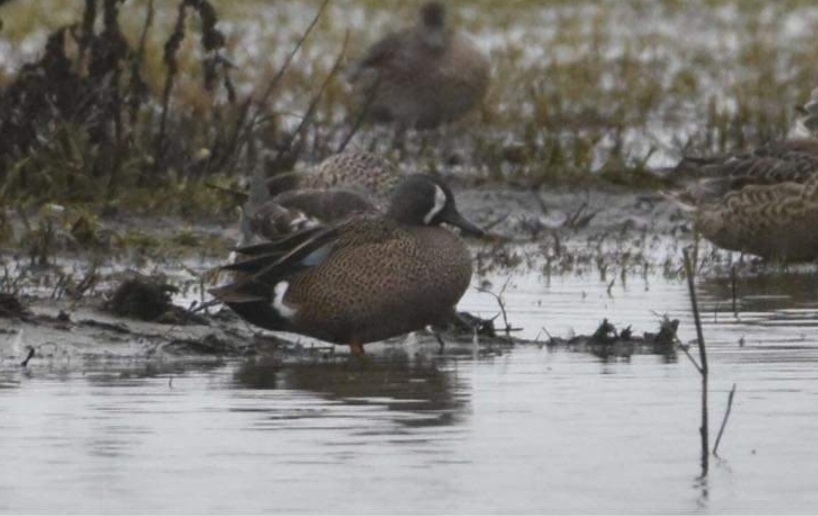
(c) Quentin Benet-Cibois, some rights reserved (CC BY) · licence
Family: Anatidae · Class: Aves · Order: Anseriformes
Spatula discors (Blue-winged Teal) is a California animal in the Anatidae family.
The Blue-winged Teal is a small dabbling duck measuring 37 to 41 cm (14.5 to 16 inches) in length with a wingspan of 56 to 64 cm (22 to 25 inches). Adult males in breeding plumage display a distinctive white crescent in front of each eye, contrasting with a slate-blue head and neck. The body is brownish with dark spotting, and both sexes exhibit prominent powder-blue wing patches visible in flight and at rest. Females and non-breeding males are mottled brown overall with the characteristic blue wing coverts. The bill is dark gray to black, and legs are yellowish to orange. Blue-winged Teal breed primarily in the prairie pothole region of the northern Great Plains and western Canada, with breeding range extending into California's Central Valley and northeastern regions. The species occurs throughout California during migration, with concentrations in the Central Valley, San Francisco Bay, and coastal wetlands. Winter populations are found primarily in Central and Imperial valleys, with smaller numbers along the coast. The species demonstrates one of the longest migration routes among North American waterfowl, with some individuals traveling from Alaska to South America. This species inhabits shallow freshwater and brackish wetlands, including marshes, ponds, flooded agricultural fields, and seasonal wetlands. Blue-winged Teal prefer areas with emergent vegetation such as cattails and sedges, along with open water for feeding. During migration and winter, they utilize rice fields, managed wetlands, and restored habitats. Optimal breeding habitat includes prairie potholes and seasonal wetlands with water depths of 15 to 61 cm (6 to 24 inches). Blue-winged Teal are omnivorous, feeding on aquatic invertebrates, seeds, and plant matter. Their diet includes midges, mayflies, snails, crustaceans, and seeds of smartweeds, sedges, and pondweeds. During breeding season, protein-rich invertebrates comprise a larger portion of their diet. The species feeds primarily by dabbling at the surface and filtering water through specialized bill structures. Breeding occurs from April through July, with females constructing ground nests in dense vegetation near water. Clutch size ranges from 6 to 14 eggs, with an incubation period of 21 to 27 days. Ducklings fledge at approximately 35 to 44 days. Blue-winged Teal are not federally or state listed but face population pressures from habitat loss and degradation. According to the North American Bird Conservation Initiative, the species has experienced moderate population declines since the 1960s. Primary threats include drainage and conversion of wetland habitats, agricultural intensification, and climate change impacts on breeding areas. The species benefits from wetland conservation programs including the North American Waterfowl Management Plan and California's Central Valley Joint Venture. Conservation efforts focus on protecting and restoring seasonal wetlands, managing water levels in existing habitats, and maintaining connectivity between breeding and wintering areas.
Classification
Class: Aves · Order: Anseriformes · Family: Anatidae
Frequently asked questions
How is Spatula discors classified?
Spatula discors belongs to class Aves, order Anseriformes, family Anatidae.
What family does Spatula discors belong to?
Spatula discors is in the Anatidae family.
What is Spatula discors?
The Blue-winged Teal is a small dabbling duck measuring 37 to 41 cm (14.5 to 16 inches) in length with a wingspan of 56 to 64 cm (22 to 25 inches).
Is Spatula discors found in California?
Yes. Spatula discors is recorded in California in The California Species Project's catalogue.
Related species
Other California species in the same genus, family, or bioregion.
Data from The California Species Project — 14,000+ California species with verified data from CNPS, CDFW, USFWS, and more.