Spea intermontana
Great Basin Spadefoot
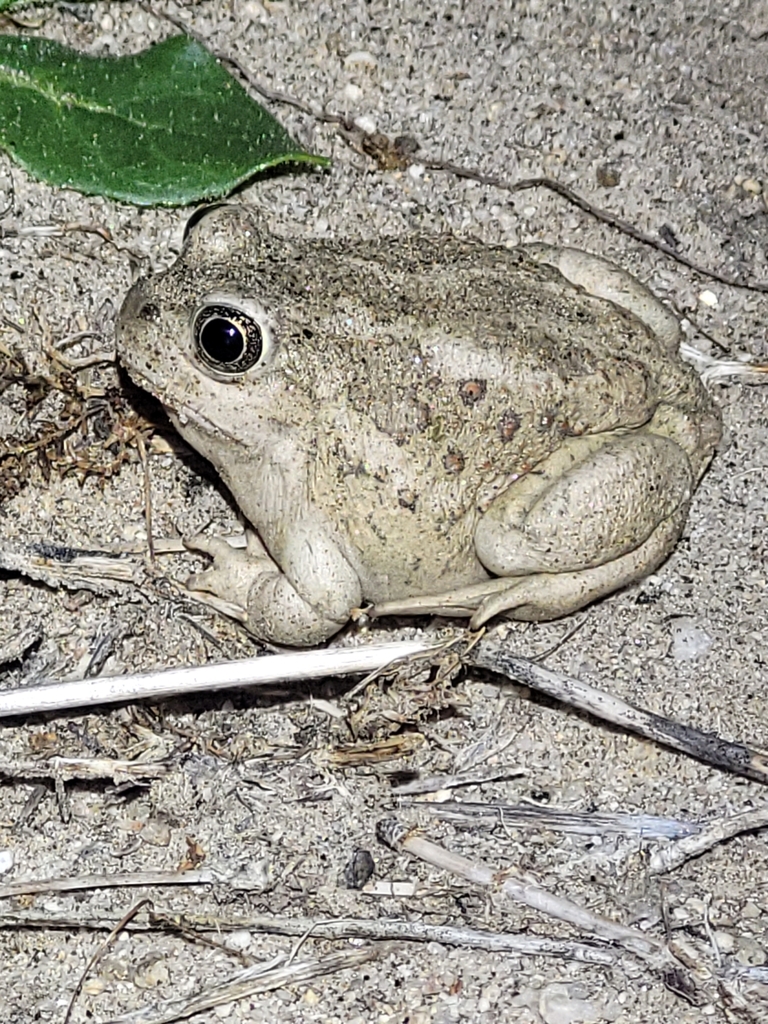
(c) RJ Baltierra, some rights reserved (CC BY) · licence
Family: Scaphiopodidae · Class: Amphibia · Order: Anura
Spea intermontana (Great Basin Spadefoot) is a California animal in the Scaphiopodidae family.
The Great Basin spadefoot (Spea intermontana) is a medium-sized burrowing toad endemic to the western United States. Adults measure 37 to 62 mm (1.5 to 2.4 inches) in snout-vent length, with females typically larger than males. The dorsal surface ranges from gray to brown or olive, marked with irregular dark blotches and light-colored tubercles. A distinctive pale stripe often extends from the snout over the head. The ventral surface is whitish to cream-colored. The species is distinguished by prominent metatarsal tubercles on the hind feet, which are hardened and wedge-shaped, enabling efficient digging in sandy soils. The Great Basin spadefoot occurs throughout much of the western United States, including portions of California's northeastern counties. The species ranges from southern British Columbia and Saskatchewan south through Washington, Oregon, Idaho, Montana, Wyoming, Utah, Colorado, Nevada, and extreme northeastern California. In California, populations are documented in Modoc and Lassen counties, representing the southwestern edge of the species' range. Historical records suggest a broader distribution in the state's northeastern region. This species inhabits arid and semi-arid environments characterized by sandy or gravelly soils suitable for burrowing. Preferred habitats include sagebrush scrub, pinyon-juniper woodland, and grassland communities at elevations ranging from 400 to 2,100 meters (1,300 to 6,900 feet). Great Basin spadefoots require temporary or ephemeral water bodies for reproduction, including seasonal pools, stock tanks, irrigation ditches, and flooded areas. Adults spend most of their lives underground in self-excavated burrows, which may extend 20 to 91 cm (8 to 36 inches) below the surface. Great Basin spadefoots are fossorial amphibians that emerge from their burrows primarily during periods of adequate soil moisture, typically following significant rainfall events. Adults are nocturnal and feed on a variety of arthropods, including beetles, ants, moths, and spiders. Breeding occurs opportunistically in response to rainfall that creates suitable aquatic habitat, typically from April through July. Males call from shallow water with a loud, metallic trill lasting 1 to 3 seconds. Females deposit 300 to 800 eggs in small clusters attached to vegetation or debris in temporary pools. Tadpoles develop rapidly, completing metamorphosis in 6 to 10 weeks depending on water temperature and availability. The Great Basin spadefoot is not federally listed under the Endangered Species Act, and its global conservation status is considered stable. However, populations face threats from habitat loss due to agricultural conversion, urban development, and water diversions that eliminate breeding sites. Climate change poses additional risks through altered precipitation patterns and increased drought frequency. In California, the species' limited range and dependence on ephemeral wetlands make local populations vulnerable to habitat modifications. Conservation efforts focus on protecting remaining breeding sites and maintaining connectivity between fragmented populations.
Classification
Class: Amphibia · Order: Anura · Family: Scaphiopodidae
Frequently asked questions
How is Spea intermontana classified?
Spea intermontana belongs to class Amphibia, order Anura, family Scaphiopodidae.
What family does Spea intermontana belong to?
Spea intermontana is in the Scaphiopodidae family.
What is Spea intermontana?
The Great Basin spadefoot (Spea intermontana) is a medium-sized burrowing toad endemic to the western United States.
Is Spea intermontana found in California?
Yes. Spea intermontana is recorded in California in The California Species Project's catalogue.
Related species
Other California species in the same genus, family, or bioregion.
Data from The California Species Project — 14,000+ California species with verified data from CNPS, CDFW, USFWS, and more.