Speranza lorquinaria
Lorquin's Angle
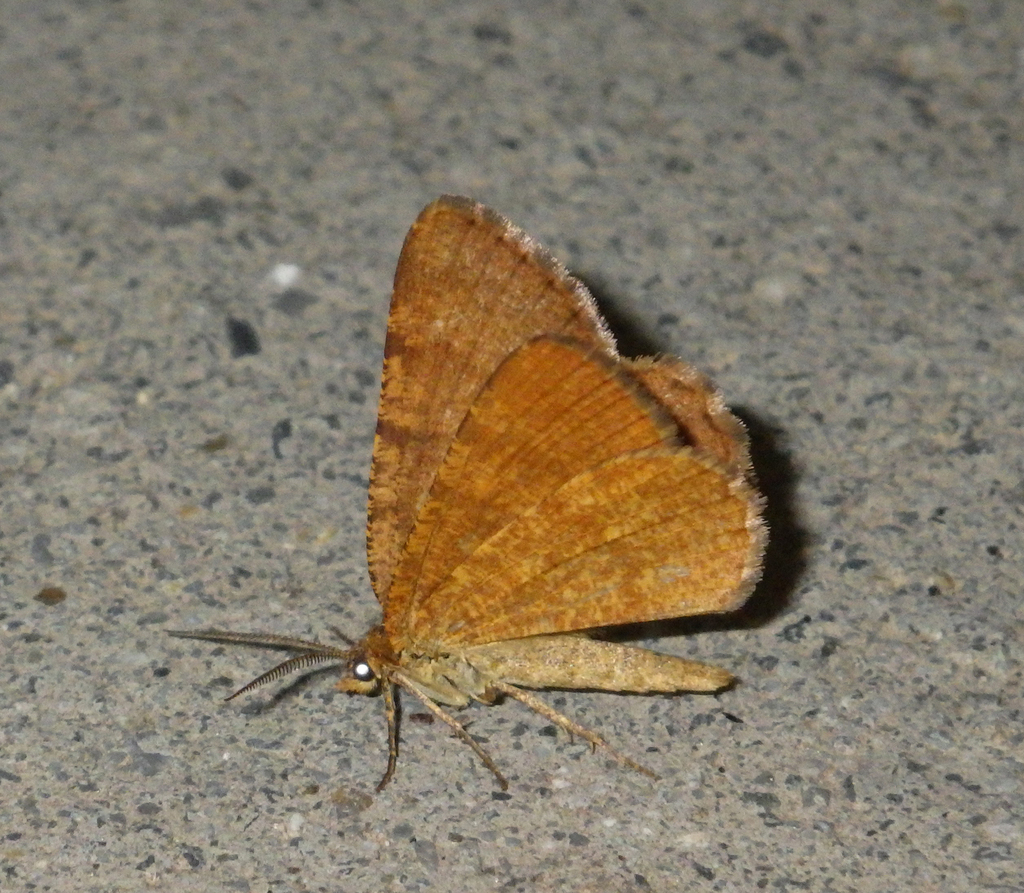
no rights reserved · CC0
Family: Geometridae · Class: Insecta · Order: Lepidoptera
Speranza lorquinaria (Lorquin's Angle) is a California animal in the Geometridae family.
Lorquin's Angle (Macaria lorquinaria) is a small geometrid moth in the subfamily Ennominae. Adults have a wingspan of 26-27 mm, with light gray to brownish-yellow forewings marked by distinctive dark features: three dark subterminal spots (two near the costa and one midway), a gently wavy postmedial line, a straight antemedial line, and an oblique discal dash (Grokipedia). The hindwings are paler with faint markings. The species' common name reflects the angled wing posture characteristic of geometrid moths at rest. This moth ranges across western North America from California north to British Columbia, Canada, and extends eastward to Montana (BugGuide). The species inhabits coniferous and mixed deciduous forests throughout this range. No specific elevation preferences have been documented, though the species appears associated with forest ecosystems containing its host plants. Lorquin's Angle occupies forest habitats where its larval host plants occur. The species utilizes trees from multiple families: Betulaceae including alder (Alnus) and birch (Betula), Salicaceae including willow (Salix) and poplar (Populus), and Pinaceae including grand fir (Abies grandis), Douglas-fir (Pseudotsuga menziesii), and spruce (Picea) (Grokipedia). This broad host range allows the species to persist across diverse western North American forest types. Adults are nocturnal and attracted to light, with flight activity occurring from May to September and peak abundance in July and August (BugGuide, Grokipedia). In California specifically, adults fly from May to August. Larvae are green and twig-like, providing camouflage while feeding on foliage of their host trees. The cryptic coloration helps protect them from predation during their arboreal feeding phase. Details of overwintering biology, mating behavior, and generation number have not been well documented. Originally described as Tephrina lorquinaria by Achille Guenée in 1858, this species has undergone several taxonomic revisions. The species was named to honor Pierre Joseph Michel Lorquin (1797-1873), a French entomologist who collected extensively in California during the Gold Rush era. Current taxonomy places the species in the genus Macaria, though some North American classifications continue to use Speranza. Recent phylogenetic studies of the Ennominae support placement in Macaria (Grokipedia). No federal or state conservation status has been assigned to Lorquin's Angle. The species is considered stable across its range with no known conservation concerns. Its broad host plant range and extensive distribution across western North American forests suggest resilience to localized habitat changes. However, large-scale forest management practices and climate-driven changes in forest composition could potentially affect populations, though specific impacts have not been studied.
Classification
Class: Insecta · Order: Lepidoptera · Family: Geometridae
Frequently asked questions
How is Speranza lorquinaria classified?
Speranza lorquinaria belongs to class Insecta, order Lepidoptera, family Geometridae.
What family does Speranza lorquinaria belong to?
Speranza lorquinaria is in the Geometridae family.
What is Speranza lorquinaria?
Lorquin's Angle (Macaria lorquinaria) is a small geometrid moth in the subfamily Ennominae.
Is Speranza lorquinaria found in California?
Yes. Speranza lorquinaria is recorded in California in The California Species Project's catalogue.
Related species
Other California species in the same genus, family, or bioregion.
Data from The California Species Project — 14,000+ California species with verified data from CNPS, CDFW, USFWS, and more.