Speyeria adiaste adiaste
Unsilvered Fritillary
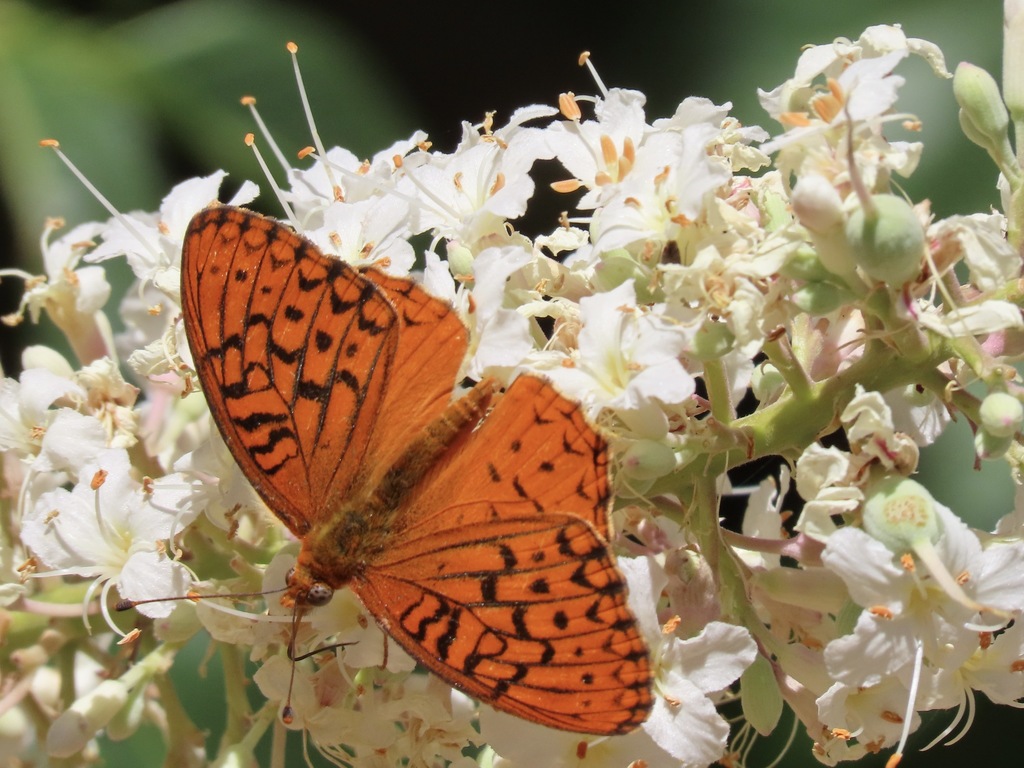
(c) John Hibbard, some rights reserved (CC BY) · licence
Family: Nymphalidae · Class: Insecta · Order: Lepidoptera
Conservation status: G1G2T1 S1S2
Speyeria adiaste adiaste (Unsilvered Fritillary) is a California animal in the Nymphalidae family.
The Unsilvered Fritillary (Speyeria adiaste adiaste) is a medium-sized butterfly endemic to California's central coast region. Adults display the characteristic fritillary wing pattern with orange-brown forewings marked by black lines and spots. The hindwings exhibit a distinctive pattern that gives this subspecies its common name - unlike most fritillaries, the ventral hindwing surface lacks the typical bright silver spots, instead showing a muted orange-brown coloration with darker markings. Males typically measure 50-65 mm (2.0-2.6 inches) in wingspan, while females are slightly larger at 55-70 mm (2.2-2.8 inches). Historically, the Unsilvered Fritillary occurred along California's central coast from the San Francisco Bay Area south to San Luis Obispo County. Current populations are restricted to scattered locations in the Santa Cruz Mountains, with documented occurrences in San Mateo, Santa Clara, and Santa Cruz counties. The subspecies has experienced significant range contraction, with many historical sites no longer supporting viable populations. This subspecies inhabits coastal scrub, chaparral, and grassland communities at elevations ranging from near sea level to approximately 800 meters (2,600 feet). Adults are typically found in areas with a mosaic of open spaces and shrub cover, particularly where their host plants occur in proximity to nectar sources. The species requires violet species (Viola) as larval host plants, with larvae feeding exclusively on these plants during their development. Unsilvered Fritillaries exhibit a univoltine life cycle, producing one generation per year. Adults emerge in late spring to early summer, typically from May through July, with peak flight activity occurring in June. Males establish territories and engage in patrolling behavior to locate females. After mating, females scatter their eggs near violet host plants rather than depositing them directly on the plants. Larvae hatch in late summer but enter diapause until the following spring when they resume feeding on emerging violet growth. The species overwinters as partially grown caterpillars. The Unsilvered Fritillary receives a global rank of G1G2T1, indicating it is critically imperiled to imperiled globally, with the subspecies rank of T1 denoting critical imperilment. California ranks the subspecies as S1S2, reflecting its critically imperiled to imperiled status within the state. Primary threats include habitat loss and fragmentation due to urban development, agricultural conversion, and recreational activities. Fire suppression has altered natural fire regimes, leading to changes in plant community composition that may negatively impact both host plants and nectar sources. Climate change poses additional threats through altered precipitation patterns and increased drought stress on host plant communities. The subspecies' limited range and small, isolated populations make it particularly vulnerable to stochastic events and genetic bottlenecks. Conservation efforts focus on habitat protection, restoration of degraded areas, and monitoring of remaining populations to track population trends and inform management decisions.
Classification
Class: Insecta · Order: Lepidoptera · Family: Nymphalidae
Conservation status
G1G2T1 S1S2
Frequently asked questions
How is Speyeria adiaste adiaste classified?
Speyeria adiaste adiaste belongs to class Insecta, order Lepidoptera, family Nymphalidae.
What family does Speyeria adiaste adiaste belong to?
Speyeria adiaste adiaste is in the Nymphalidae family.
Is Speyeria adiaste adiaste protected or of conservation concern?
Speyeria adiaste adiaste carries the following status: G1G2T1 S1S2.
What is Speyeria adiaste adiaste?
The Unsilvered Fritillary (Speyeria adiaste adiaste) is a medium-sized butterfly endemic to California's central coast region.
Is Speyeria adiaste adiaste found in California?
Yes. Speyeria adiaste adiaste is recorded in California in The California Species Project's catalogue.
Related species
Other California species in the same genus, family, or bioregion.
Data from The California Species Project — 14,000+ California species with verified data from CNPS, CDFW, USFWS, and more.