Speyeria callippe
Callippe Fritillary
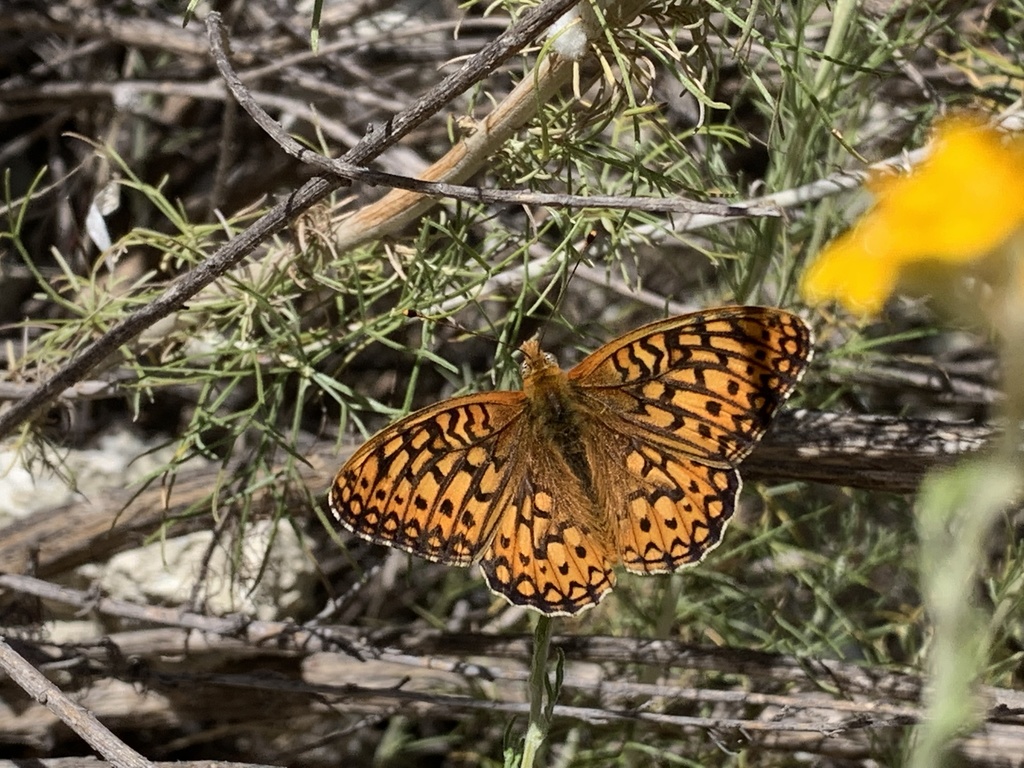
(c) william_hoyer, some rights reserved (CC BY) · licence
Family: Nymphalidae · Class: Insecta · Order: Lepidoptera
Speyeria callippe (Callippe Fritillary) is a California animal in the Nymphalidae family.
The Callippe fritillary is a medium-sized butterfly with distinctive orange and black markings characteristic of the greater fritillary group. Adults have a wingspan ranging from 57 to 75 mm (2.2 to 3.0 inches). The dorsal wing surfaces are bright orange with black spots and lines, while the ventral hindwings display silver-white spots against a brownish background. Males are typically smaller and more brightly colored than females, with distinctive scent patches (androconial patches) on the forewings used during courtship. The species can be distinguished from similar fritillaries by the specific arrangement of silver spots on the hindwing undersurface and the pattern of black markings on the dorsal forewings. Speyeria callippe has an extensive range across western North America, extending from central British Columbia east to South Dakota and Manitoba, south to southern California, Nevada, Utah, and Colorado. In California, the species occurs primarily in mountainous regions from the Cascade Range and Sierra Nevada to scattered locations in coastal ranges. Populations are documented from elevations ranging from approximately 1,200 to 3,000 meters (4,000 to 10,000 feet), with most occurrences in montane and subalpine zones. The Callippe fritillary inhabits open meadows, grasslands, and forest clearings within coniferous forest zones. Adults are commonly found in areas with abundant violet populations, including mountain meadows, forest edges, and disturbed areas such as logging clearings or burned sites where violets have colonized. The species requires areas with both nectar sources for adults and suitable violet host plants for larval development. Adults are active from late May through September, with peak flight periods varying by elevation and latitude. Males emerge first and establish territories in violet-rich areas where they await females. Mating occurs in summer, and females deposit eggs singly near or on violet plants. The eggs remain dormant through winter, hatching in early spring when young violet leaves become available. Larvae feed exclusively on violets, including Viola purpurea, V. pedunculata, V. beckwithii, V. douglasii, and V. nuttallii. Caterpillars are nocturnal feeders, spending daylight hours hidden at the base of host plants. The species completes one generation per year, with pupation occurring in late spring or early summer. Adult Callippe fritillaries are strong fliers and feed on a variety of flowering plants including thistles, mints, and composite flowers. Males exhibit territorial behavior, perching on prominent objects and chasing other butterflies that enter their territory. The species shows considerable geographic variation in size, coloration, and wing pattern, leading to the recognition of multiple subspecies across its range. The Callippe fritillary is not federally or state listed, though some localized populations may face pressures from habitat loss, particularly in areas experiencing development or changes in land management practices. The species' dependence on violet host plants makes it vulnerable to habitat degradation that affects these understory plants. Climate change may impact high-elevation populations through shifting temperature and precipitation patterns that affect both host plant availability and suitable habitat conditions.
Classification
Class: Insecta · Order: Lepidoptera · Family: Nymphalidae
Frequently asked questions
How is Speyeria callippe classified?
Speyeria callippe belongs to class Insecta, order Lepidoptera, family Nymphalidae.
What family does Speyeria callippe belong to?
Speyeria callippe is in the Nymphalidae family.
What is Speyeria callippe?
The Callippe fritillary is a medium-sized butterfly with distinctive orange and black markings characteristic of the greater fritillary group.
Is Speyeria callippe found in California?
Yes. Speyeria callippe is recorded in California in The California Species Project's catalogue.
Related species
Other California species in the same genus, family, or bioregion.
Data from The California Species Project — 14,000+ California species with verified data from CNPS, CDFW, USFWS, and more.