Speyeria callippe callippe
Callippe silverspot butterfly
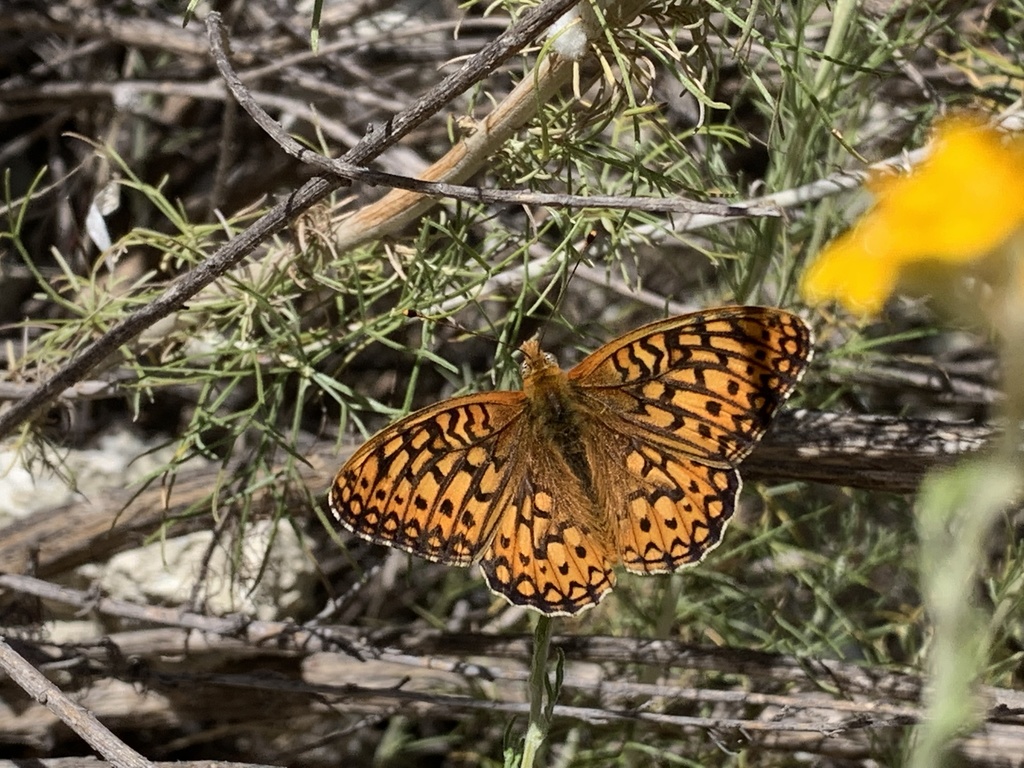
(c) william_hoyer, some rights reserved (CC BY) · licence
Family: Nymphalidae · Class: Insecta · Order: Lepidoptera
Conservation status: Endangered · G5T1 S1
Speyeria callippe callippe (Callippe silverspot butterfly) is a California animal in the Nymphalidae family.
The Callippe silverspot butterfly (Speyeria callippe callippe) is a medium-sized fritillary with distinctive orange and black markings. Adults have a wingspan of approximately 50-70 mm (2.0-2.8 inches). The dorsal wing surfaces are bright orange with black spots and markings, while the ventral hindwings display characteristic silver spots that give the species its common name. Males are typically smaller and more brightly colored than females, with distinct scent patches on their forewings. The species can be distinguished from other fritillaries by its specific pattern of silver spots on the underside of the hindwings and its relatively compact size. Historically, the Callippe silverspot was found around the eastern, southern, and western sides of San Francisco Bay. The species' range once extended throughout the San Francisco Bay Area, including areas now occupied by San Francisco, Oakland, and Berkeley. Currently, the butterfly is restricted to just seven sites, representing a dramatic reduction from its historical distribution. These remaining populations are scattered across isolated patches of suitable habitat in the greater San Francisco Bay region. The species inhabits native grasslands and adjacent habitats, typically on serpentine soils that support specialized plant communities. These grasslands are characterized by a mix of native bunch grasses, forbs, and the butterfly's essential host plant. The remaining habitat fragments are often found on hillsides and slopes where development has been limited by topography or soil conditions. Elevation ranges vary across sites but generally occur below 500 meters (1,640 feet). Females lay their eggs exclusively on Johnny-jump-up (Viola pedunculata), a native violet species that serves as the sole larval food plant. Adult butterflies are active from late March through early July, with peak flight activity typically occurring in May and June. Females deposit eggs singly near the host plant, and larvae develop through five instars before pupating. The species overwinters as first-instar larvae in a state of diapause. Adults feed on nectar from various native wildflowers, including thistles, mints, and composite flowers. Males establish territories and engage in mate-seeking behavior, often patrolling suitable habitat for receptive females. The U.S. Fish and Wildlife Service listed the Callippe silverspot butterfly as federally endangered in 1997. The species' decline is primarily attributed to habitat loss and degradation. The vast majority of potential habitat now lies beneath urban development in the San Francisco Bay Area. Remaining open areas within the butterfly's historical range are dominated by introduced plant species that do not support the native plant communities required by the species. Additional threats include cattle grazing, mining activities, and heavy recreational use of remaining habitat fragments. Invasive plants can outcompete native species, including the essential Johnny-jump-up host plant. Recovery efforts focus on habitat restoration, invasive species control, and protection of existing populations through land acquisition and management agreements.
Classification
Class: Insecta · Order: Lepidoptera · Family: Nymphalidae
Conservation status
Endangered · G5T1 S1
Frequently asked questions
How is Speyeria callippe callippe classified?
Speyeria callippe callippe belongs to class Insecta, order Lepidoptera, family Nymphalidae.
What family does Speyeria callippe callippe belong to?
Speyeria callippe callippe is in the Nymphalidae family.
Is Speyeria callippe callippe protected or of conservation concern?
Speyeria callippe callippe carries the following status: Endangered · G5T1 S1.
What is Speyeria callippe callippe?
The Callippe silverspot butterfly (Speyeria callippe callippe) is a medium-sized fritillary with distinctive orange and black markings.
Is Speyeria callippe callippe found in California?
Yes. Speyeria callippe callippe is recorded in California in The California Species Project's catalogue.
Related species
Other California species in the same genus, family, or bioregion.
Data from The California Species Project — 14,000+ California species with verified data from CNPS, CDFW, USFWS, and more.