Speyeria coronis
Coronis Fritillary
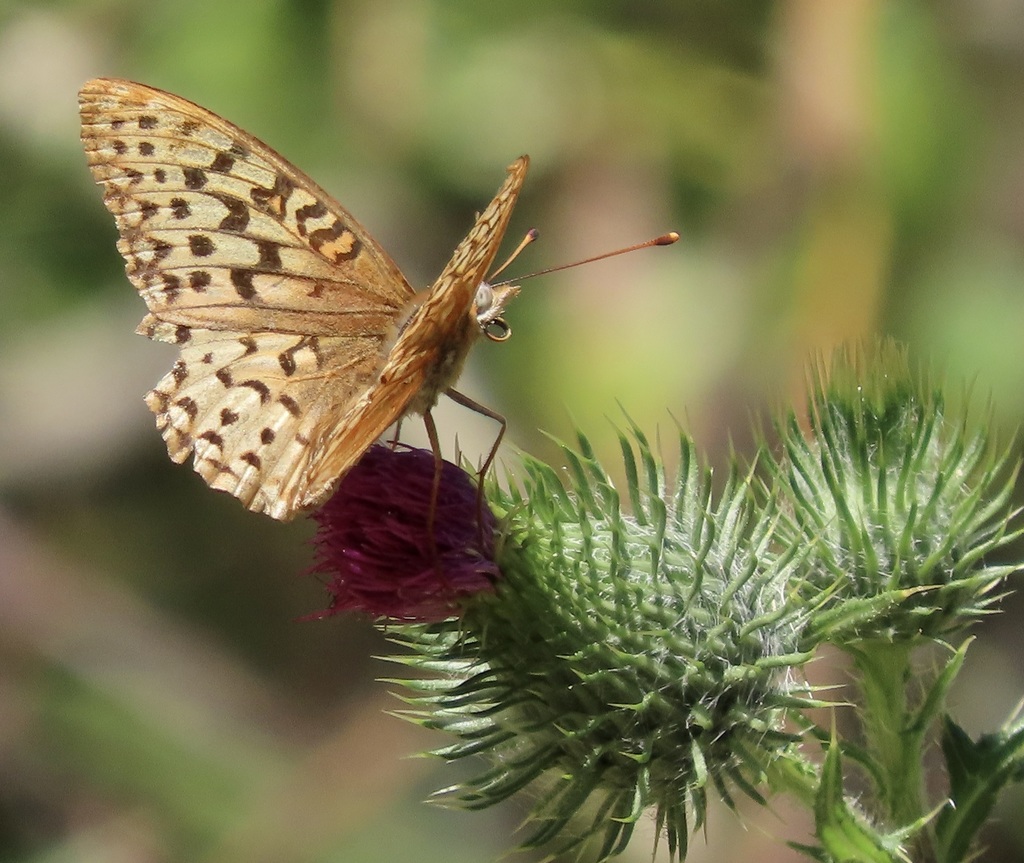
(c) John Hibbard, some rights reserved (CC BY) · licence
Family: Nymphalidae · Class: Insecta · Order: Lepidoptera
Speyeria coronis (Coronis Fritillary) is a California animal in the Nymphalidae family.
The Coronis fritillary is a medium to large butterfly with a wingspan ranging from 58 to 76 mm (2.3 to 3.0 inches). Males display bright orange dorsal wing surfaces with distinctive black markings, including a series of black spots and lines arranged in rows across both forewings and hindwings. Females are typically larger and darker, with more subdued orange coloration and heavier black markings. The ventral hindwings feature characteristic silver-white spots outlined in black, a key identification feature that distinguishes this species from similar fritillaries. The underside of the forewings shows a pale orange to yellowish coloration with black spotting. Speyeria coronis exhibits an extensive range across western North America, extending from southern Washington eastward through the Great Basin to central South Dakota, Wyoming, Nebraska, and Colorado. The species occurs south through Nevada and California to northwest Baja California Norte, Mexico. Within California, populations are documented in the Sierra Nevada, Cascade Range, Coast Ranges, and various mountain systems throughout the northern and central portions of the state. The species occurs at elevations ranging from approximately 300 to 3,000 meters (1,000 to 10,000 feet). This fritillary inhabits diverse montane and foothill environments, including open woodlands, chaparral, grasslands, meadows, and forest clearings. Adults are commonly observed in areas with scattered trees, particularly oak woodlands and mixed coniferous forests. The species shows a preference for areas with moderate to abundant wildflower blooms, which provide essential nectar sources. Suitable habitat typically includes south-facing slopes and ridge systems where host plants and nectar sources co-occur. Coronis fritillary larvae are specialized feeders that depend exclusively on various violet species, including Viola nuttallii, V. purpurea, V. douglasii, and V. beckwithii. Adult flight period typically extends from late June through September, with peak activity occurring in July and August. Males engage in hilltop territoriality, establishing territories on elevated areas where they patrol for receptive females. Females deposit eggs singly near violet host plants in late summer. The species overwinters as first-instar larvae, which remain dormant until spring when they resume feeding on emerging violet foliage. Adults are active nectaring butterflies, visiting a variety of flowering plants including thistles, mints, and composites. The Coronis fritillary currently holds no special conservation status at federal or state levels and is not listed under the California Endangered Species Act. The species maintains relatively stable populations across much of its range, though local populations may face pressures from habitat fragmentation, urban development, and altered fire regimes. Climate change poses potential long-term challenges through shifting vegetation zones and altered precipitation patterns that could affect both host plant availability and suitable habitat conditions. Conservation efforts focus on maintaining diverse montane habitats and preserving connectivity between populations through appropriate land management practices.
Classification
Class: Insecta · Order: Lepidoptera · Family: Nymphalidae
Frequently asked questions
How is Speyeria coronis classified?
Speyeria coronis belongs to class Insecta, order Lepidoptera, family Nymphalidae.
What family does Speyeria coronis belong to?
Speyeria coronis is in the Nymphalidae family.
What is Speyeria coronis?
The Coronis fritillary is a medium to large butterfly with a wingspan ranging from 58 to 76 mm (2.3 to 3.0 inches).
Is Speyeria coronis found in California?
Yes. Speyeria coronis is recorded in California in The California Species Project's catalogue.
Related species
Other California species in the same genus, family, or bioregion.
Data from The California Species Project — 14,000+ California species with verified data from CNPS, CDFW, USFWS, and more.