Speyeria cybele
Great Spangled Fritillary
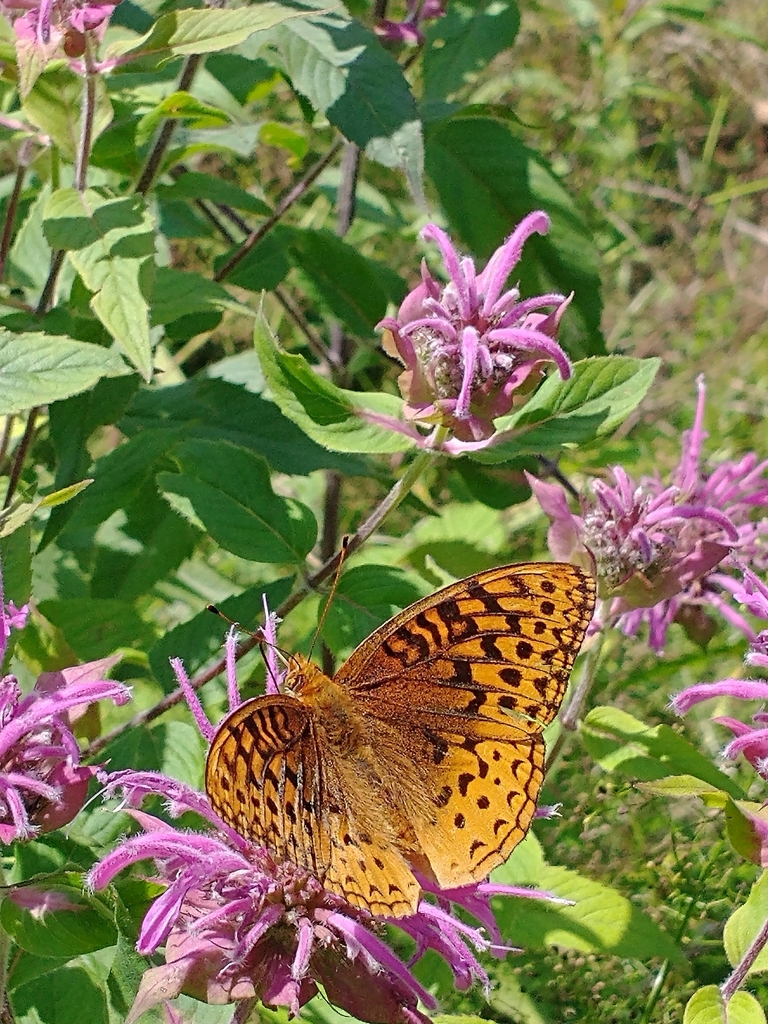
(c) Tom Norton, some rights reserved (CC BY) · licence
Family: Nymphalidae · Class: Insecta · Order: Lepidoptera
Speyeria cybele (Great Spangled Fritillary) is a California animal in the Nymphalidae family.
The Great Spangled Fritillary is a large butterfly with a wingspan ranging from 70 to 95 mm (2.8 to 3.7 inches). Males display bright orange dorsal wing surfaces with distinctive black markings, including chevron patterns near the wing borders and scattered spots across the forewings. The hindwings feature prominent black borders with a series of dark spots. Females are slightly larger and darker orange with heavier black markings. The ventral hindwings of both sexes show the characteristic silver spots that give fritillaries their name, along with a buff-colored band near the wing base. Males can be distinguished from females by their narrower forewings and the presence of scent patches along the forewings. The Great Spangled Fritillary ranges from Alberta east to Nova Scotia, extending south to central California, New Mexico, central Arkansas, and northern Georgia. This species represents the most common fritillary throughout most of the eastern United States. In California, populations occur primarily in mountainous regions and areas with suitable violet habitat. The western populations are generally smaller and may show slight variations in wing patterns compared to eastern specimens. This species inhabits meadows, prairies, pastures, and open woodlands where violet host plants occur. Great Spangled Fritillaries prefer areas with a mixture of open spaces for nectaring and shaded locations where violets grow. They are found from sea level to elevations of approximately 2,500 meters (8,200 feet) in mountainous regions. Adults require access to nectar sources including thistles, milkweeds, ironweed, and other composite flowers. Great Spangled Fritillaries have a complex life cycle closely tied to various violet species (Viola). Adults emerge in late June through early August and mate shortly after emergence. Females deposit eggs individually near but not directly on violet plants in late summer. The eggs remain dormant through winter, hatching the following spring when violet leaves become available. First-instar larvae locate and feed exclusively on violet foliage, developing through five instars before pupating in late spring. The species completes one generation per year. Adults are strong fliers and may travel considerable distances while foraging for nectar or searching for mates. The Great Spangled Fritillary is not federally or state-listed and appears to maintain stable populations across much of its range. However, like many meadow-dependent butterflies, local populations may be affected by habitat loss through agricultural conversion, urban development, and forest succession that eliminates open meadow habitat. The species' dependence on violet host plants makes it vulnerable to herbicide applications and intensive land management practices that reduce native plant diversity. Climate change may also affect the synchronization between egg hatching and violet leaf emergence, potentially impacting larval survival rates.
Classification
Class: Insecta · Order: Lepidoptera · Family: Nymphalidae
Frequently asked questions
How is Speyeria cybele classified?
Speyeria cybele belongs to class Insecta, order Lepidoptera, family Nymphalidae.
What family does Speyeria cybele belong to?
Speyeria cybele is in the Nymphalidae family.
What is Speyeria cybele?
The Great Spangled Fritillary is a large butterfly with a wingspan ranging from 70 to 95 mm (2.8 to 3.7 inches).
Is Speyeria cybele found in California?
Yes. Speyeria cybele is recorded in California in The California Species Project's catalogue.
Related species
Other California species in the same genus, family, or bioregion.
Data from The California Species Project — 14,000+ California species with verified data from CNPS, CDFW, USFWS, and more.