Speyeria egleis
Great Basin Fritillary
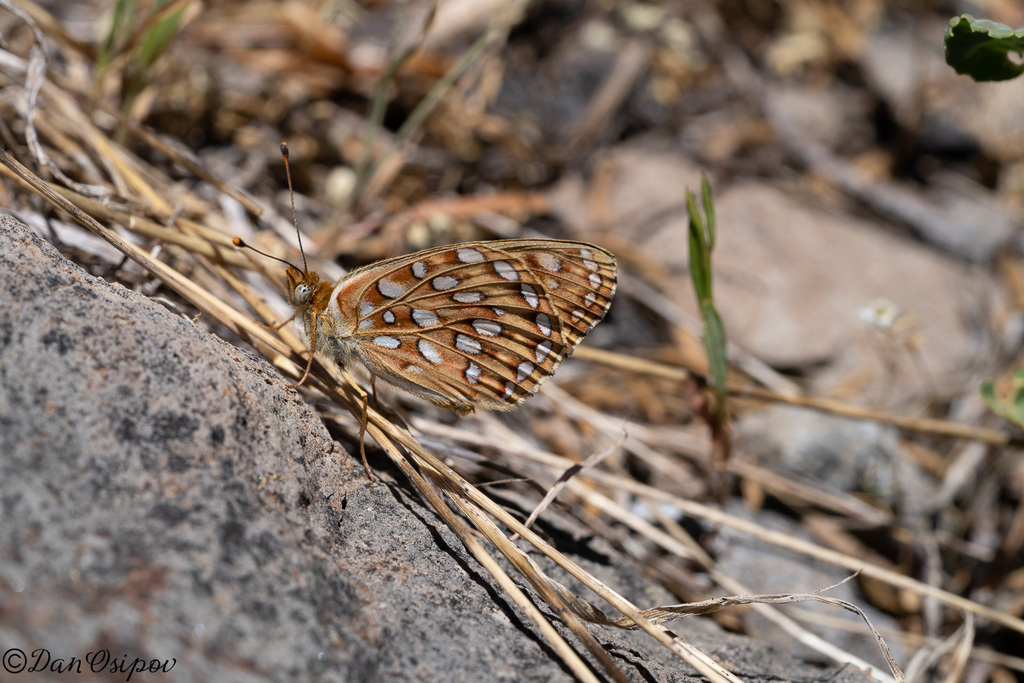
(c) Dan Osipov, some rights reserved (CC BY) · licence
Family: Nymphalidae · Class: Insecta · Order: Lepidoptera
Speyeria egleis (Great Basin Fritillary) is a California animal in the Nymphalidae family.
The Great Basin Fritillary (Speyeria egleis) is a medium-sized butterfly in the family Nymphalidae. Adults have a wingspan of 50-65 mm (2.0-2.6 inches), with males typically smaller than females. The dorsal wing surfaces are bright orange with distinctive black markings, including a series of black spots and lines across both forewings and hindwings. The ventral hindwings display characteristic silver spots on a brownish-orange background, a key identifying feature of fritillary butterflies. Males are generally more vibrant in coloration, while females tend to be larger and darker. This species ranges from North Dakota southwest through Oregon to California, extending south to Colorado. In California, Great Basin Fritillary populations occur primarily in the Sierra Nevada and Cascade Range, typically at elevations between 1,500 and 3,000 meters (4,900-9,800 feet). The species also occurs in scattered locations in the northern Coast Ranges and has been documented in mountainous regions of southern California. Great Basin Fritillary inhabits mountain meadows, forest clearings, and subalpine environments. The species requires open areas with abundant nectar sources and proximity to host plants. Preferred habitats include wet meadows, streamside areas, and forest edges where violets grow in association with grasses and forbs. These butterflies are typically found in areas with moderate to high moisture levels during the growing season. Adults are active from June through August, with peak flight periods varying by elevation and latitude. Males emerge first and patrol territories while searching for mates. Mating occurs in mid-summer, after which females seek violet host plants for egg-laying. Host plants include several violet species: Viola adunca (hookedspur violet), V. nuttallii (Nuttall's violet), V. purpurea (goosefoot violet), and V. walteri (Walter's violet). Females deposit eggs singly near or on violet plants, typically in late summer. Eggs overwinter and larvae develop the following spring, feeding exclusively on violet foliage. The species completes one generation per year. Adults are strong fliers and can travel considerable distances between nectar sources and breeding areas. They feed on various flowering plants including thistles, mints, asters, and other composite flowers. Males engage in hilltopping behavior, gathering on elevated areas to locate females. The Great Basin Fritillary does not currently hold federal or state listing status. However, like many montane butterfly species, populations may face pressure from climate change, habitat fragmentation, and altered fire regimes. Mountain meadow habitats are particularly vulnerable to warming temperatures and changing precipitation patterns. Grazing, recreational activities, and development can also impact local populations by degrading habitat quality and reducing host plant availability. Conservation efforts focus on maintaining healthy meadow ecosystems and protecting connectivity between suitable habitats across the species' mountainous range.
Classification
Class: Insecta · Order: Lepidoptera · Family: Nymphalidae
Frequently asked questions
How is Speyeria egleis classified?
Speyeria egleis belongs to class Insecta, order Lepidoptera, family Nymphalidae.
What family does Speyeria egleis belong to?
Speyeria egleis is in the Nymphalidae family.
What is Speyeria egleis?
The Great Basin Fritillary (Speyeria egleis) is a medium-sized butterfly in the family Nymphalidae.
Is Speyeria egleis found in California?
Yes. Speyeria egleis is recorded in California in The California Species Project's catalogue.
Related species
Other California species in the same genus, family, or bioregion.
Data from The California Species Project — 14,000+ California species with verified data from CNPS, CDFW, USFWS, and more.