Speyeria hesperis
Northwestern Fritillary
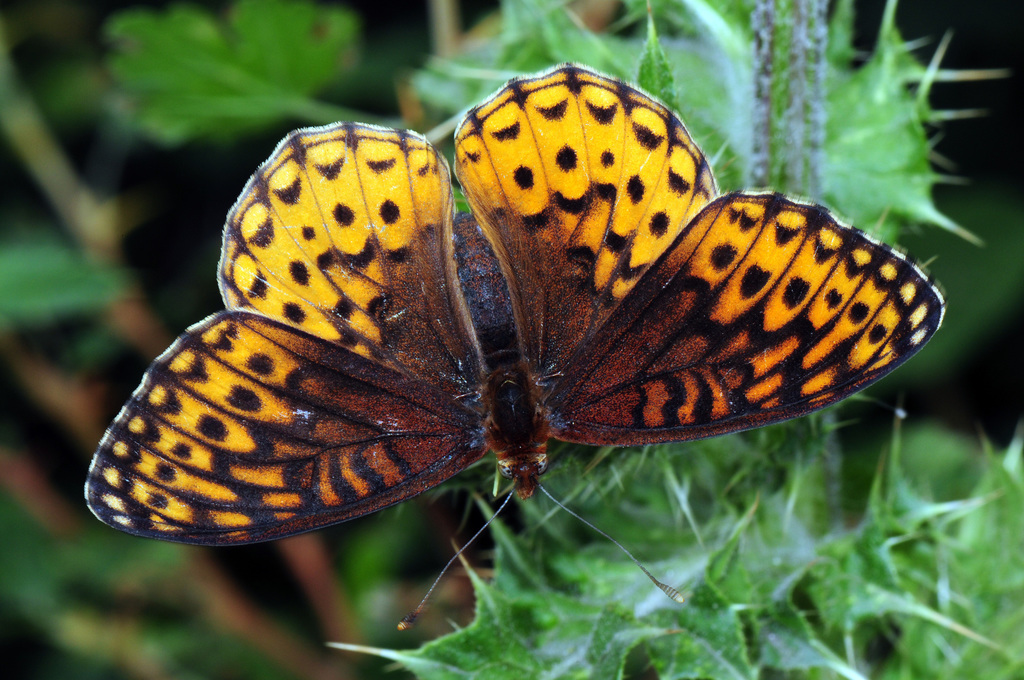
(c) Tom Kennedy, some rights reserved (CC BY) · licence
Family: Nymphalidae · Class: Insecta · Order: Lepidoptera
Speyeria hesperis (Northwestern Fritillary) is a California animal in the Nymphalidae family.
The Northwestern Fritillary is a medium-sized butterfly with distinctive orange-brown wings marked by black spots and lines. Adults typically measure 50 to 65 mm (2.0 to 2.6 inches) in wingspan. The dorsal wing surfaces are bright orange-brown with a pattern of black spots, lines, and crescents. Males tend to be slightly smaller and more vibrant orange than females. The ventral hindwings display the characteristic fritillary pattern of silver or pale yellow spots outlined in black, which distinguishes this species from similar butterflies in its range. The forewings have a distinctive row of black chevron marks along the outer margin. The Northwestern Fritillary occurs across western mountains from central western Alaska, Yukon, and Northwest Territories south to central California, Arizona, and New Mexico. In California, populations are found primarily in the Sierra Nevada, Cascade Range, and northern Coast Ranges at elevations typically between 1,200 and 3,000 meters (4,000 to 10,000 feet). The species reaches its southernmost extent in the high mountains of southern California and extends eastward into the Rocky Mountain system through Colorado and New Mexico. This species inhabits mountain meadows, forest openings, and subalpine environments where its host plants occur. Northwestern Fritillaries prefer moist to moderately dry sites with partial shade to full sun exposure. Adults are commonly found in areas with scattered conifers, aspen groves, and natural clearings. The species requires proximity to violet species, which serve as the sole larval host plants. Suitable habitat includes meadow edges, stream corridors, and forest clearings at higher elevations. Adults are active from June through August, with peak flight typically occurring in July at most locations. Males patrol territories and seek females through active flight patterns. Females deposit eggs singly near violet plants, though larvae may not immediately locate host plants upon hatching. The species exhibits a long larval development period, with caterpillars overwintering and feeding exclusively on various violet species. Northwestern Fritillaries are strong fliers and may travel considerable distances between suitable habitat patches. Adults nectar on a variety of wildflowers including asters, goldenrods, thistles, and mint family plants. The Northwestern Fritillary currently holds no special conservation status at federal or state levels. However, like many montane butterflies, populations may face pressure from climate change as suitable habitat shifts to higher elevations. Habitat fragmentation from development, logging, and recreational activities in mountain areas could impact local populations. The species' dependence on specific violet host plants makes it vulnerable to changes in plant community composition. Forest management practices that maintain natural meadow and forest edge habitats support population stability across the species' range.
Classification
Class: Insecta · Order: Lepidoptera · Family: Nymphalidae
Frequently asked questions
How is Speyeria hesperis classified?
Speyeria hesperis belongs to class Insecta, order Lepidoptera, family Nymphalidae.
What family does Speyeria hesperis belong to?
Speyeria hesperis is in the Nymphalidae family.
What is Speyeria hesperis?
The Northwestern Fritillary is a medium-sized butterfly with distinctive orange-brown wings marked by black spots and lines.
Is Speyeria hesperis found in California?
Yes. Speyeria hesperis is recorded in California in The California Species Project's catalogue.
Related species
Other California species in the same genus, family, or bioregion.
Data from The California Species Project — 14,000+ California species with verified data from CNPS, CDFW, USFWS, and more.