Speyeria hydaspe
Hydaspe Fritillary
no rights reserved · CC0
Family: Nymphalidae · Class: Insecta · Order: Lepidoptera
Speyeria hydaspe (Hydaspe Fritillary) is a California animal in the Nymphalidae family.
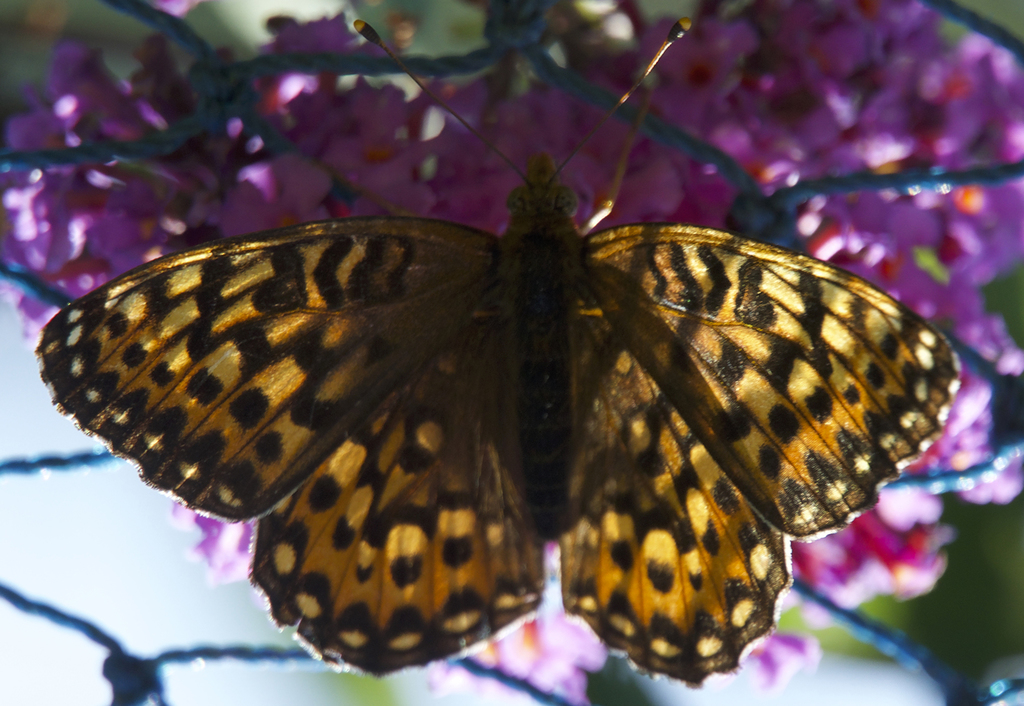
The Hydaspe fritillary (Speyeria hydaspe) is a medium-sized butterfly in the longwing subfamily Heliconiinae. Adults have a wingspan ranging from 57 to 70 mm (2.2 to 2.8 inches). The dorsal wing surfaces are bright orange with black markings typical of greater fritillaries, including irregular black lines and spots forming a distinctive pattern. The ventral hindwings display silver-white spots on a brownish-orange background, with the silver spots being less prominent than in some related Speyeria species. Males are generally smaller and more brightly colored than females, with distinguishable scent patches on the forewings. The species ranges from British Columbia east to Alberta, south through the western United States to southern California, Idaho, Montana, and New Mexico. In California, populations occur primarily in the Sierra Nevada, Cascade Range, and northern Coast Ranges. The species is found at elevations ranging from near sea level in northern coastal areas to approximately 3,000 meters (9,800 feet) in montane regions. Hydaspe fritillaries inhabit diverse forest and woodland environments, including coniferous forests, mixed conifer-hardwood forests, mountain meadows, and forest clearings. Adults are commonly observed in areas with abundant nectar sources and proximity to violet populations. The species shows a preference for partially shaded environments with dappled sunlight, often found along forest edges, trails, and clearings where violets grow in association with trees and shrubs. The species is univoltine, producing one generation per year. Adults typically emerge from late June through August, with peak flight periods varying by elevation and latitude. Males emerge several days before females and engage in patrolling behavior to locate mates. After mating, females scatter their eggs near but not directly on host plants. Larvae feed exclusively on violets, including Viola adunca, V. glabella, V. nuttallii, V. orbiculata, and V. purpurea. First-instar larvae enter diapause shortly after hatching and remain dormant through winter. Development resumes the following spring, with larvae feeding primarily at night and resting in leaf litter during the day. Pupation occurs in late spring to early summer, with chrysalids attached to vegetation or debris near the ground. Adults are active nectarers, feeding on various flowering plants including thistles, mints, composites, and other summer-blooming species. Flight behavior is characterized by rapid, direct flight interspersed with gliding periods. Males establish territories in areas with suitable nectar sources and patrol regularly for females. The Hydaspe fritillary is not federally or state-listed and appears to maintain stable populations throughout most of its range. However, like many forest-dependent species, populations may face localized pressures from habitat fragmentation, fire suppression altering natural forest dynamics, and climate change affecting the timing of seasonal emergence and host plant phenology. The species' dependence on violet species for larval development makes it vulnerable to changes in forest understory composition.
Classification
Class: Insecta · Order: Lepidoptera · Family: Nymphalidae
Frequently asked questions
How is Speyeria hydaspe classified?
Speyeria hydaspe belongs to class Insecta, order Lepidoptera, family Nymphalidae.
What family does Speyeria hydaspe belong to?
Speyeria hydaspe is in the Nymphalidae family.
What is Speyeria hydaspe?
The Hydaspe fritillary (Speyeria hydaspe) is a medium-sized butterfly in the longwing subfamily Heliconiinae.
Is Speyeria hydaspe found in California?
Yes. Speyeria hydaspe is recorded in California in The California Species Project's catalogue.
Related species
Other California species in the same genus, family, or bioregion.
Data from The California Species Project — 14,000+ California species with verified data from CNPS, CDFW, USFWS, and more.