Speyeria mormonia
Mormon Fritillary
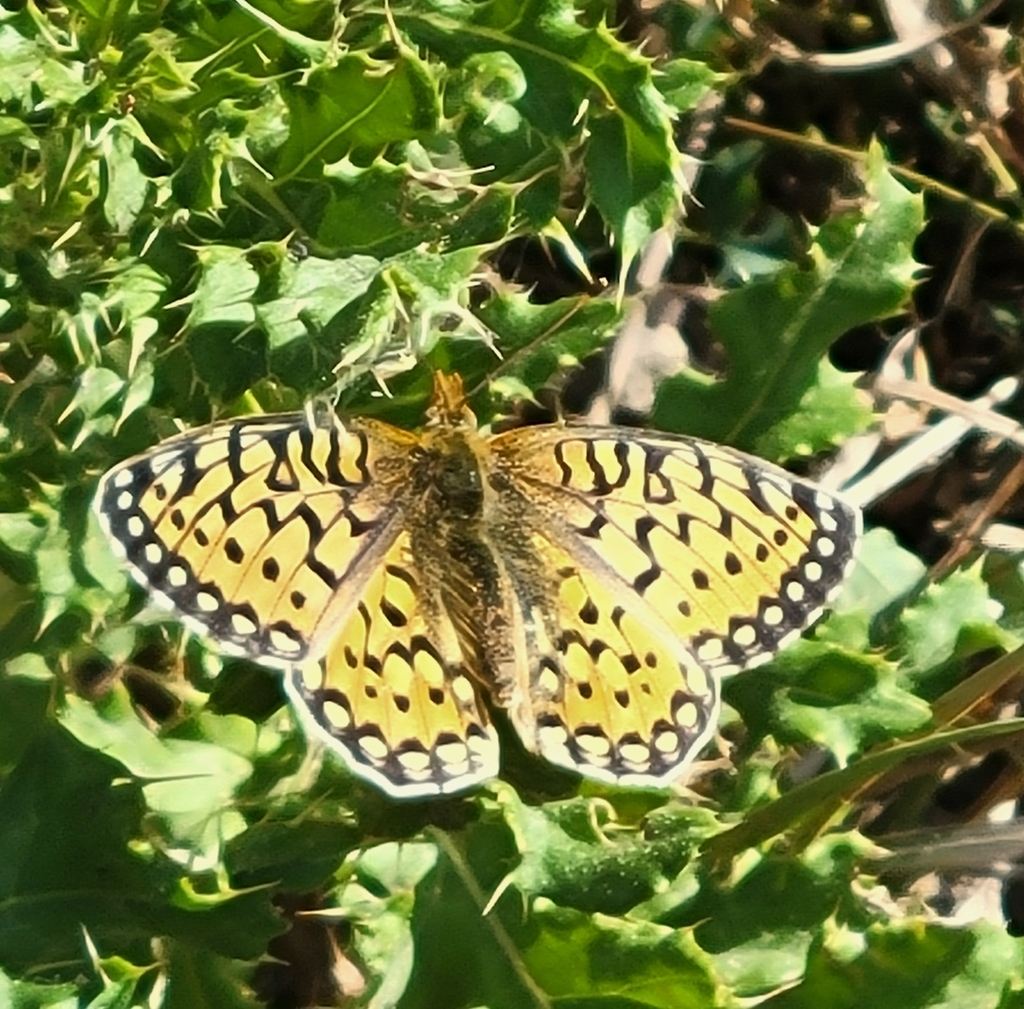
no rights reserved · CC0
Family: Nymphalidae · Class: Insecta · Order: Lepidoptera
Speyeria mormonia (Mormon Fritillary) is a California animal in the Nymphalidae family.
The Mormon fritillary is a medium-sized butterfly in the family Nymphalidae with distinctive orange-brown dorsal wing surfaces marked by black lines and spots. Males typically measure 48-60 mm (1.9-2.4 inches) in wingspan, while females are slightly larger at 52-68 mm (2.0-2.7 inches). The forewings display prominent black markings that form a reticulated pattern across the orange ground color. Females exhibit more subdued coloration with heavier black markings and often show pale yellow spotting on the forewings. The ventral hindwings are characteristic of the genus Speyeria, featuring silver-white metallic spots against a brownish-orange background with pale submarginal bands. The species occurs throughout western mountains from southern Alaska south and east to Manitoba and the Dakotas, extending south to central California, eastern Nevada, southeastern Arizona, and northern New Mexico. In California, Mormon fritillaries are found primarily in montane regions of the Sierra Nevada and Cascade Range, typically at elevations between 1,500 and 3,400 meters (4,900-11,200 feet). The species inhabits meadows, forest clearings, and alpine zones where host plants are abundant. Mormon fritillaries occupy diverse montane habitats including subalpine meadows, forest openings, riparian areas, and alpine zones. They prefer areas with scattered trees or shrubs that provide shelter while maintaining open spaces for nectaring and mate-seeking behavior. The species is closely associated with moist areas where violet species thrive, including stream margins, seeps, and north-facing slopes that retain moisture through the growing season. Adults emerge from late June through August, with peak flight occurring in July at most elevations. Males establish territories in suitable habitat and engage in patrolling behavior to locate females. Mating occurs after courtship flights, and females deposit eggs individually near violet host plants in late summer. The species is univoltine, producing one generation annually. Larvae feed exclusively on violets, including Viola adunca, V. nuttallii, V. nephrophylla, and V. palustris. First-instar caterpillars overwinter after hatching but do not feed until the following spring. Adults are strong fliers and nectar on various flowers including paintbrush, lupine, asters, and thistles. The Mormon fritillary currently holds no federal or state conservation listing in California. However, climate change poses potential threats to high-elevation populations through habitat shifts and altered precipitation patterns. The species' dependence on specific violet host plants and montane meadow habitats makes it vulnerable to habitat degradation from overgrazing, recreational impacts, and hydrological changes. Some subspecies, particularly those restricted to isolated mountain ranges, may face population pressures from habitat fragmentation. Long-term monitoring data suggest stable populations across much of the range, though localized declines have been documented in areas experiencing severe drought or habitat modification.
Classification
Class: Insecta · Order: Lepidoptera · Family: Nymphalidae
Frequently asked questions
How is Speyeria mormonia classified?
Speyeria mormonia belongs to class Insecta, order Lepidoptera, family Nymphalidae.
What family does Speyeria mormonia belong to?
Speyeria mormonia is in the Nymphalidae family.
What is Speyeria mormonia?
The Mormon fritillary is a medium-sized butterfly in the family Nymphalidae with distinctive orange-brown dorsal wing surfaces marked by black lines and spots.
Is Speyeria mormonia found in California?
Yes. Speyeria mormonia is recorded in California in The California Species Project's catalogue.
Related species
Other California species in the same genus, family, or bioregion.
Data from The California Species Project — 14,000+ California species with verified data from CNPS, CDFW, USFWS, and more.