Speyeria nokomis
Nokomis Fritillary
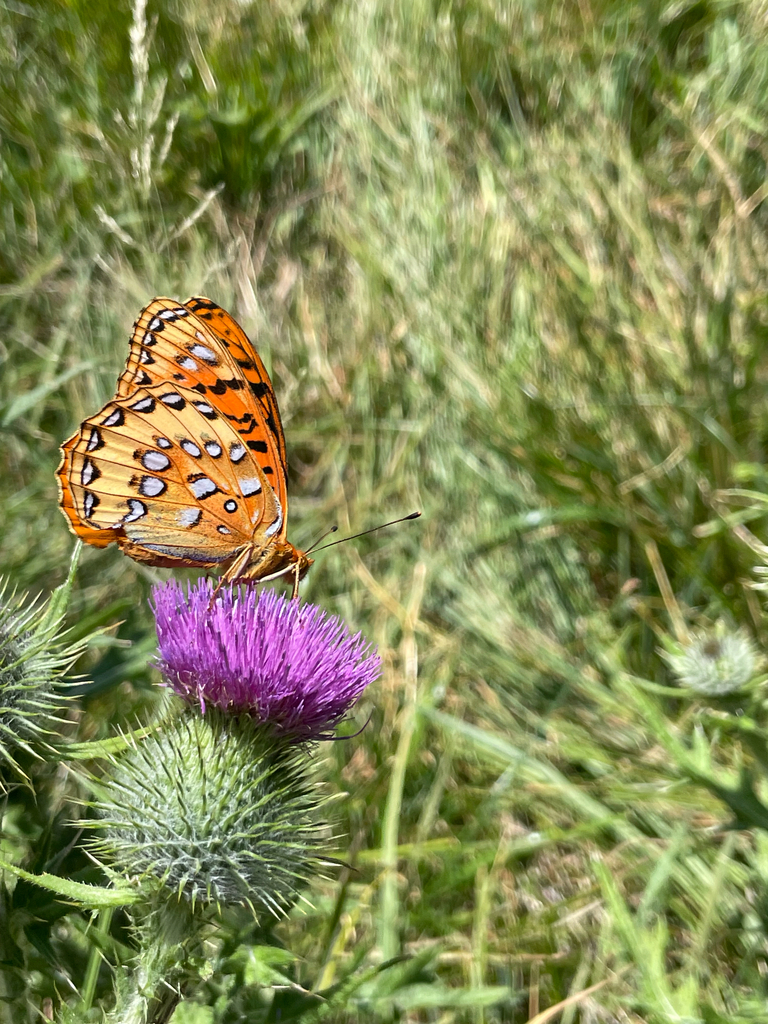
(c) Lauren Vanier, some rights reserved (CC BY) · licence
Family: Nymphalidae · Class: Insecta · Order: Lepidoptera
Speyeria nokomis (Nokomis Fritillary) is a California animal in the Nymphalidae family.
The Nokomis fritillary (Speyeria nokomis) is a large butterfly in the family Nymphalidae, distinguished by its robust build and distinctive wing patterns. Adults have a wingspan ranging from 70 to 95 mm (2.8 to 3.7 inches), making it one of the larger fritillary species in North America. Males display bright orange dorsal wing surfaces with black markings including spots and lines, while the ventral hindwings show silver-white spots on a brownish background. Females are typically larger and darker than males, with more subdued orange coloration and heavier black markings. The species exhibits sexual dimorphism common among Speyeria fritillaries, with females often appearing more brownish-orange overall. The Nokomis fritillary occurs in east-central California, Nevada, Utah, and Colorado, extending south through Arizona and New Mexico into Mexico. In California, populations are primarily found in the eastern Sierra Nevada and White Mountains regions. The species inhabits montane and subalpine environments, typically occurring at elevations between 1,800 and 3,400 meters (6,000 to 11,000 feet). Historical records indicate the species was once more widely distributed across suitable high-elevation habitat in the western United States. This fritillary requires moist meadows, seeps, and riparian areas within coniferous forests and alpine zones. Adults are closely associated with areas containing their obligate host plant, the kidney-leaved violet (Viola nephrophylla), which grows in wet soils near streams, springs, and boggy areas. The species depends on high-quality wetland habitats that maintain consistent moisture throughout the growing season. Adults are often observed nectaring on native wildflowers including thistles, asters, and other composite flowers. Nokomis fritillaries have a single generation per year, with adults typically flying from mid-July through early September depending on elevation and local conditions. Mating occurs in late summer, and females deposit eggs singly near host plants. Larvae overwinter in the first instar and resume development the following spring when violets begin active growth. The caterpillars feed exclusively on Viola nephrophylla leaves, completing development through five instars before pupating in early to mid-summer. Adults emerge after approximately two weeks in the pupal stage. While not currently listed under federal or state endangered species acts, Nokomis fritillary populations face significant conservation challenges. The species has experienced documented declines across portions of its range, particularly in California where suitable high-elevation wetland habitat is naturally fragmented and vulnerable. Primary threats include habitat degradation from livestock grazing, water diversions that alter wetland hydrology, recreational impacts, and climate change effects on montane ecosystems. Drought conditions can severely impact both host plant availability and adult nectar sources. Some populations in California are considered imperiled due to their small size and isolation. Conservation efforts focus on protecting critical wetland habitats and maintaining water sources that support both the host plant and associated plant communities.
Classification
Class: Insecta · Order: Lepidoptera · Family: Nymphalidae
Frequently asked questions
How is Speyeria nokomis classified?
Speyeria nokomis belongs to class Insecta, order Lepidoptera, family Nymphalidae.
What family does Speyeria nokomis belong to?
Speyeria nokomis is in the Nymphalidae family.
What is Speyeria nokomis?
The Nokomis fritillary (Speyeria nokomis) is a large butterfly in the family Nymphalidae, distinguished by its robust build and distinctive wing patterns.
Is Speyeria nokomis found in California?
Yes. Speyeria nokomis is recorded in California in The California Species Project's catalogue.
Related species
Other California species in the same genus, family, or bioregion.
Data from The California Species Project — 14,000+ California species with verified data from CNPS, CDFW, USFWS, and more.