Speyeria zerene behrensii
Behren’s silverspot butterfly
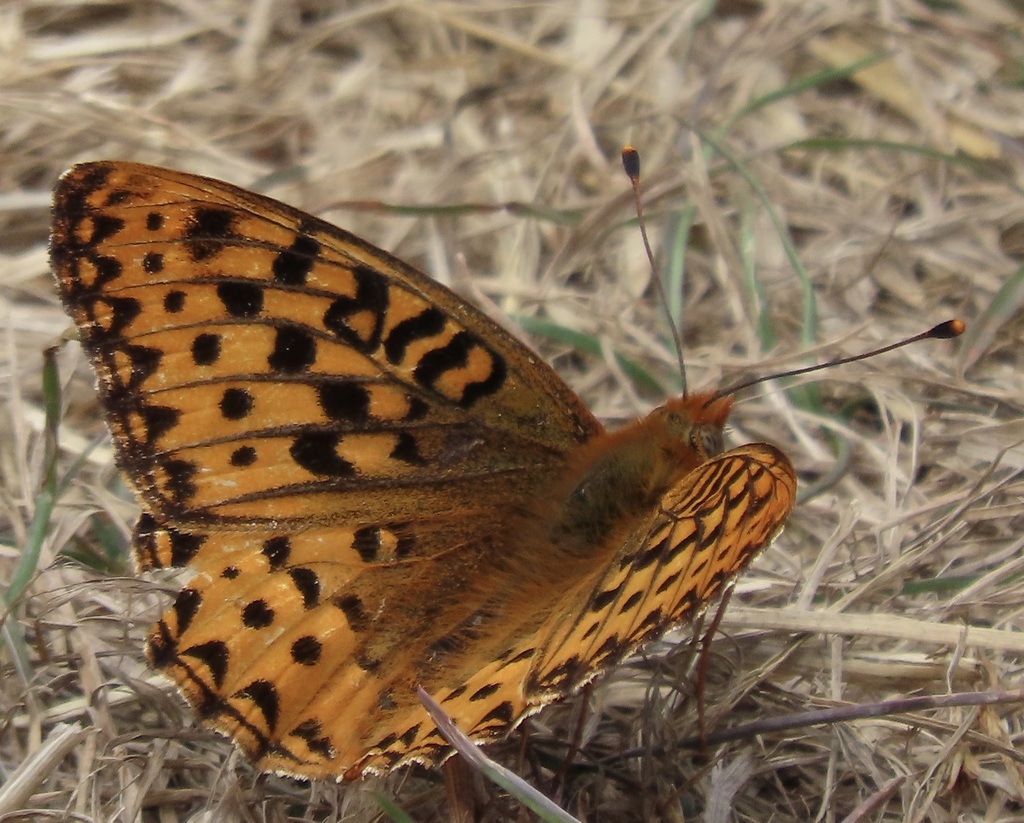
(c) John Hibbard, some rights reserved (CC BY) · licence
Family: Nymphalidae · Class: Insecta · Order: Lepidoptera
Conservation status: Endangered · G5T1 S1
Speyeria zerene behrensii (Behren’s silverspot butterfly) is a California animal in the Nymphalidae family.
Behren's silverspot butterfly (Speyeria zerene behrensii) is a subspecies of the zerene fritillary, endemic to California's north coast. Adults display the typical fritillary wing pattern with bright orange dorsal surfaces marked by black spots and lines. The forewings measure 32 to 40 mm (1.3 to 1.6 inches) in length. Males are generally smaller and more brightly colored than females, with distinctive scent patches on their forewings. The ventral hindwings feature characteristic silver spots that give the species its common name, along with a buff-colored background typical of coastal Speyeria subspecies. Historically, Behren's silverspot occurred along much of California's north coast, ranging from Mendocino County north to the Oregon border. The subspecies inhabited coastal terrace prairies from sea level to approximately 150 meters (500 feet) elevation. Today, the butterfly exists as a single known population in Mendocino County, representing one of the most geographically restricted butterflies in North America. This dramatic range reduction reflects widespread habitat loss throughout the region. The species occupies coastal terrace prairie habitat, a plant community dominated by native perennial grasses and forbs. These prairies develop on marine terraces above the Pacific Ocean, where persistent summer fog moderates temperatures and provides moisture. The habitat requires a mosaic of open grassland interspersed with patches of shrubs and the host plant, western dog violet (Viola adunca). Optimal sites maintain moderate disturbance regimes that prevent encroachment by invasive grasses and woody vegetation while preserving violet populations. Behren's silverspot follows a univoltine life cycle, producing one generation annually. Adults emerge in late July and August, with peak flight activity occurring in early to mid-August. Males patrol territories seeking females, which mate once and then search for suitable oviposition sites. Females deposit eggs singly on or near western dog violet plants, the sole larval host species. Newly hatched caterpillars feed briefly before entering diapause for winter. Larvae resume feeding in spring, progressing through five instars before pupating in early summer. The complete dependence on western dog violet makes violet population health critical for butterfly persistence. The U.S. Fish and Wildlife Service listed Behren's silverspot as endangered in 1997. The primary threats include habitat loss from residential and commercial development, invasive plant species that displace native prairie vegetation, inappropriate grazing or mowing that eliminates host plants, and recreational activities that degrade habitat. Climate change poses additional risks through altered precipitation patterns and increased wildfire frequency. The species' extremely limited distribution makes it vulnerable to stochastic events that could cause extinction. Conservation efforts focus on habitat restoration and protection of the remaining population site. Management activities include invasive species control, prescribed burning or mechanical treatments to maintain prairie conditions, and monitoring of both butterfly and violet populations. The recovery strategy emphasizes establishing additional populations through habitat restoration and potential translocation, though the butterfly's specialized habitat requirements present significant challenges for range expansion.
Classification
Class: Insecta · Order: Lepidoptera · Family: Nymphalidae
Conservation status
Endangered · G5T1 S1
Frequently asked questions
How is Speyeria zerene behrensii classified?
Speyeria zerene behrensii belongs to class Insecta, order Lepidoptera, family Nymphalidae.
What family does Speyeria zerene behrensii belong to?
Speyeria zerene behrensii is in the Nymphalidae family.
Is Speyeria zerene behrensii protected or of conservation concern?
Speyeria zerene behrensii carries the following status: Endangered · G5T1 S1.
What is Speyeria zerene behrensii?
Behren's silverspot butterfly (Speyeria zerene behrensii) is a subspecies of the zerene fritillary, endemic to California's north coast.
Is Speyeria zerene behrensii found in California?
Yes. Speyeria zerene behrensii is recorded in California in The California Species Project's catalogue.
Related species
Other California species in the same genus, family, or bioregion.
Data from The California Species Project — 14,000+ California species with verified data from CNPS, CDFW, USFWS, and more.