Speyeria zerene myrtleae
Myrtle’s silverspot butterfly
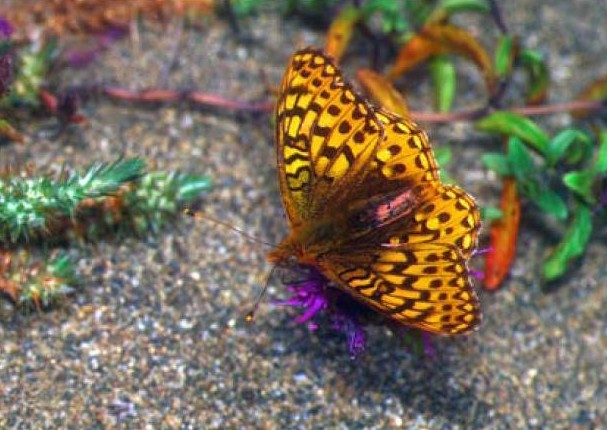
John Hafernik (via Wikimedia Commons) · CC0
Family: Nymphalidae · Class: Insecta · Order: Lepidoptera
Conservation status: Endangered · G5T1 S1
Speyeria zerene myrtleae (Myrtle’s silverspot butterfly) is a California animal in the Nymphalidae family.
Myrtle's silverspot butterfly (Speyeria zerene myrtleae) is a medium-sized fritillary endemic to coastal California. Adults have a wingspan of 57-70 mm (2.2-2.8 inches), with males typically smaller than females. The dorsal wing surfaces are bright orange with black spots and markings characteristic of fritillary butterflies. The undersides of the hindwings display distinctive silver spots that give the species its common name, along with a yellowish-buff ground color. Males exhibit a more vibrant orange coloration, while females tend to be duller with heavier black markings. Myrtle's silverspot butterfly occurs along the Pacific coast in Marin and Sonoma counties, California. The species is restricted to coastal scrub and grassland habitats within approximately 3 kilometers of the ocean. Historical populations were documented at Point Reyes National Seashore, the Marin Headlands, and coastal areas of southern Sonoma County. Current populations are fragmented and occur at fewer than ten sites. The species inhabits coastal prairie, scrub, and dune systems where its host plant, the western dog violet (Viola adunca), grows in association with native bunch grasses and coastal shrubs. Adults require nectar sources including coastal goldfields (Lasthenia californica), seaside daisy (Erigeron glaucus), and various members of the mint family. The butterfly occurs from sea level to approximately 300 meters elevation in areas with moderate to heavy summer fog influence. Adults are active from late June through August, with peak flight occurring in July. Females deposit eggs singly near violet host plants in late summer. Eggs remain dormant through winter and hatch the following spring. Larvae feed exclusively on western dog violet leaves during their development through five instars. The species completes one generation per year, with pupation occurring in early summer among leaf litter or low vegetation. Adults are strong fliers and males patrol territories to locate mates. The U.S. Fish and Wildlife Service listed Myrtle's silverspot butterfly as federally endangered in 1992. According to the California Department of Fish and Wildlife, taxonomic uncertainty exists regarding whether the subspecies designation is warranted, as some authorities question the distinction from other Speyeria zerene populations. Regardless of taxonomic status, coastal Speyeria zerene populations in Marin and Sonoma counties remain protected under the 1992 federal listing. Primary threats include habitat loss from coastal development, invasive plant species that displace native host plants and nectar sources, altered fire regimes, recreational activities, and climate change effects on coastal fog patterns. Habitat fragmentation has isolated remaining populations, reducing genetic diversity and limiting dispersal between sites. Conservation efforts focus on habitat restoration, invasive species control, and protection of remaining coastal prairie remnants through land acquisition and management partnerships with federal, state, and local agencies.
Classification
Class: Insecta · Order: Lepidoptera · Family: Nymphalidae
Conservation status
Endangered · G5T1 S1
Frequently asked questions
How is Speyeria zerene myrtleae classified?
Speyeria zerene myrtleae belongs to class Insecta, order Lepidoptera, family Nymphalidae.
What family does Speyeria zerene myrtleae belong to?
Speyeria zerene myrtleae is in the Nymphalidae family.
Is Speyeria zerene myrtleae protected or of conservation concern?
Speyeria zerene myrtleae carries the following status: Endangered · G5T1 S1.
What is Speyeria zerene myrtleae?
Myrtle's silverspot butterfly (Speyeria zerene myrtleae) is a medium-sized fritillary endemic to coastal California.
Is Speyeria zerene myrtleae found in California?
Yes. Speyeria zerene myrtleae is recorded in California in The California Species Project's catalogue.
Related species
Other California species in the same genus, family, or bioregion.
Data from The California Species Project — 14,000+ California species with verified data from CNPS, CDFW, USFWS, and more.