Sphaerophoria contigua
Tufted Globetail
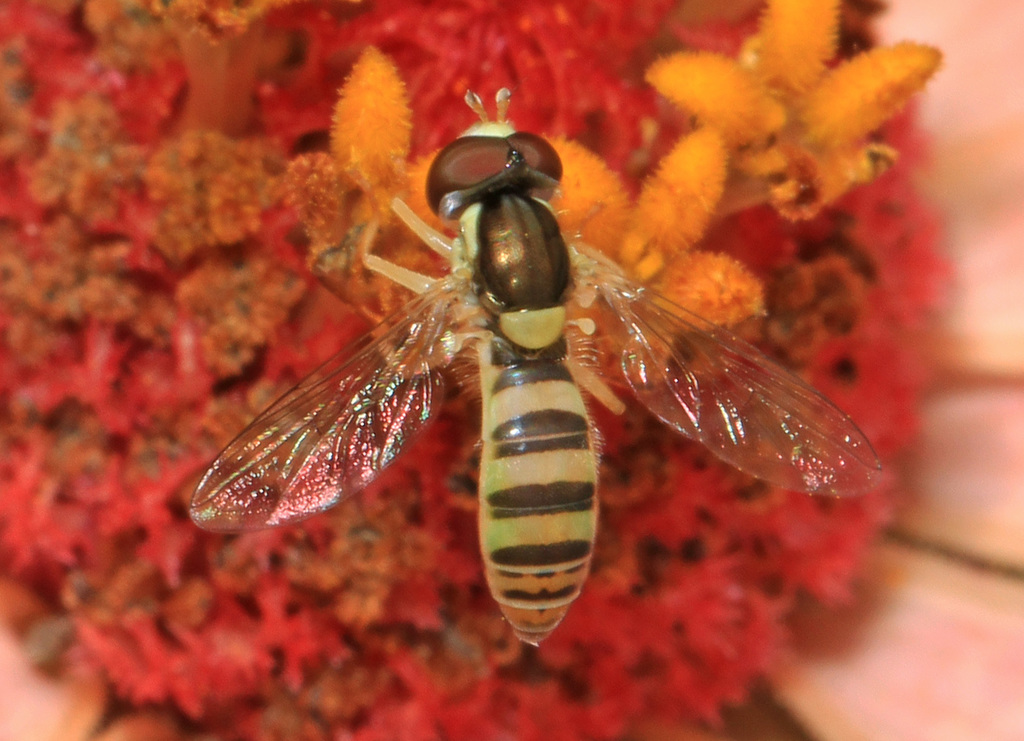
(c) Judy Gallagher, some rights reserved (CC BY-SA) · licence
Family: Syrphidae · Class: Insecta · Order: Diptera
Sphaerophoria contigua (Tufted Globetail) is a California animal in the Syrphidae family.
The Tufted Globetail is a small hover fly measuring 6.5 to 8.8 mm (0.26 to 0.35 inches) in length (BugGuide). This member of the family Syrphidae exhibits the characteristic slender body form typical of the genus Sphaerophoria. Males can be distinguished by their elongated abdomens and distinctive genital structures that give the species its common name. The species displays the typical yellow and black coloration pattern of many hover flies, with yellow markings on a darker background. Sphaerophoria contigua has a broad distribution across North America (BugGuide), extending from coast to coast. The species occurs throughout the continental United States and into southern Canada. Recent observations document its presence from Georgia in the southeast to Wisconsin in the upper Midwest, indicating a wide latitudinal range. In California, this species likely occurs statewide given its broad North American distribution, though specific county-level records require further documentation. This hover fly inhabits diverse ecosystems including forests, meadows, bogs, marshes, and beach environments (BugGuide). The species demonstrates considerable habitat flexibility, occurring in both natural and modified landscapes. Adults are commonly found visiting flowers in open areas where they feed on nectar and pollen. The variety of habitats utilized suggests the species can adapt to different moisture regimes and vegetation types, from wetland margins to upland meadows. As with other Syrphidae, adult Tufted Globetails are important pollinators, visiting various flowering plants for nectar while inadvertently transferring pollen between flowers. The larvae are predatory, feeding on aphids and other soft-bodied insects, making this species beneficial for natural pest control. Adults are most active during warmer months when flowers are abundant. Mating occurs on or near host plants, with females laying eggs in proximity to aphid colonies where larvae will develop. The species likely completes multiple generations per year in warmer regions. The Tufted Globetail currently has no special conservation status at federal or state levels. The species appears to maintain stable populations across its range, benefiting from its broad habitat tolerance and generalist feeding habits. However, like many pollinators, it may face challenges from habitat loss, pesticide use, and climate change. The species' adaptability to various habitats may provide some resilience against environmental changes. Its role as both pollinator and biological control agent makes it ecologically valuable in agricultural and natural systems. Continued monitoring through citizen science platforms like BugGuide helps document its distribution and abundance patterns across North America. Conservation efforts that maintain diverse flowering plant communities and reduce pesticide applications benefit this species along with other beneficial insects.
Classification
Class: Insecta · Order: Diptera · Family: Syrphidae
Frequently asked questions
How is Sphaerophoria contigua classified?
Sphaerophoria contigua belongs to class Insecta, order Diptera, family Syrphidae.
What family does Sphaerophoria contigua belong to?
Sphaerophoria contigua is in the Syrphidae family.
What is Sphaerophoria contigua?
The Tufted Globetail is a small hover fly measuring 6.5 to 8.8 mm (0.26 to 0.35 inches) in length (BugGuide).
Is Sphaerophoria contigua found in California?
Yes. Sphaerophoria contigua is recorded in California in The California Species Project's catalogue.
Related species
Other California species in the same genus, family, or bioregion.
Data from The California Species Project — 14,000+ California species with verified data from CNPS, CDFW, USFWS, and more.