Sphex ichneumoneus
Great Golden Digger Wasp
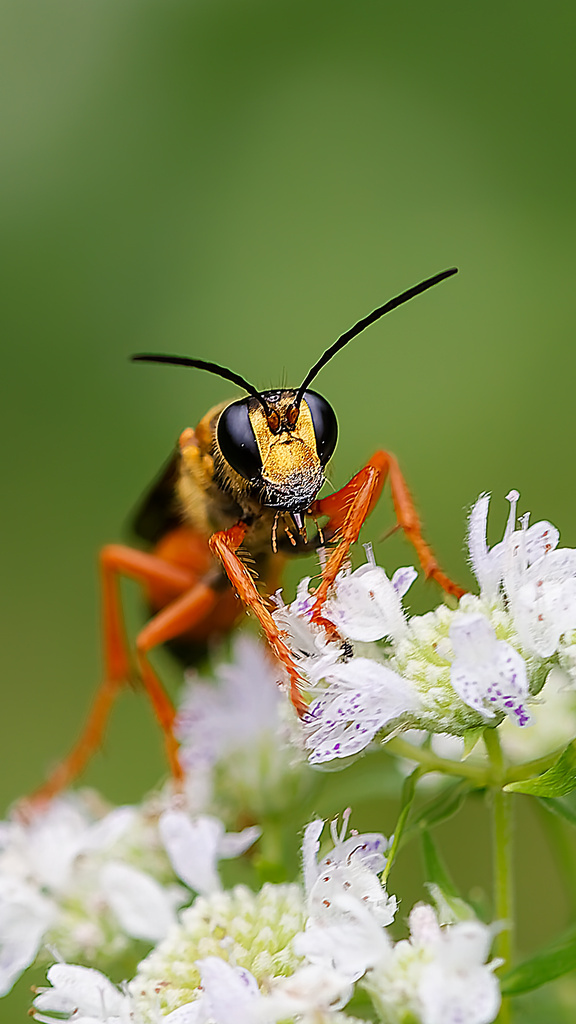
(c) Daughter Dad, some rights reserved (CC BY) · licence
Family: Sphecidae · Class: Insecta · Order: Hymenoptera
Sphex ichneumoneus (Great Golden Digger Wasp) is a California animal in the Sphecidae family.
The Great Golden Digger Wasp is a large, solitary wasp measuring more than 25 mm (1 inch) in length. The species is characterized by its distinctive golden-yellow setae covering the head and thorax, which creates a metallic shimmering appearance. The abdomen is typically dark with lighter markings, and the wings are amber-tinted. Adults are robust and powerful fliers, well-adapted for their predatory lifestyle. Sphex ichneumoneus occurs across North America, with populations documented from southern Canada through the United States and into northern Mexico. In California, the species has been recorded throughout much of the state, including documented occurrences at Ballona Creek Reserve in Los Angeles County (Nagano et al. 1981). The wasp's distribution extends across diverse climatic zones and elevations. This species inhabits a variety of open habitats including fields, meadows, gardens, parks, and suburban areas. Great Golden Digger Wasps prefer areas with sandy or loose soil suitable for excavating burrows, combined with access to flowering plants for nectar feeding. Adults are commonly observed in areas where their cricket prey is abundant, including grassy fields and edge habitats between woodlands and open spaces. Great Golden Digger Wasps are specialized hunters that prey exclusively on tree crickets and field crickets. Females exhibit complex hunting behavior, using precise stings to paralyze their prey rather than killing it outright. The wasp delivers targeted stings to nerve centers, typically three stings to immobilize a cricket - one to the throat and additional stings to other nerve clusters (Xerces Society). This paralysis technique keeps the prey fresh for extended periods, preventing decomposition while providing live food for developing larvae. After capturing and paralyzing a cricket, the female transports it to her underground burrow, which she excavates in sandy soil. The burrow consists of a vertical shaft leading to one or more horizontal chambers where she provisions her eggs. Each cell receives a single paralyzed cricket and one egg before being sealed. The larva develops by consuming the immobilized cricket over a period of one to two weeks. Adults are active during summer months and are frequently observed visiting flowers for nectar, particularly favoring plants in the Asteraceae family. Sphex ichneumoneus is not federally or state listed and appears to maintain stable populations across its range. NatureServe has not assigned a global conservation rank (GNR), indicating insufficient data for formal assessment (NatureServe 2025). The species benefits from its adaptability to human-modified landscapes, successfully nesting in suburban gardens and parks where suitable soil conditions exist. Urban and suburban environments often provide abundant prey in the form of crickets and adequate nectar sources from ornamental plantings, supporting local populations of this beneficial predator.
Classification
Class: Insecta · Order: Hymenoptera · Family: Sphecidae
Frequently asked questions
How is Sphex ichneumoneus classified?
Sphex ichneumoneus belongs to class Insecta, order Hymenoptera, family Sphecidae.
What family does Sphex ichneumoneus belong to?
Sphex ichneumoneus is in the Sphecidae family.
What is Sphex ichneumoneus?
The Great Golden Digger Wasp is a large, solitary wasp measuring more than 25 mm (1 inch) in length.
Is Sphex ichneumoneus found in California?
Yes. Sphex ichneumoneus is recorded in California in The California Species Project's catalogue.
Related species
Other California species in the same genus, family, or bioregion.
Data from The California Species Project — 14,000+ California species with verified data from CNPS, CDFW, USFWS, and more.