Sphinx asellus
Asella sphinx
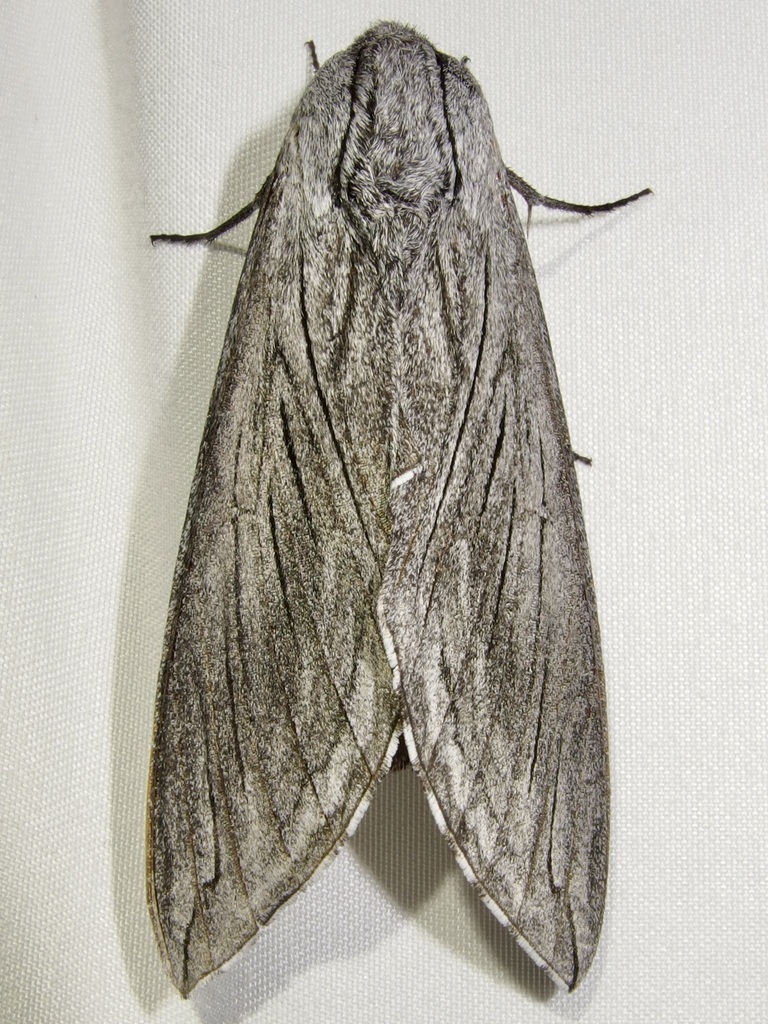
(c) Sue Carnahan, some rights reserved (CC BY) · licence
Family: Sphingidae · Class: Insecta · Order: Lepidoptera
Sphinx asellus (Asella sphinx) is a California animal in the Sphingidae family.
The Asella sphinx (Sphinx asellus) is a medium-sized hawkmoth belonging to the family Sphingidae. Adults typically measure 50 to 75 mm (2.0 to 3.0 inches) in wingspan, with a robust, streamlined body characteristic of sphinx moths. The forewings are elongated and narrow, displaying mottled gray-brown coloration with darker bands and pale spots that provide effective camouflage against tree bark. The hindwings are lighter, often with orange or reddish-brown patches near the base. The thorax is densely covered with gray-brown scales, while the abdomen shows alternating dark and light bands. Like other sphinx moths, adults possess a long proboscis for nectar feeding and prominent, feathery antennae. Sphinx asellus occurs across the southwestern United States, with confirmed populations in Nevada, Utah, Colorado, Arizona, and New Mexico. The species' range encompasses portions of the Great Basin, Colorado Plateau, and southern Rocky Mountains. Distribution appears patchy within this range, likely reflecting specific habitat requirements and the fragmented nature of suitable ecosystems across the arid Southwest. The moth's presence in these states suggests adaptation to high-desert and montane environments characteristic of the region. This species inhabits arid and semi-arid environments typical of the American Southwest, including pinyon-juniper woodlands, oak scrublands, and mixed conifer forests at moderate elevations. Based on collection records from similar southwestern sphingids, Sphinx asellus likely occurs between 1,200 and 2,400 meters (4,000 to 8,000 feet) elevation. The species appears to favor areas with scattered trees and shrubs that provide both larval host plants and adult nectar sources. Rocky canyons, mesa edges, and mountain slopes with diverse plant communities may represent optimal habitat. Host plant associations for Sphinx asellus larvae remain unreported in the literature, representing a significant knowledge gap for this species. Most sphinx moths in the genus Sphinx utilize woody plants as larval hosts, particularly members of the olive family (Oleaceae), rose family (Rosaceae), or honeysuckle family (Caprifoliaceae). Adults are presumed to be crepuscular or nocturnal, following typical hawkmoth behavior patterns. They likely feed on nectar from tubular flowers of native plants such as four o'clocks, evening primrose, or desert willow. Flight periods probably coincide with warm months when host plants are actively growing and flowering, potentially from late spring through early fall depending on elevation and local climate. The conservation status of Sphinx asellus has not been formally assessed at federal or state levels, and the species lacks formal listing status. Limited distributional records and the absence of host plant data suggest this moth may be uncommon or poorly studied rather than abundant. Climate change poses potential threats to southwestern lepidoptera through altered precipitation patterns, increased temperatures, and shifts in plant community composition. Habitat fragmentation from urban development and altered fire regimes may also impact local populations. Additional research is needed to determine population trends, host plant relationships, and specific habitat requirements to better assess conservation needs.
Classification
Class: Insecta · Order: Lepidoptera · Family: Sphingidae
Frequently asked questions
How is Sphinx asellus classified?
Sphinx asellus belongs to class Insecta, order Lepidoptera, family Sphingidae.
What family does Sphinx asellus belong to?
Sphinx asellus is in the Sphingidae family.
What is Sphinx asellus?
The Asella sphinx (Sphinx asellus) is a medium-sized hawkmoth belonging to the family Sphingidae.
Is Sphinx asellus found in California?
Yes. Sphinx asellus is recorded in California in The California Species Project's catalogue.
Related species
Other California species in the same genus, family, or bioregion.
Data from The California Species Project — 14,000+ California species with verified data from CNPS, CDFW, USFWS, and more.