Sphinx chersis
Great ash sphinx
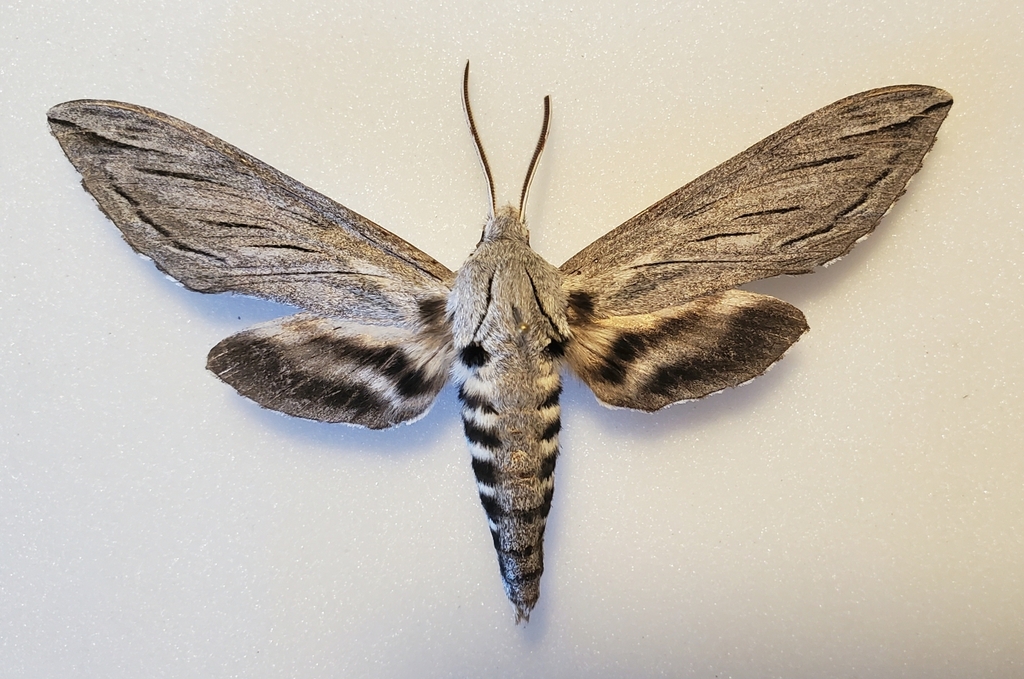
(c) Laura Gaudette, some rights reserved (CC BY) · licence
Family: Sphingidae · Class: Insecta · Order: Lepidoptera
Sphinx chersis (Great ash sphinx) is a California animal in the Sphingidae family.
The great ash sphinx (Sphinx chersis) is a large moth in the family Sphingidae, commonly known as hawkmoths or sphinx moths. Adults have a wingspan ranging from 90 to 125 mm (3.5 to 4.9 inches), making it one of the larger sphinx moths in North America. The forewings are predominantly gray-brown with darker irregular bands and white streaking along the veins. The hindwings are gray with black bands and display orange-yellow patches near the base. The thorax is gray-brown with darker longitudinal stripes, while the abdomen features alternating dark and light bands. At rest, the moth resembles a piece of bark, providing effective camouflage. The great ash sphinx occurs across a broad range extending from Mexico north through most of the United States, though it is rare in the Gulf States. In California, the species is found primarily in areas where suitable host plants are present, including urban and suburban environments with cultivated lilacs and ash trees, as well as natural habitats supporting native host species. The moth's distribution correlates closely with the presence of its larval host plants. This species inhabits diverse environments from sea level to moderate elevations, including deciduous and mixed woodlands, urban parks, residential areas, and riparian zones. Adults are attracted to areas with abundant nectar sources and are commonly found near flowering plants during their active period. The larvae require specific host plants for development and are typically found on the foliage of their preferred species. Great ash sphinx moths are nocturnal and crepuscular, becoming active at dusk. Adults feed on nectar from various flowers, hovering like hummingbirds while extending their long proboscis to reach deep into blossoms. They are particularly attracted to tubular flowers such as honeysuckle, petunias, and tobacco. The species produces one to two generations per year depending on latitude and climate. Mating occurs in late spring through summer, with females laying large, pale green eggs singly on host plant leaves. Larvae feed on a variety of plants including lilac (Syringa vulgaris), quaking aspen (Populus tremuloides), ash (Fraxinus species), and privet (Ligustrum species). The caterpillars are distinctive green hornworms reaching 90 to 100 mm (3.5 to 4.0 inches) in length, with diagonal white stripes and a prominent caudal horn. Pupation occurs in underground chambers, with adults emerging the following spring or summer. The great ash sphinx is not currently listed under federal or state endangered species legislation and appears to maintain stable populations across most of its range. The species benefits from the widespread cultivation of ornamental host plants, particularly lilacs and ash trees in urban and suburban environments. However, like many moths, populations may face pressure from habitat loss, light pollution, and pesticide use. Climate change could potentially affect the species' range and synchronization with host plant phenology, though comprehensive population monitoring data are limited.
Classification
Class: Insecta · Order: Lepidoptera · Family: Sphingidae
Frequently asked questions
How is Sphinx chersis classified?
Sphinx chersis belongs to class Insecta, order Lepidoptera, family Sphingidae.
What family does Sphinx chersis belong to?
Sphinx chersis is in the Sphingidae family.
What is Sphinx chersis?
The great ash sphinx (Sphinx chersis) is a large moth in the family Sphingidae, commonly known as hawkmoths or sphinx moths.
Is Sphinx chersis found in California?
Yes. Sphinx chersis is recorded in California in The California Species Project's catalogue.
Related species
Other California species in the same genus, family, or bioregion.
Data from The California Species Project — 14,000+ California species with verified data from CNPS, CDFW, USFWS, and more.