Sphinx dollii
Doll's sphinx
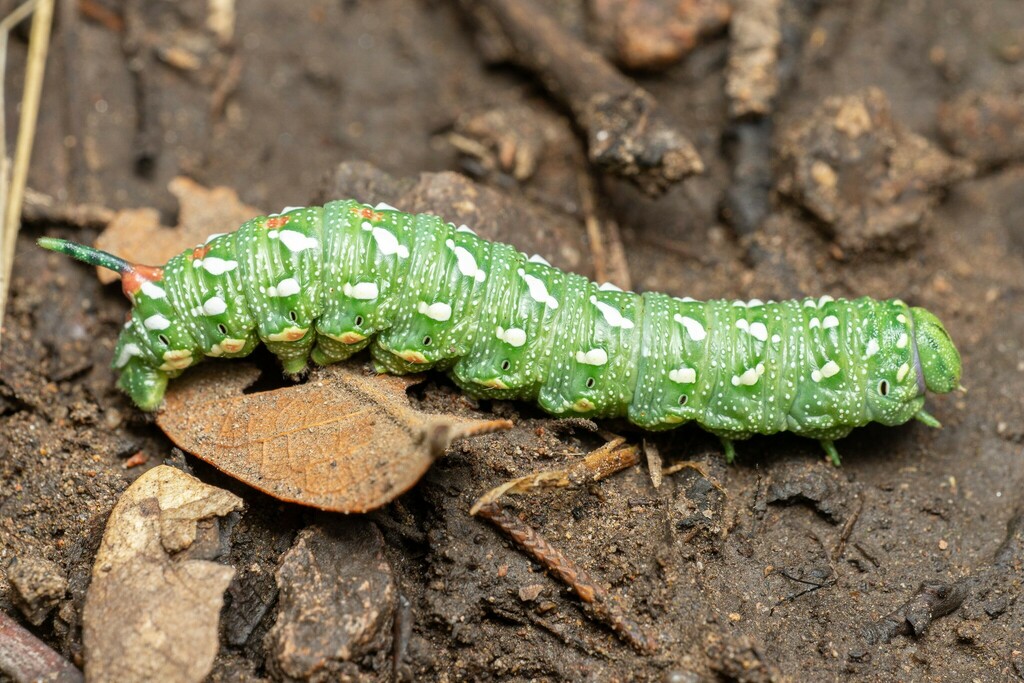
(c) Jake Nitta, some rights reserved (CC BY) · licence
Family: Sphingidae · Class: Insecta · Order: Lepidoptera
Sphinx dollii (Doll's sphinx) is a California animal in the Sphingidae family.
Doll's sphinx (Sphinx dollii) is a medium-sized hawkmoth in the family Sphingidae, characterized by its robust body and distinctive wing patterns. Adults have a wingspan ranging from 75 to 95 mm (3.0 to 3.7 inches). The forewings are brownish-gray with darker banding and pale longitudinal streaks, while the hindwings display alternating dark and light bands. The thorax is densely covered in grayish-brown scales, and the abdomen features paired dark spots along the dorsal surface. The species can be distinguished from related sphinx moths by its specific wing pattern and association with juniper host plants. Doll's sphinx occurs across the southwestern United States, with its range extending through Utah, Arizona, Colorado, and New Mexico to Oklahoma and Texas. The species inhabits areas where juniper woodlands are present, typically at elevations between 1,200 and 2,400 meters (4,000 to 8,000 feet). In California, the species may occur in the eastern portions of the state where suitable juniper habitat exists, though specific county records require verification. This moth is closely associated with juniper ecosystems, particularly areas dominated by alligator juniper (Juniperus deppeana) and other juniper species. Adults are found in pinyon-juniper woodlands, juniper savannas, and mixed conifer forests where juniper trees are present. The species requires healthy juniper stands for larval development and adult nectar sources. Habitat preferences include areas with scattered juniper trees interspersed with open spaces, typical of semi-arid mountain slopes and plateaus. Doll's sphinx larvae feed exclusively on juniper foliage, with alligator juniper serving as the primary host plant throughout much of the species' range. Other juniper species, including Utah juniper (Juniperus osteosperma) and Rocky Mountain juniper (Juniperus scopulorum), may also serve as hosts where alligator juniper is absent. Adults are nocturnal and active during warm months, typically from April through September, with peak activity occurring during summer months. The species likely has one generation per year in most of its range. Adults feed on nectar from various flowering plants and may be attracted to artificial lights. Doll's sphinx does not appear on federal or state endangered species lists and lacks formal conservation status designations. However, like many specialist herbivores, the species may be vulnerable to habitat loss and fragmentation affecting juniper ecosystems. Threats to juniper woodlands include urban development, agricultural conversion, altered fire regimes, and climate change impacts on semi-arid ecosystems. Drought conditions and bark beetle infestations affecting juniper health could impact larval survival. The species' dependence on specific host plants makes it potentially sensitive to changes in juniper woodland distribution and health. Conservation of intact pinyon-juniper ecosystems benefits this species and associated wildlife communities.
Classification
Class: Insecta · Order: Lepidoptera · Family: Sphingidae
Frequently asked questions
How is Sphinx dollii classified?
Sphinx dollii belongs to class Insecta, order Lepidoptera, family Sphingidae.
What family does Sphinx dollii belong to?
Sphinx dollii is in the Sphingidae family.
What is Sphinx dollii?
Doll's sphinx (Sphinx dollii) is a medium-sized hawkmoth in the family Sphingidae, characterized by its robust body and distinctive wing patterns.
Is Sphinx dollii found in California?
Yes. Sphinx dollii is recorded in California in The California Species Project's catalogue.
Related species
Other California species in the same genus, family, or bioregion.
Data from The California Species Project — 14,000+ California species with verified data from CNPS, CDFW, USFWS, and more.