Sphinx drupiferarum
Wild cherry sphinx
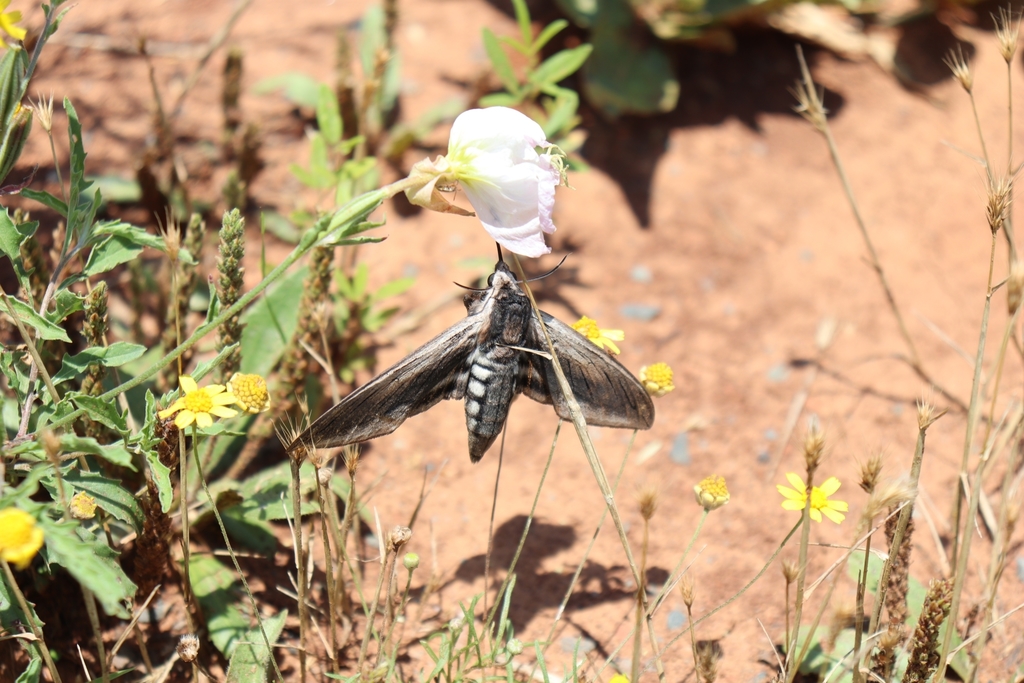
no rights reserved · CC0
Family: Sphingidae · Class: Insecta · Order: Lepidoptera
Sphinx drupiferarum (Wild cherry sphinx) is a California animal in the Sphingidae family.
The wild cherry sphinx (Sphinx drupiferarum) is a medium-sized hawk moth with a wingspan ranging from 70 to 90 millimeters (2.8 to 3.5 inches). Adults display gray-brown forewings with irregular dark lines and patches, creating an effective bark-like camouflage pattern. The hindwings are typically lighter gray with darker marginal bands. The thorax is robust and covered in dense scales, while the abdomen features alternating light and dark bands. The species can be distinguished from related sphinx moths by its specific wing pattern and the arrangement of white spots along the hindwing margins. The wild cherry sphinx occurs across a broad range from Nova Scotia south to Georgia, extending west through most of the United States and southern Canada to British Columbia and central California. Despite this extensive range, the species is considered uncommon throughout its distribution. In California, populations are primarily documented in the northern and central regions, with scattered records extending into the Sierra Nevada foothills and coastal areas. This species inhabits deciduous and mixed woodlands, particularly areas where its host plants are abundant. Wild cherry sphinx moths are found from sea level to elevations of approximately 1,500 meters (4,900 feet). Adults prefer woodland edges, orchards, parks, and suburban areas with mature trees. The species shows a strong association with areas containing wild cherry and plum species, which serve as the primary larval food source. Adult wild cherry sphinx moths are active during twilight hours and at night, typically flying from May through August depending on latitude and elevation. Males are attracted to artificial lights and can be found at porch lights and moth traps. Females deposit eggs singly on the undersides of leaves of host plants, which include wild cherry and plum (Prunus species), lilac (Syringa vulgaris), hackberry (Celtis occidentalis), and apple (Malus sylvestris). The larvae, commonly called hornworms, are large green caterpillars reaching 75 to 80 millimeters (3.0 to 3.1 inches) in length. They possess a characteristic horn projection at the rear end and develop through five instars before pupating in underground chambers. The species typically produces one generation per year in northern portions of its range and may have a partial second generation in warmer southern areas. The wild cherry sphinx is not federally or state listed and appears to maintain stable populations across much of its range. However, habitat loss due to urbanization and the removal of native cherry and plum trees may affect local populations. The species benefits from the preservation of woodland habitats and the maintenance of native Prunus species in urban and suburban landscapes. Climate change may potentially affect the timing of adult emergence and larval development, though specific impacts have not been extensively studied.
Classification
Class: Insecta · Order: Lepidoptera · Family: Sphingidae
Frequently asked questions
How is Sphinx drupiferarum classified?
Sphinx drupiferarum belongs to class Insecta, order Lepidoptera, family Sphingidae.
What family does Sphinx drupiferarum belong to?
Sphinx drupiferarum is in the Sphingidae family.
What is Sphinx drupiferarum?
The wild cherry sphinx (Sphinx drupiferarum) is a medium-sized hawk moth with a wingspan ranging from 70 to 90 millimeters (2.8 to 3.5 inches).
Is Sphinx drupiferarum found in California?
Yes. Sphinx drupiferarum is recorded in California in The California Species Project's catalogue.
Related species
Other California species in the same genus, family, or bioregion.
Data from The California Species Project — 14,000+ California species with verified data from CNPS, CDFW, USFWS, and more.