Sphinx sequoiae
Sequoia sphinx
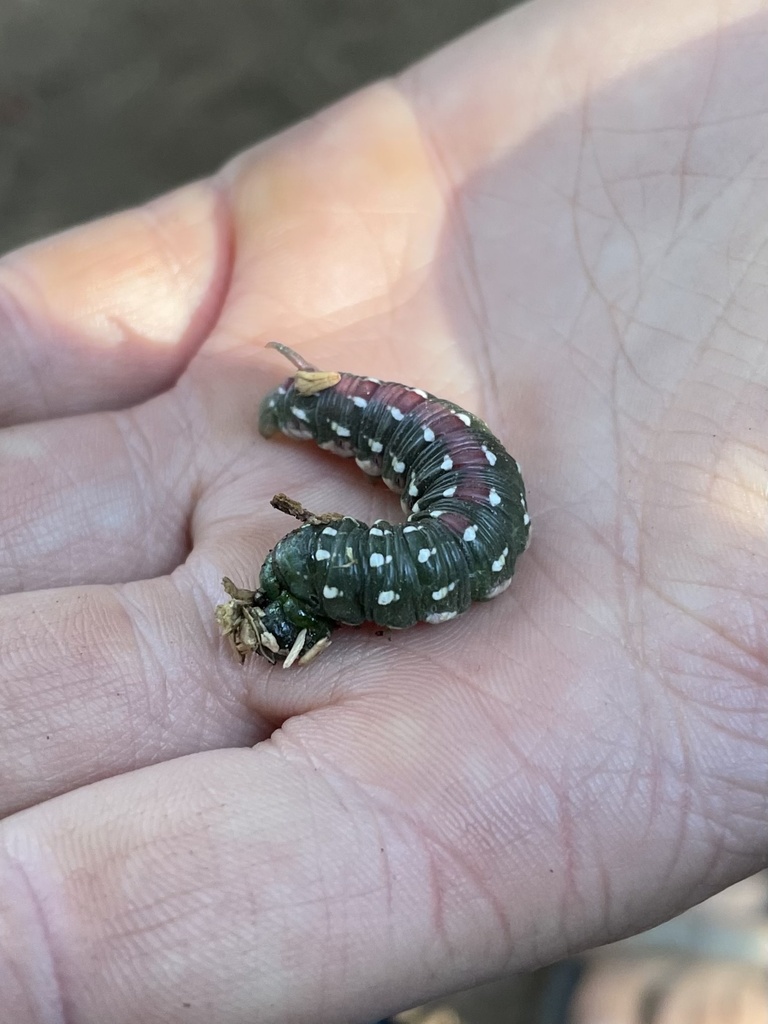
(c) Amelia Tauber, some rights reserved (CC BY) · licence
Family: Sphingidae · Class: Insecta · Order: Lepidoptera
Sphinx sequoiae (Sequoia sphinx) is a California animal in the Sphingidae family.
The Sequoia sphinx is a medium to large hawkmoth in the family Sphingidae. Adults typically measure 40 to 60 mm (1.6 to 2.4 inches) in wingspan, with a robust, streamlined body characteristic of sphinx moths. The forewings are mottled gray-brown with irregular darker crosslines and pale patches, providing effective camouflage against tree bark. The hindwings are lighter brown with darker marginal bands. The thorax displays gray-brown scaling with darker longitudinal stripes, while the abdomen shows alternating light and dark banding patterns. The species ranges from Oregon south through California, Nevada, and southeastern Utah to Arizona, extending into northern Baja California. In California, Sphinx sequoiae occurs primarily in the southern Sierra Nevada, Transverse Ranges, and Peninsular Ranges, with scattered populations in the Coast Ranges. The distribution closely follows that of its primary host plants, creating a patchy occurrence pattern across suitable habitat. Sequoia sphinx inhabits arid and semi-arid regions where juniper woodlands and pinyon-juniper communities occur, typically at elevations between 900 and 2,100 meters (3,000 to 7,000 feet). The species is most commonly found in open juniper stands on rocky slopes, mesa tops, and canyon walls. Adults require access to nectar sources including evening primrose, four o'clock, and other night-blooming flowers that coincide with their crepuscular and nocturnal activity patterns. Larvae feed exclusively on California juniper (Juniperus californica) and Rocky Mountain juniper (J. osteosperma). Caterpillars are typically green with white lateral stripes and a prominent caudal horn, reaching lengths of 70 to 90 mm (2.8 to 3.5 inches) when fully mature. Adults emerge primarily in late spring and early summer, with flight periods extending from May through August depending on elevation and local climate conditions. Females deposit eggs singly on juniper foliage, and larvae develop through five instars before pupating in underground chambers. The species likely produces one generation per year in most locations. Adults are strong fliers, capable of hovering while feeding at flowers during twilight hours. Males are attracted to lights and pheromone sources, suggesting they use chemical communication for mate location. The species' dependence on specific juniper species and relatively specialized habitat requirements make it vulnerable to habitat fragmentation and climate change impacts on juniper woodland distributions. While not federally or state listed, Sphinx sequoiae faces potential conservation challenges from habitat loss due to urban development, particularly in California's expanding metropolitan areas. Drought conditions and rising temperatures may affect juniper woodland health and distribution, potentially impacting future population stability. The species' restricted host plant relationships and patchy distribution warrant continued monitoring to assess population trends across its range.
Classification
Class: Insecta · Order: Lepidoptera · Family: Sphingidae
Frequently asked questions
How is Sphinx sequoiae classified?
Sphinx sequoiae belongs to class Insecta, order Lepidoptera, family Sphingidae.
What family does Sphinx sequoiae belong to?
Sphinx sequoiae is in the Sphingidae family.
What is Sphinx sequoiae?
The Sequoia sphinx is a medium to large hawkmoth in the family Sphingidae.
Is Sphinx sequoiae found in California?
Yes. Sphinx sequoiae is recorded in California in The California Species Project's catalogue.
Related species
Other California species in the same genus, family, or bioregion.
Data from The California Species Project — 14,000+ California species with verified data from CNPS, CDFW, USFWS, and more.