Sphinx vashti
Vashti sphinx
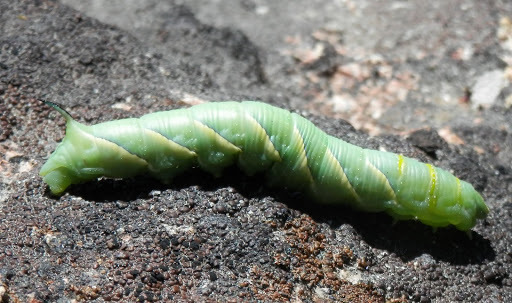
(c) 101595408250610106310, some rights reserved (CC BY) · licence
Family: Sphingidae · Class: Insecta · Order: Lepidoptera
Sphinx vashti (Vashti sphinx) is a California animal in the Sphingidae family.
The Vashti sphinx (Sphinx vashti) is a medium-sized hawkmoth in the family Sphingidae. Adults have a wingspan of 75-95 mm (3.0-3.7 inches), with forewings displaying a mottled pattern of brown and gray tones. The forewings feature distinct wavy lines and pale patches, while the hindwings are typically brownish with darker banding. The thorax is covered in dense scales that appear brownish-gray, and the abdomen shows alternating light and dark bands. Adults possess the characteristic hawkmoth features of a robust body, narrow forewings, and a long proboscis adapted for nectar feeding. The Vashti sphinx ranges from British Columbia east to Manitoba, south to southern California, Nevada, central Arizona, New Mexico, and west Texas. In California, the species occurs primarily in foothill and montane regions where suitable host plants are present. The distribution follows elevation gradients and plant community associations rather than strict geographic boundaries. This species inhabits areas where snowberry (Symphoricarpos albus) and coralberry (S. orbiculatus) grow naturally. These host plants typically occur in woodland edges, clearings, riparian zones, and disturbed areas from sea level to approximately 2,400 meters (8,000 feet) elevation. The moths favor semi-open habitats including mixed coniferous forests, oak woodlands, chaparral margins, and canyon bottoms where Symphoricarpos species form understory components. Vashti sphinx adults are primarily nocturnal and crepuscular, becoming active at dusk to feed on nectar from various flowering plants. Flight period varies by elevation and latitude but generally occurs from May through August, with peak activity in June and July. Females lay eggs singly on host plant leaves, typically on the undersides. Larvae feed exclusively on Symphoricarpos species, developing through five instars over approximately 4-6 weeks. Mature caterpillars are green with diagonal white stripes and a prominent caudal horn. Pupation occurs in underground cells, with most individuals overwintering in the pupal stage. Adult moths exhibit strong attraction to artificial lights and are frequently encountered at porch lights and moth sheets in suitable habitat. Males can be distinguished from females by their more pointed forewings and slightly smaller size. The species appears to have a single generation per year throughout most of its range. The Vashti sphinx is not federally or state listed and appears to maintain stable populations across much of its range. However, habitat modification and urbanization in some areas may affect local populations through loss of host plants. The species' dependence on Symphoricarpos makes it vulnerable to activities that eliminate native understory vegetation. Forest management practices that maintain diverse understory communities benefit this species by preserving host plant populations and adult nectar sources.
Classification
Class: Insecta · Order: Lepidoptera · Family: Sphingidae
Frequently asked questions
How is Sphinx vashti classified?
Sphinx vashti belongs to class Insecta, order Lepidoptera, family Sphingidae.
What family does Sphinx vashti belong to?
Sphinx vashti is in the Sphingidae family.
What is Sphinx vashti?
The Vashti sphinx (Sphinx vashti) is a medium-sized hawkmoth in the family Sphingidae.
Is Sphinx vashti found in California?
Yes. Sphinx vashti is recorded in California in The California Species Project's catalogue.
Related species
Other California species in the same genus, family, or bioregion.
Data from The California Species Project — 14,000+ California species with verified data from CNPS, CDFW, USFWS, and more.