Sphyrapicus nuchalis
Red-naped Sapsucker
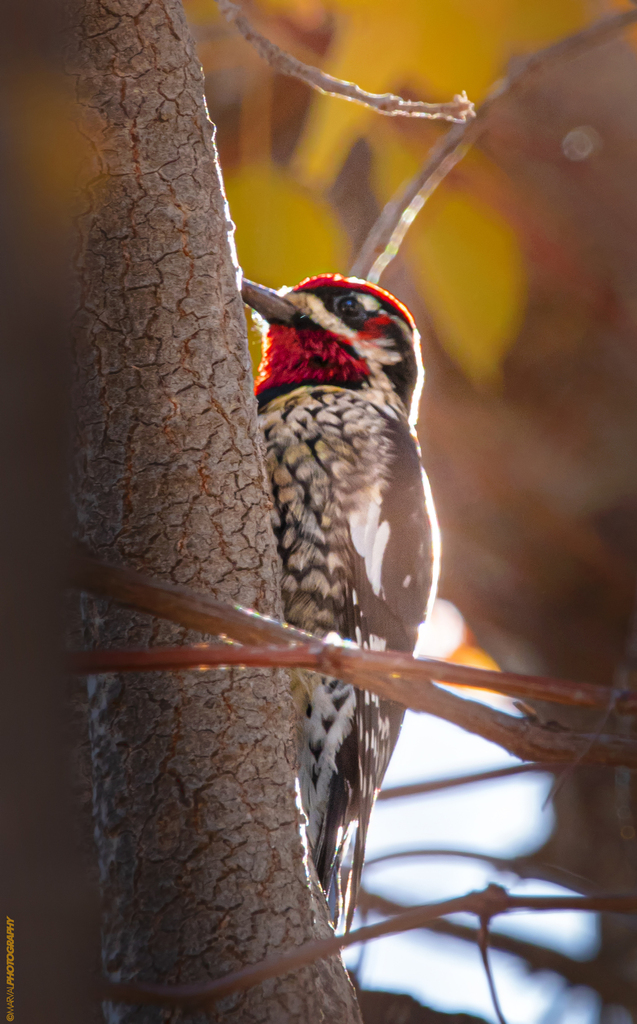
(c) MarvalPhotography19, some rights reserved (CC BY) · licence
Family: Picidae · Class: Aves · Order: Piciformes
Sphyrapicus nuchalis (Red-naped Sapsucker) is a California animal in the Picidae family.
The Red-naped Sapsucker (Sphyrapicus nuchalis) is a medium-sized woodpecker measuring 19-21 cm (7.5-8.3 inches) in length with a wingspan of 35-40 cm (14-16 inches). Males display a distinctive red patch on the back of the neck (nape), bright red forehead and crown, and red throat. The face is white with black stripes extending from the bill through the eye and around the auricular region. Females are similar but have a white throat with varying amounts of red. Both sexes exhibit a black back with white barring, yellowish underparts, and a prominent white rump patch visible in flight. Juveniles lack the distinctive red markings and appear more brownish overall. The Red-naped Sapsucker breeds primarily in montane forests of western North America, with its range extending from British Columbia south through the Rocky Mountains to Arizona and New Mexico. In California, the species occurs mainly in the eastern Sierra Nevada and Cascade Range, breeding at elevations from 1,200 to 3,400 meters (3,900 to 11,200 feet). During winter, populations migrate to lower elevations and more southerly latitudes, including parts of southern California, Arizona, and Mexico. Breeding habitat consists primarily of mixed coniferous forests dominated by aspen (Populus tremuloides), with Douglas fir, lodgepole pine, and Engelmann spruce also important components. The species shows a strong preference for areas with abundant aspen groves, which provide both nesting sites and sap sources. Red-naped Sapsuckers require mature or semi-mature forests with adequate snag density for nesting cavities. During migration and winter, they utilize a broader range of habitats including riparian woodlands, oak savannas, and urban areas with suitable trees. Red-naped Sapsuckers are primarily sapivores, drilling characteristic rows of small holes in tree bark to access phloem sap. They maintain these sap wells throughout the breeding season, returning regularly to feed and defend them from other species. Their diet also includes insects, particularly ants, beetles, and flies, which they glean from bark surfaces or catch while foraging around sap wells. Breeding occurs from May through July, with pairs excavating nest cavities in living aspen trees, typically 3-12 meters (10-40 feet) above ground. Females lay 3-7 glossy white eggs, which both parents incubate for 12-13 days. Young fledge after 25-29 days. The Red-naped Sapsucker is not federally or state listed and maintains stable populations across most of its range. According to the North American Breeding Bird Survey, populations have shown slight increases in recent decades. However, the species faces potential threats from forest management practices that reduce aspen abundance, climate change affecting montane forest composition, and habitat fragmentation in some regions. Conservation efforts focus on maintaining diverse forest age classes and preserving aspen communities within mixed coniferous forests.
Classification
Class: Aves · Order: Piciformes · Family: Picidae
Frequently asked questions
How is Sphyrapicus nuchalis classified?
Sphyrapicus nuchalis belongs to class Aves, order Piciformes, family Picidae.
What family does Sphyrapicus nuchalis belong to?
Sphyrapicus nuchalis is in the Picidae family.
What is Sphyrapicus nuchalis?
The Red-naped Sapsucker (Sphyrapicus nuchalis) is a medium-sized woodpecker measuring 19-21 cm (7.5-8.3 inches) in length with a wingspan of 35-40 cm (14-16 inches).
Is Sphyrapicus nuchalis found in California?
Yes. Sphyrapicus nuchalis is recorded in California in The California Species Project's catalogue.
Related species
Other California species in the same genus, family, or bioregion.
Data from The California Species Project — 14,000+ California species with verified data from CNPS, CDFW, USFWS, and more.