Sphyrapicus thyroideus nataliae
Williamson's Sapsucker (Rocky)
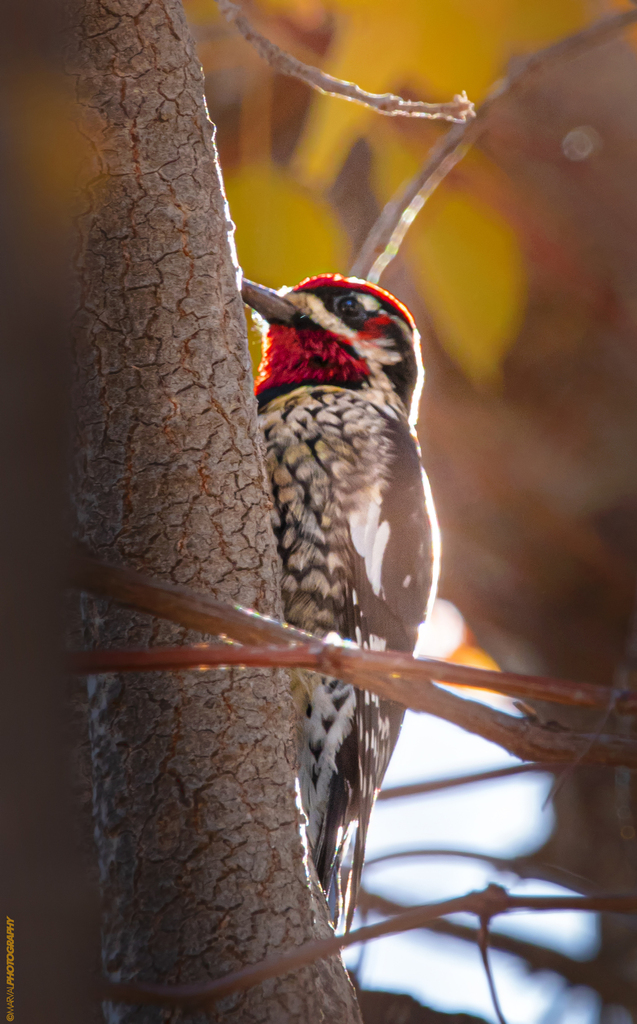
(c) MarvalPhotography19, some rights reserved (CC BY) · licence
Family: Picidae · Class: Aves · Order: Piciformes
Sphyrapicus thyroideus nataliae (Williamson's Sapsucker (Rocky)) is a California animal in the Picidae family.
Williamson's Sapsucker (Rocky Mountain subspecies) is a medium-sized woodpecker that exhibits pronounced sexual dimorphism. Males display a glossy black head, back, and wings with a bright red throat patch and narrow white facial stripes. The breast and belly are bright yellow, with white rump patches visible in flight. Females are brown-headed with a barred back pattern and yellow belly, historically mistaken for a separate species. Adults measure 23-25 cm (9-10 inches) in length with a wingspan of 43-48 cm (17-19 inches). The Rocky Mountain subspecies (S. t. nataliae) occurs primarily in the mountainous regions of western North America, including the Sierra Nevada and Rocky Mountain ranges. In California, this subspecies inhabits higher elevation coniferous forests throughout the Sierra Nevada and northern mountains. The subspecies ranges from British Columbia south through the western United States to northern Mexico, with breeding populations concentrated in montane regions. This sapsucker inhabits open coniferous and mixed coniferous-deciduous forests, typically at elevations between 1,500-3,400 meters (4,900-11,200 feet). The species shows strong preference for mature forests dominated by ponderosa pine, Douglas fir, western larch, and true firs. It requires large-diameter trees for nesting cavities and foraging sites. Williamson's Sapsucker has been considered a sensitive indicator species because of its specific habitat requirements (Birds of the World). Like other sapsuckers, this species drills conspicuous rings of holes called "sap wells" into tree trunks, specializing on coniferous sap and phloem. The birds maintain these wells by returning regularly to collect flowing sap and the insects attracted to it. During the breeding season, adults switch to a diet primarily composed of ants to feed their nestlings. Breeding occurs from May through July, with pairs excavating new nest cavities annually in dead or diseased trees. Females typically lay 3-7 white eggs, with incubation lasting 12-14 days. The species exhibits altitudinal migration patterns, moving to lower elevations during winter months. Williamson's Sapsucker populations had a stable trend overall from 1966-2019 based on Breeding Bird Survey routes (Birds of the World). However, the subspecies faces localized threats from habitat loss due to logging of mature forests, fire suppression altering natural forest succession, and climate change affecting montane ecosystems. The species appears on the U.S. Fish and Wildlife Service's Birds of Conservation Concern 2021 list. In Canada, the species was designated as Endangered in 2005 and re-confirmed in 2017, primarily due to small populations and habitat loss of mature western larch forests. Conservation efforts focus on maintaining mature forest habitat and managing fire regimes to preserve the open forest structure preferred by this subspecies.
Classification
Class: Aves · Order: Piciformes · Family: Picidae
Frequently asked questions
How is Sphyrapicus thyroideus nataliae classified?
Sphyrapicus thyroideus nataliae belongs to class Aves, order Piciformes, family Picidae.
What family does Sphyrapicus thyroideus nataliae belong to?
Sphyrapicus thyroideus nataliae is in the Picidae family.
What is Sphyrapicus thyroideus nataliae?
Williamson's Sapsucker (Rocky Mountain subspecies) is a medium-sized woodpecker that exhibits pronounced sexual dimorphism.
Is Sphyrapicus thyroideus nataliae found in California?
Yes. Sphyrapicus thyroideus nataliae is recorded in California in The California Species Project's catalogue.
Related species
Other California species in the same genus, family, or bioregion.
Data from The California Species Project — 14,000+ California species with verified data from CNPS, CDFW, USFWS, and more.