Spilogale gracilis
Western Spotted Skunk
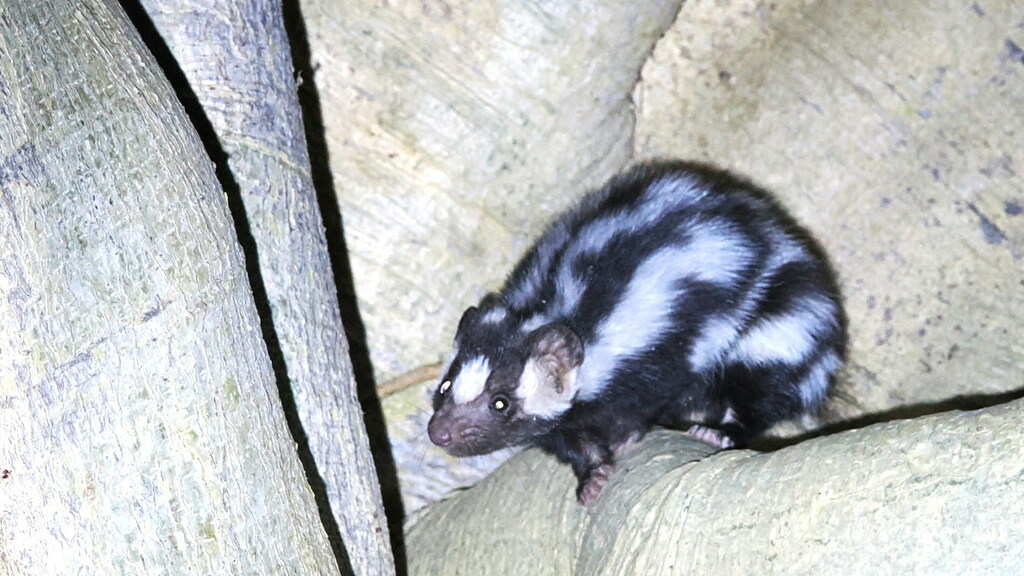
no rights reserved · CC0
Family: Mephitidae · Class: Mammalia · Order: Carnivora
Spilogale gracilis (Western Spotted Skunk) is a California animal in the Mephitidae family.
The western spotted skunk is a small carnivore distinguished by its distinctive black and white striped and spotted pattern. Adults measure 35 to 44 centimeters (14 to 17 inches) in body length, with an additional 17 to 28 centimeters (7 to 11 inches) of tail length. Body weight ranges from 200 to 900 grams (0.4 to 2.0 pounds), with males typically larger than females. The pelage consists of four to six broken white stripes on a black background, with additional white spots on the forehead, cheeks, and behind the ears. Unlike striped skunks, the white markings do not form continuous stripes but appear as discontinuous patterns across the body. Historically, western spotted skunks ranged throughout California from sea level to mountainous regions. The species occurred in diverse habitats across the state, from coastal areas to the Sierra Nevada foothills and into the Mojave Desert regions. Current distribution appears more fragmented, with populations documented in the North Coast, San Francisco Bay Area, Central Valley foothills, and southern California mountains. Recent surveys suggest significant range contraction compared to historical records, particularly in coastal and valley floor habitats. Western spotted skunks occupy varied habitat types including chaparral, oak woodlands, mixed forests, riparian areas, and agricultural lands. They utilize elevations from sea level to approximately 2,400 meters (7,900 feet). The species requires areas with adequate cover such as rock crevices, hollow trees, brush piles, or human structures for denning. Dense understory vegetation provides foraging habitat and protection from predators. This nocturnal species demonstrates opportunistic feeding behavior, consuming insects, small mammals, birds, eggs, reptiles, amphibians, and seasonal fruits. Spotted skunks are excellent climbers, capable of ascending trees and rocky surfaces to access prey and den sites. Breeding occurs in late summer and early fall, with delayed implantation extending gestation to approximately 230 days. Females give birth to litters of two to five kits in spring, typically April through June. The characteristic defensive behavior includes performing a handstand before spraying, a unique threat display among North American skunks. The western spotted skunk lacks federal listing status but faces conservation concerns across its range. Population monitoring data suggests substantial declines since the mid-20th century, with the species now considered rare or extirpated from many previously occupied areas. Primary threats include habitat loss from urban development and agricultural conversion, fragmentation of remaining habitats, vehicle strikes, and secondary poisoning from rodenticides. Climate change may further impact populations through altered precipitation patterns affecting prey availability. The California Department of Fish and Wildlife considers the species a Species of Special Concern due to declining populations and habitat threats. Limited recent survey data hampers comprehensive population assessment, highlighting the need for targeted monitoring efforts to determine current status and distribution patterns throughout California.
Classification
Class: Mammalia · Order: Carnivora · Family: Mephitidae
Frequently asked questions
How is Spilogale gracilis classified?
Spilogale gracilis belongs to class Mammalia, order Carnivora, family Mephitidae.
What family does Spilogale gracilis belong to?
Spilogale gracilis is in the Mephitidae family.
What is Spilogale gracilis?
The western spotted skunk is a small carnivore distinguished by its distinctive black and white striped and spotted pattern.
Is Spilogale gracilis found in California?
Yes. Spilogale gracilis is recorded in California in The California Species Project's catalogue.
Related species
Other California species in the same genus, family, or bioregion.
Data from The California Species Project — 14,000+ California species with verified data from CNPS, CDFW, USFWS, and more.