Spilosoma virginica
Virginian Tiger Moth or Yellow Woolybear Moth
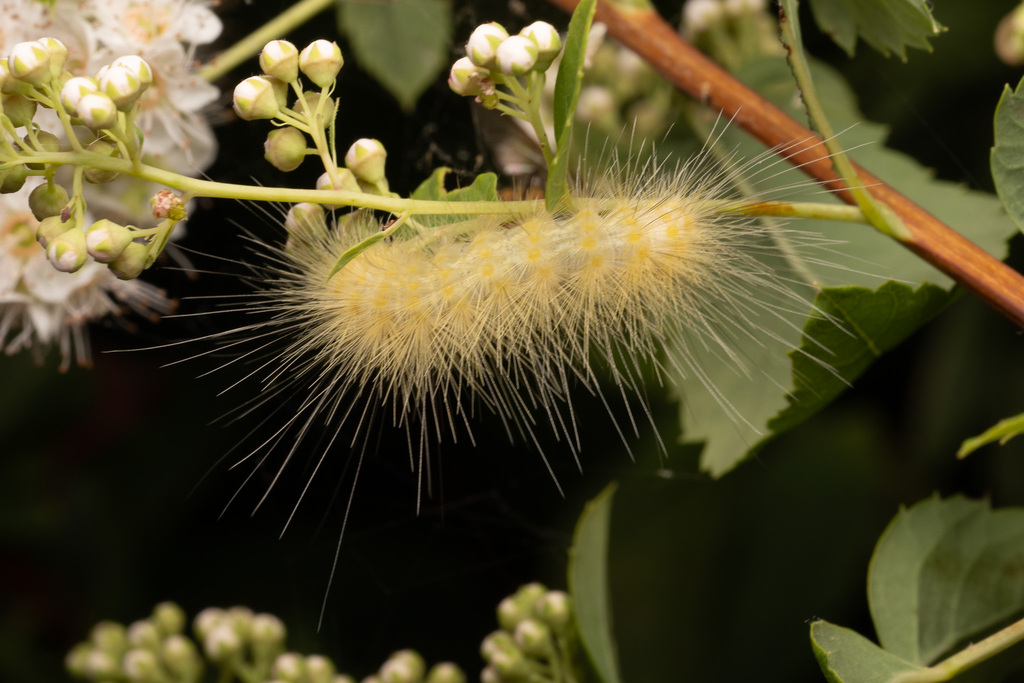
(c) Jack Forrester, some rights reserved (CC BY) · licence
Family: Erebidae · Class: Insecta · Order: Lepidoptera
Spilosoma virginica (Virginian Tiger Moth or Yellow Woolybear Moth) is a California animal in the Erebidae family.
The Virginian tiger moth (Spilosoma virginica), also known as the yellow woolybear moth, is a medium-sized moth in the family Erebidae. Adults have a wingspan ranging from 32 to 45 mm (1.3 to 1.8 inches). The forewings are white to cream-colored with variable black spotting that can range from sparse to dense, creating distinct individual patterns. The hindwings are typically white or pale yellow with fewer markings. Males possess broader, more feathered antennae compared to females, and both sexes display a robust, hairy thorax characteristic of the tiger moth group. This species occurs throughout most of North America, from southern Canada to northern Mexico. In California, Spilosoma virginica is found statewide from sea level to moderate elevations, inhabiting diverse regions including the Central Valley, coastal areas, Sierra Nevada foothills, and desert margins. The species demonstrates broad adaptability to varied climatic conditions across its extensive range. Virginian tiger moths occupy a wide variety of habitats, including gardens, agricultural areas, grasslands, woodland edges, and disturbed sites. Adults are commonly attracted to artificial lights and can be found in urban and suburban environments. The species thrives in areas with abundant herbaceous vegetation and shows particular association with weedy, disturbed habitats where host plants are readily available. Adults are primarily nocturnal and most active from late spring through early fall, with peak activity during summer months. The species is multivoltine in warmer regions, producing two or more generations per year, while cooler areas typically support a single annual generation. Larvae, known as yellow woolybear caterpillars, are generalist feeders that consume a diverse array of host plants including dandelion (Taraxacum officinale), plantain (Plantago species), clover (Trifolium species), various grasses, and numerous garden vegetables and ornamental plants. This polyphagous feeding behavior contributes significantly to the species' ecological success and wide distribution. The caterpillars are densely covered with long, soft hairs that are typically yellow to orange-brown, giving rise to the common name 'yellow woolybear.' Mature larvae reach approximately 35 to 40 mm (1.4 to 1.6 inches) in length. Pupation occurs in loose cocoons constructed from larval hairs and silk, typically in leaf litter or soil crevices. Adults emerge after approximately two weeks, depending on temperature conditions. Spilosoma virginica is not listed under state or federal endangered species legislation and maintains stable populations throughout its range. The species' broad host plant tolerance, multiple generations per year, and adaptability to human-modified landscapes contribute to its conservation security. In agricultural settings, the larvae occasionally reach pest status on crops, but population levels are typically regulated by natural predators, parasites, and environmental factors. Climate change may potentially expand the species' range northward and increase generation numbers in marginal habitats, though current populations show no conservation concern.
Classification
Class: Insecta · Order: Lepidoptera · Family: Erebidae
Frequently asked questions
How is Spilosoma virginica classified?
Spilosoma virginica belongs to class Insecta, order Lepidoptera, family Erebidae.
What family does Spilosoma virginica belong to?
Spilosoma virginica is in the Erebidae family.
What is Spilosoma virginica?
The Virginian tiger moth (Spilosoma virginica), also known as the yellow woolybear moth, is a medium-sized moth in the family Erebidae.
Is Spilosoma virginica found in California?
Yes. Spilosoma virginica is recorded in California in The California Species Project's catalogue.
Related species
Other California species in the same genus, family, or bioregion.
Data from The California Species Project — 14,000+ California species with verified data from CNPS, CDFW, USFWS, and more.