Spinus lawrencei
Lawrence's Goldfinch
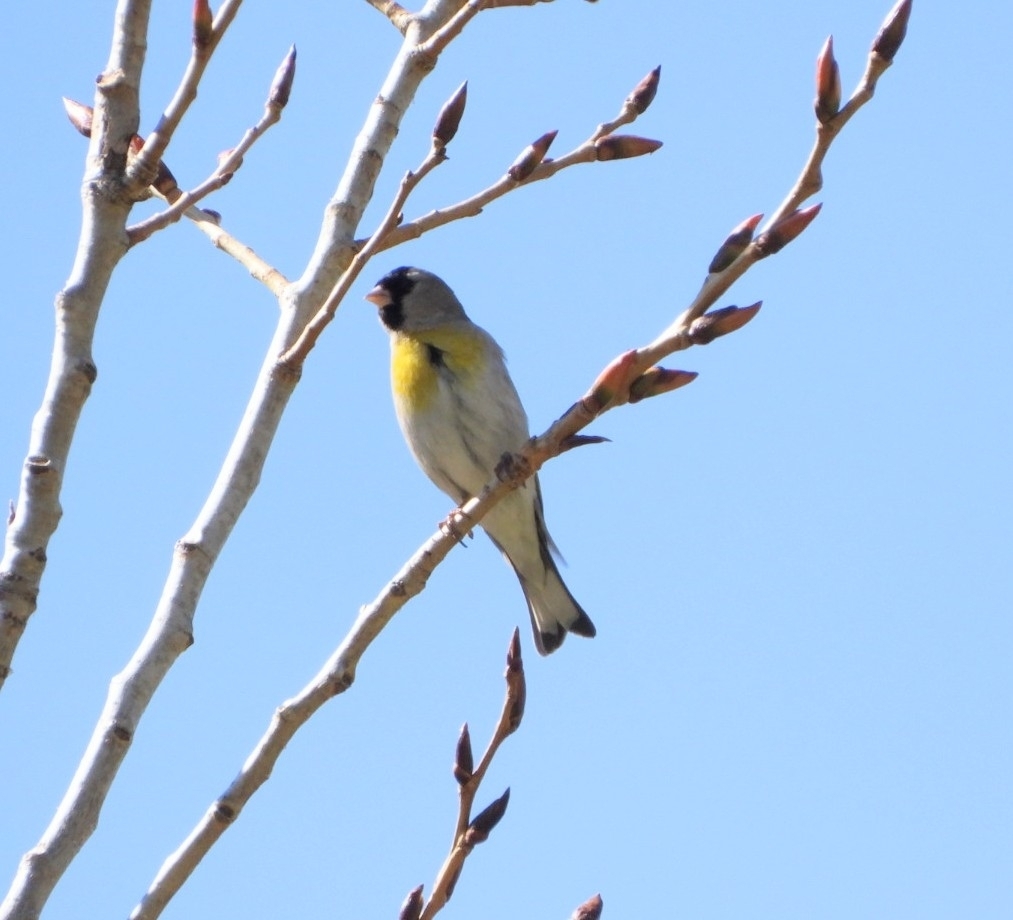
(c) Brodie Cass Talbott, some rights reserved (CC BY) · licence
Family: Fringillidae · Class: Aves · Order: Passeriformes
Conservation status: G3G4 S4
Spinus lawrencei (Lawrence's Goldfinch) is a California animal in the Fringillidae family.
Lawrence's Goldfinch is a small songbird endemic to California and Baja California, distinguished by its unique yellow wing patches and nomadic behavior patterns. Adults measure 11 to 12 centimeters (4.3 to 4.7 inches) in length with a wingspan of 19 to 20 centimeters (7.5 to 7.9 inches). Males display a black face and chin contrasting with gray head and back, while the wings and tail show bright yellow patches. Females lack the black facial markings and appear more subdued with grayish-brown plumage and similar yellow wing markings. Both sexes have pale bills and dark eyes. The species occurs primarily in California from sea level to approximately 1,800 meters (5,900 feet) elevation, with populations extending into northern Baja California. Lawrence's Goldfinch inhabits chaparral, oak woodlands, riparian areas, and desert edge habitats throughout much of the state. The species shows irregular distribution patterns and is notably nomadic, with populations appearing and disappearing from areas based on food availability and environmental conditions. Winter range may extend beyond California into Arizona and northern Mexico during some years. Lawrence's Goldfinch occupies open woodlands, chaparral, and scrubland habitats, particularly areas with scattered trees and abundant seed sources. The species shows strong preference for habitats containing chamise, various oak species, and other shrubs that produce small seeds. Riparian corridors and canyon bottoms provide important nesting and foraging areas. The species adapts to elevations from coastal areas to montane zones, following seasonal food resources. This goldfinch feeds primarily on small seeds from chamise, fiddleneck, and various forbs and shrubs. The diet includes seeds from plants in the sunflower family, particularly tarweed and other composites. Lawrence's Goldfinch is highly social, often forming mixed flocks with Lesser Goldfinches and other seed-eating birds. Breeding typically occurs from March through July, with pairs constructing cup-shaped nests in shrubs or low trees. Females lay 3 to 5 pale blue or greenish eggs with fine brown spots. The species may raise multiple broods per year when conditions are favorable. Lawrence's Goldfinch is not federally or state listed but carries a Global Rank of G3G4, indicating the species may be vulnerable to population decline. Population trends are difficult to assess due to the species' nomadic nature and irregular occurrence patterns. Climate change poses potential threats through altered precipitation patterns affecting seed production in preferred habitats. Habitat loss from development and fire suppression altering natural vegetation communities presents ongoing conservation concerns. The species' dependence on specific seed sources makes it vulnerable to changes in plant community composition.
Classification
Class: Aves · Order: Passeriformes · Family: Fringillidae
Conservation status
G3G4 S4
Frequently asked questions
How is Spinus lawrencei classified?
Spinus lawrencei belongs to class Aves, order Passeriformes, family Fringillidae.
What family does Spinus lawrencei belong to?
Spinus lawrencei is in the Fringillidae family.
Is Spinus lawrencei protected or of conservation concern?
Spinus lawrencei carries the following status: G3G4 S4.
What is Spinus lawrencei?
Lawrence's Goldfinch is a small songbird endemic to California and Baja California, distinguished by its unique yellow wing patches and nomadic behavior patterns.
Is Spinus lawrencei found in California?
Yes. Spinus lawrencei is recorded in California in The California Species Project's catalogue.
Related species
Other California species in the same genus, family, or bioregion.
Data from The California Species Project — 14,000+ California species with verified data from CNPS, CDFW, USFWS, and more.